-
Engineering and Architecture
Exams
Colleges
Predictors
Resources
-
Computer Application and IT
Quick Links
Colleges
-
Pharmacy
Colleges
Resources
-
Hospitality and Tourism
Colleges
Resources
Diploma Colleges
-
Competition
Other Exams
Resources
-
School
Exams
Top Schools
Products & Resources
-
Study Abroad
Top Countries
Resources
-
Arts, Commerce & Sciences
Colleges
Upcoming Events
Resources
-
Management and Business Administration
Exams
Colleges & Courses
Predictors
-
Learn
Law Preparation
MBA Preparation
Engineering Preparation
Medical Preparation
-
Online Courses and Certifications
Top Streams
Specializations
- Digital Marketing Certification Courses
- Cyber Security Certification Courses
- Artificial Intelligence Certification Courses
- Business Analytics Certification Courses
- Data Science Certification Courses
- Cloud Computing Certification Courses
- Machine Learning Certification Courses
- View All Certification Courses
Resources
-
Medicine and Allied Sciences
Colleges
Predictors
Resources
-
Law
Resources
Colleges
-
Animation and Design
Exams
Predictors & Articles
Colleges
Resources
-
Media, Mass Communication and Journalism
Colleges
Resources
-
Finance & Accounts
Top Courses & Careers
Colleges
MOLE CONCEPT AND MOLAR MASS - (Concept)
Mole:
-
A mole is a unit that represents 6.023 x 10²³ particles, atoms, molecules or ions, etc., irrespective of their nature.
-
Mole is related to the mass of the substance, the volume of gaseous substance and the number of particles
-
Here G.m.m. = Gram molecular mass or molar mass which is the mass of 1 mole of any substance
-
-
The volume of one mole of any gas is equal to 22.4 litres or dm3 at STP. It is known as molar volume.
-
Relationship of Mole:
A mole of any substance (like O2) stands for:
-
6.023 x 10²³ molecules of O2
-
2 x 6.023 x 1023 atoms of Oxygen
-
32 gm of Oxygen
-
22.4 litre of O2 at STP.
To Find the Total Number of Identities:
-
Total number of Molecule = mole(n) x NA
-
Total number of Atoms = mole (n) x NA x No. of atoms present in one molecule (atomicity).
-
Total number of Electrons = mole (n) x NA x No. of electron present in one atom.
-
Total charge on any ion = mole (n) x NA x charge on one ion x 1.6 x 10⁻¹⁹ C
| Exam | Chapter |
| JEE MAIN | Some basic concepts in chemistry |
Number of atoms in 558.5 gram Fe (at. wt.of Fe = 55.85 g mol-1) is:
| A. |
|
| B. |
|
| C. |
|
| D. |
|
If we consider that 1/6, in place of 1/12, mass of carbon atom is taken to be the relative atomic mass unit, the mass of one mole of a substance will
| A. |
|
| B. |
|
| C. |
|
| D. |
|
A solution of sodium sulfate contains 92g of ions per kilogram of water. The molality of
ions in that solution in mol Kg-1 is:
| A. |
|
| B. |
|
| C. |
|
| D. |
|
of
weigh
and
of
weigh
The molar mass of
and molar mass of
in
are :
| A. |
|
| B. |
|
| C. |
|
| D. |
|
What is the molecular mass of H2SO4?
(response should be like 67 or 70)
| A. |
|
| B. |
|
| C. |
|
| D. |
|
An unknown chlorohydrocarbon has 3.55% of chlorine. If each molecule of the hydrocarbon has one chlorine atom only; chlorine atoms present in 1 g of
chlorohydrocarbon are : (Atomic wt. of Cl=35.5 u;Avogadro constant= )
| A. |
|
| B. |
|
| C. |
|
| D. |
|
The percentage composition of carbon by 1 mole in methane is:
| A. |
|
| B. |
|
| C. |
|
| D. |
|
The minimum amount of consumed per gram of reactant is for the reaction :
(Given atomic mass :
,
)
| A. |
|
| B. |
|
| C. |
|
| D. |
|
Which of the following has the maximum number of molecules?
| A. |
|
| B. |
|
| C. |
|
| D. |
|
What is the number of molecules in 16g of Oxygen?
| A. |
|
| B. |
|
| C. |
|
| D. |
|
In the reaction,
$2 \mathrm{Al}_{(s)}+6 \mathrm{HCl}_{(a q)} \rightarrow 2 \mathrm{Al}^{3+}{ }_{(a q)}+6 \mathrm{Cl}_{(a q)}^{-}+3 \mathrm{H}_{2(g)}$
| A. |
|
| B. |
|
| C. |
|
| D. |
|
One litre of a gas at STP weighs 1.16 g. The gas can possibly be
| A. |
|
| B. |
|
| C. |
|
| D. |
|
The number of water molecules is maximum in :
| A. |
|
| B. |
|
| C. |
|
| D. |
|
The number of chlorine atoms in 20 mL of chlorine gas at STP is __________1021. (Round off to the Nearest Integer). [ Assume chlorine is an ideal gas at STP, R = 0.083 L bar mol-1 K-1, NA = 6.023 x10²³]
| A. |
|
| B. |
|
| C. |
|
| D. |
|
Complete combustion of 3 g of ethane gives $\mathrm{x} \times 10^{22}$ molecules of water. The value of $x$ is ____________(Rounded off to the Nearest Integer).
[Use : $\mathrm{N}_{\mathrm{A}}=6.023 \times 10^{23}$; Atomic masses in u : C : $12.0 ; \mathrm{O}$ $: 16.0 ; \mathrm{H}: 1.0]$
| A. |
|
| B. |
|
| C. |
|
| D. |
|
A reaction of 0.1 mole of Benzylamine with bromomethane gave 23 g of Benzyl trimethyl ammonium bromide. The number of moles of bromomethane consumed in this reaction are $n \times 10^{-1}$ when n = _________. (Round off to the Nearest Integer).
[Given : Atomic masses : C : 12.0 u, H : 1.0 u, N : 14.0 u, Br : 80.0 u]
| A. |
|
| B. |
|
| C. |
|
| D. |
|
The number of N atoms in 681 g of . The value of x is _________.
(Nearest Integer)
| A. |
|
| B. |
|
| C. |
|
| D. |
|
Two elements which form
moles of
type compounds. If both
weigh equally, then the atomic weight of A is____________ times of atomic weight of B.
| A. |
|
| B. |
|
| C. |
|
| D. |
|
The number of atoms in . The value of
is ___________.(Nearest integer)
| A. |
|
| B. |
|
| C. |
|
| D. |
|
An organic compound contains C, H, and S. The minimum molecular weight of the compound containing 8% sulfur is :
(atomic weight of S = 32 amu)
| A. |
|
| B. |
|
| C. |
|
| D. |
|
Reaction of 6.0 g of A, 6.01023 atoms of B, and 0.036 mol of C yields 4.8 g of compound AB2C3. If the atomic mass of A and C are 60 and 80 amu, respectively, the atomic mass of B is (Avogadro no.=6
1023) :
| A. |
|
| B. |
|
| C. |
|
| D. |
|
The amount of oxygen in 3.6 moles of water is :
| A. |
|
| B. |
|
| C. |
|
| D. |
|
Number of atoms in the following samples of substances is the largest in:
| A. |
|
| B. |
|
| C. |
|
| D. |
|
of an ideal gas
occupies
at STP. The value of x is
| A. |
|
| B. |
|
| C. |
|
| D. |
|
How many moles of magnesium phosphate, will contain 0.25 mole of oxygen atoms?
| A. |
|
| B. |
|
| C. |
|
| D. |
|
What is the number of moles in 8g of Helium?
| A. |
|
| B. |
|
| C. |
|
| D. |
|
What is the mass (in g) of molecules of H3PO4?
| A. |
|
| B. |
|
| C. |
|
| D. |
|
Calculate the number of moles of carbon atoms in 39g of benzene.
| A. |
|
| B. |
|
| C. |
|
| D. |
|
What is the percentage mass of N in a mixture of 0.5 mole NH3 and 1 mole Ca(NO3)2?
| A. |
|
| B. |
|
| C. |
|
| D. |
|
What is the percentage purity of a sample of CaCO3 if 150g of the sample gives out 44g of CO2 on heating?
| A. |
|
| B. |
|
| C. |
|
| D. |
|
What is the total number of moles if we have a mixture of 34g of Ammonia, 78g of Benzene and 10g Hydrogen?
| A. |
|
| B. |
|
| C. |
|
| D. |
|
We have a substance . What is the molar mass (in g) of
if 2 moles of it weigh 196g?
| A. |
|
| B. |
|
| C. |
|
| D. |
|
14 g Nitrogen gas and 22 g of CO2 gas are mixed together. Find the volume of gaseous mixture at STP.
(Response should be upto only one decimal digit like 78.7).
| A. |
|
| B. |
|
| C. |
|
| D. |
|
A compound possess 8% sulphur by mass. The least molecular mass is :
(Response should be in integer only like 100 or 1000).
| A. |
|
| B. |
|
| C. |
|
| D. |
|
In order to oxidize a mixture of one mole of each of $\mathrm{FeC}_2 \mathrm{O}_4, \mathrm{Fe}_2\left(\mathrm{C}_2 \mathrm{O}_4\right)_3, \mathrm{FeSO}_4$ and $\mathrm{Fe}_2\left(\mathrm{SO}_4\right)_3$ in acidic medium, the number of moles of $\mathrm{KMn} \mathrm{O}_4$ required is :
| A. |
|
| B. |
|
| C. |
|
| D. |
|
of
surfactant solution forms a monolayer covering
on a polar substrate . If the polar head is approximated as a cube , what is its edge length (in pm) ?
| A. |
|
| B. |
|
| C. |
|
| D. |
|
The maximum prescribed concentration of copper in drinking water is:
| A. |
|
| B. |
|
| C. |
|
| D. |
|
The label on a H2O2 bottle reads as 10 Vol. How many grams of H2O2 are present in 1 L of the solution ____g
| A. |
|
| B. |
|
| C. |
|
| D. |
|
The ratio of the masses percentages of and
of a saturated acyclic organic compound
are 4:1 and 3:4 respectively . Then , the moles of oxygen gas required for complete combustion of two moles of organic compound
is_____________
| A. |
|
| B. |
|
| C. |
|
| D. |
|
if moles of oxygen combine with
to form
, then the weight of
used in the reaction is (Al = 27 g/mol)
| A. |
|
| B. |
|
| C. |
|
| D. |
|
The moles of methane required to produce of water after complete combustion is __________
.[nearest integer]
| A. |
|
| B. |
|
| C. |
|
| D. |
|
$\mathrm{SO}_2 \mathrm{Cl}_2$ on reaction with excess of water results into acidic mixture
$$
\mathrm{SO}_2 \mathrm{Cl}_2+2 \mathrm{H}_2 \mathrm{O} \rightarrow \mathrm{H}_2 \mathrm{SO}_4+2 \mathrm{HCl}
$$
16 moles of NaOH is required for the complete neutralisation of the resultant acidic mixture. The number of moles of $\mathrm{SO}_2 \mathrm{Cl}_2$ used is:
| A. |
|
| B. |
|
| C. |
|
| D. |
|
solution of
-glucose in water contains
of carbon by weight. The molality of the solution is nearest to
(Given: Atomic Weights are, )
| A. |
|
| B. |
|
| C. |
|
| D. |
|
If Avogadro number NA, is changed from 6.022 x 10²³ mol-1 to 6.022 x 10²⁰ mol-1, this would change :
| A. |
|
| B. |
|
| C. |
|
| D. |
|
Which of the following has maximum number of molecules?
| A. |
|
| B. |
|
| C. |
|
| D. |
|
How many moles of PCl5 need to be heated to give 22.4 L of Cl2?
$\mathrm{PCl}_5 \stackrel{\Delta}{\rightarrow} \mathrm{PCl}_3+\mathrm{Cl}_2$
| A. |
|
| B. |
|
| C. |
|
| D. |
|
How much CaCO3 and water must be weighed to make a solution that is 10% CaCO3?
| A. |
|
| B. |
|
| C. |
|
| D. |
|
The number of molecules and moles in 2.8375 litres of at STP are respectively
| A. |
|
| B. |
|
| C. |
|
| D. |
|
Match List I with List II

Choose the correct answer from the options given below:
| A. |
|
| B. |
|
| C. |
|
| D. |
|
Find the molarity strength of a sample which is prepared by mixing 7000 mL of $0.5 \mathrm{M} \mathrm{H}_2 \mathrm{SO}_4$ (specific gravity $=1.03$ ) and 4 L of $98 \%(\mathrm{w} / \mathrm{V})$ of $\mathrm{H}_2 \mathrm{SO}_4$ (specific gravity $=1.84$ ). Also, the specific gravity of the resultant mixture is 1.4 and assume there is no loss of mass during mixing.
| A. |
|
| B. |
|
| C. |
|
| D. |
|
of solution was made by taking
of a sample of
having
as an impurity. Out of the prepared volume,
of the solution needed
of
solutions. What will be the composition in
| A. |
|
| B. |
|
| C. |
|
| D. |
|
2.5 g of Al metal was treated with 85 mL of $\mathrm{H}_2 \mathrm{SO}_4$ having specific gravity of 1.18. After complete dissolution of the metal, the resultant solution was diluted to 500 mL . Find the molarity (in M) of free $\mathrm{H}_2 \mathrm{SO}_4$ in the final solution if $24.7 \% \mathrm{H}_2 \mathrm{SO}_4$ by weight was used.
| A. |
|
| B. |
|
| C. |
|
| D. |
|
1 ml each of methane, ethane & propane requires exactly x, y & z ml of $\mathrm{O}_2$ respectively.
Find value of $x+y+z(\mathrm{ml})$
| A. |
|
| B. |
|
| C. |
|
| D. |
|
The mass of silver (Molar mass of $\mathrm{Ag}: 108 \mathrm{gmol}^{-1}$ ) displaced by a quantity of electricity which displace 5600 $\mathrm{mL}$ of $\mathrm{O}_2$ at S.T.P will be________g.
| A. |
|
| B. |
|
| C. |
|
| D. |
|
Mass of methane required to produce $22 \mathrm{~g}$ of $\mathrm{CO}_2$ after complete combustion is___________ g.
(Given Molar mass in g $\begin{aligned} \mathrm{mol}^{-1} \mathrm{C} & =12.0 \\ \mathrm{H} & =1.0 \\ \mathrm{O} & =16.0)\end{aligned}$
| A. |
|
| B. |
|
| C. |
|
| D. |
|
Volume of $3 \mathrm{M} \mathrm{NaOH}$ (formula weight $40 \mathrm{~g} \mathrm{~mol}^{-1}$ ) which can be prepared from $84 \mathrm{~g}$ of $\mathrm{NaOH}$ is $\times 10^{-1} \mathrm{dm}^3$_____$\times 10^{-1} \mathrm{dm}^3$.
| A. |
|
| B. |
|
| C. |
|
| D. |
|
1 mole of $\mathrm{PbS}$ is oxidised by "X" moles of $\mathrm{O}_3$ to get "Y" moles of $\mathrm{O}_2 . \mathrm{X}+\mathrm{Y}=$______.
| A. |
|
| B. |
|
| C. |
|
| D. |
|
$9.3 \mathrm{~g}$ of aniline is subjected to reaction with excess of acetic anhydride to prepare acetanilide. The mass of acetanilide produced if the reaction is $100 \%$ completed is _______$\times 10^{-1} \mathrm{~g}$.
(Given molar mass in g mol -1 N : 14, O : 16, C : 12, H : 1)
| A. |
|
| B. |
|
| C. |
|
| D. |
|
If 50 mL of 0.5M oxalic acid is required to neutralise 25 mL of NaOH solution, the amount of NaOH in 50 mL of given NaOH solution is _______ g.
| A. |
|
| B. |
|
| C. |
|
| D. |
|
$0.05 \mathrm{~cm}$ thick coating of silver is deposited on a plate of $0.05 \mathrm{~m}^2$ area. The number of silver atoms deposited on plate are________$\times 10^{23}$. (At mass $\left.\mathrm{Ag}=108, \mathrm{~d}=7.9 \mathrm{~g} \mathrm{~cm}^{-3}\right)$
| A. |
|
| B. |
|
| C. |
|
| D. |
|
The mass of sodium acetate $\left(\mathrm{CH}_3 \mathrm{COONa}\right)$ required to prepare $250 \mathrm{~mL}$ of $0.35 \mathrm{M}$ aqueous solution is_________ g. (Molar mass of $\mathrm{CH}_3 \mathrm{COONa}$ is $82.02 \mathrm{~g} \mathrm{~mol}^{-1}$ )
| A. |
|
| B. |
|
| C. |
|
| D. |
|
Molar mass of the salt from $\mathrm{NaBr}, \mathrm{NaNO}_3, \mathrm{KI}$ and $\mathrm{CaF}_2$ which does not evolve coloured vapours on heating with concentrated $\mathrm{H}_2 \mathrm{SO}_4$ is_________ $\mathrm{g} \mathrm{mol}^{-1}$.
(Molar mass in $\mathrm{g} \mathrm{mol}^{-1}: \mathrm{Na}: 23, \mathrm{~N}: 14, \mathrm{~K}: 39, \mathrm{O}: 16, \mathrm{Br}: 80, \mathrm{I}: 127, \mathrm{~F}: 19, \mathrm{Ca}: 40$ )
| A. |
|
| B. |
|
| C. |
|
| D. |
|
Number of moles of methane required to produce $22 \mathrm{~g} \mathrm{CO}_2(\mathrm{~g})$ after combustion is $\mathrm{x} \times 10^{-2}$ moles. The value of $\mathrm{x}$ is_________.
| A. |
|
| B. |
|
| C. |
|
| D. |
|
A sample of $\mathrm{CaCO}_3$ and $\mathrm{MgCO}_3$ weighed $2.21 \mathrm{~g}$ is ignited to constant weight of $1.152 \mathrm{~g}$. The composition of mixture is: (Given molar mass in $\mathrm{g} \mathrm{mol}^{-1} \mathrm{CaCO}_3: 100, \mathrm{MgCO}_3: 84$ )
| A. |
|
| B. |
|
| C. |
|
| D. |
|
Number of moles of $\mathrm{H}^{+}$ions required by 1 mole of $\mathrm{MnO}_4^{-}$to oxidise oxalate ion to $\mathrm{CO}_2$ is_______.
| A. |
|
| B. |
|
| C. |
|
| D. |
|
Consider the following reaction :
$3 \mathrm{PbCl}_2+2\left(\mathrm{NH}_4\right)_3 \mathrm{PO}_4 \rightarrow \mathrm{Pb}_3\left(\mathrm{PO}_4\right)_2+6 \mathrm{NH}_4 \mathrm{Cl}$
If $72 \mathrm{mmol}$ of $\mathrm{PbCl}_2$ is mixed with $50 \mathrm{mmol}$ of $\left(\mathrm{NH}_4\right)_3 \mathrm{PO}_4$, then the amount of $\mathrm{Pb}_3\left(\mathrm{PO}_4\right)_2$ formed is_______ mmol (nearest integer).
| A. |
|
| B. |
|
| C. |
|
| D. |
|
$10 \mathrm{~mL}$ of gaseous hydrocarbon on combustion gives $40 \mathrm{~mL}$ of $\mathrm{CO}_2(\mathrm{~g})$ and $50 \mathrm{~mL}$ of water vapour. Total number of carbon and hydrogen atoms in the hydrocarbon is_______.
| A. |
|
| B. |
|
| C. |
|
| D. |
|
$\mathrm{X} \mathrm{g}$ of ethylamine is subjected to reaction with $\mathrm{NaNO}_2 / \mathrm{HCl}$ followed by water; evolved dinitrogen gas which occupied $2.24 \mathrm{~L}$ volume at STP. $\mathrm{X}$ is________ $\qquad$ $\times 10^{-1} \mathrm{~g}$.
| A. |
|
| B. |
|
| C. |
|
| D. |
|
4 gm of impure CaCO3 on treatment with excess HCl produces 0.88 gm CO2. What is the percent purity of the CaCO3 sample?
| A. |
|
| B. |
|
| C. |
|
| D. |
|
Mass of $\mathrm{H}_2 \mathrm{O}$ in 1000 Kg of $\mathrm{CuSO}_4 \cdot 5 \mathrm{H}_2 \mathrm{O}$ is ____ $\times$10−1kg
| A. |
|
| B. |
|
| C. |
|
| D. |
|
Molar Mass = Vapour density X 2 , is valid for :
| A. |
|
| B. |
|
| C. |
|
| D. |
|
How many atoms are contained in a mole of 2- HYDROXY-PROPANOIC ACID (Lactic acid) (Answer in terms of $N_A$, where $N_A$ is Avogadro number)
| A. |
|
| B. |
|
| C. |
|
| D. |
|
How many volume will $\mathrm{CO}_2$ gas will occur in 88 g of its at STP?
| A. |
|
| B. |
|
| C. |
|
| D. |
|
Number of moles in 80 g of Calcium is
| A. |
|
| B. |
|
| C. |
|
| D. |
|
Number of atoms in 400.78 grams of Ca ( At wt of Ca is $40.078 \mathrm{~g} / \mathrm{mole}$ )
| A. |
|
| B. |
|
| C. |
|
| D. |
|
Which option is correct for the compound AxBy.
| A. |
|
| B. |
|
| C. |
|
| D. |
|
Find the edge length in ppm if polar head is approximated as cube if 10 mL of 1 mM surfactant solution forms a monolayer covering 0.36 cm2 in polar substrate.
| A. |
|
| B. |
|
| C. |
|
| D. |
|
The mass of $\mathrm{AgNo}_3$ present in 100 ml of its 0.25 Molar solution is____ $\times$10−2g
| A. |
|
| B. |
|
| C. |
|
| D. |
|
Volume occupied by $3.01 \times 10^{23}$ molecules of acetylene at NTP is ____ $\times$10−1litre
| A. |
|
| B. |
|
| C. |
|
| D. |
|
A 1.84 mg sample of polyhydric alcoholic compound ${ }^{\prime} X^{\prime}$ of molar mass $92.0 \mathrm{~g} / \mathrm{mol}$ gave 1.344 mL of $\mathrm{H}_2$ gas at STP. The number of alcoholic hydrogens present in compound ' X ' is _______________.
| A. |
|
| B. |
|
| C. |
|
| D. |
|

In the above reaction, 5 g of toluene is converted into benzaldehyde with $92 \%$ yield. The amount of benzaldehyde produced is ______________ $\times 10^{-2}$ g. (Nearest integer)
| A. |
|
| B. |
|
| C. |
|
| D. |
|
$100 g$ of a mixture of $\mathrm{Na}_2 \mathrm{SO}_4, \mathrm{Na}_2 \mathrm{CO}_3$ & $\mathrm{NaOH}$ requires $51.1 \mathrm{~g}$ of $\mathrm{HCl}$ for complete neutralisation & mixture on reaction with excess of $\mathrm{BaCl}_2$ produce $46.6 \mathrm{~g}$ of $\mathrm{BaSO}_4 ~$ ppt. Calculate mole fraction of $\mathrm{Na}_2 \mathrm{CO}_3$ in mixture.
| A. |
|
| B. |
|
| C. |
|
| D. |
|
When 35 mL of 0.15 M lead nitrate solution is mixed with 20mL of 0.12 M chromic sulfate solution, ______ $\times 10^{-5}$ moles of lead sulfate precipitate out. (Rounded off to the nearest integer)
| A. |
|
| B. |
|
| C. |
|
| D. |
|
When 400 ml of 0.4 M acetic acid is shaken with 0.8 g of wood charcoal, the final concentration of acetic acid alter adsorption is 0.3 M. The mass of acetic acid absorbed per gram of carbon will be
| A. |
|
| B. |
|
| C. |
|
| D. |
|
A cylinder of cooking gas in a household contains 11.6 kg of butane.The thermochemical reaction for the combustion of butane is
2C4H10(g) + 13O2(g) 8CO2(g) + 10H2O
;
H = - 2658 KJ/mol.
If the household needs 15000 KJ of energy per day, the cooking gas cylinder will last for about how many days?
| A. |
|
| B. |
|
| C. |
|
| D. |
|
In the DNA of E. coli, the mole ratio of adenine to cytosine is 0.7. If the number of moles of adenine in DNA is 350000, the number of moles of guanine is equal to
| A. |
|
| B. |
|
| C. |
|
| D. |
|
The addition of 0.643 g of a compound to 50 ml of benzene (density = 0.879 g mlñ1) lowers the freezing point from 5.51ºC to 5.03ºC. If the freezing point constant, Kf for benzene is 5.12 K Kg mol-1 , the molar mass of the compound ( g mol-1)is approximately
| A. |
|
| B. |
|
| C. |
|
| D. |
|
How much amount of Cl2 will be liberated after heating 44.8L of PCl5 ?
| A. |
|
| B. |
|
| C. |
|
| D. |
|
LiOH reacts with $\mathrm{CO}_2$ to form $\mathrm{Li}_2 \mathrm{CO}_3$ (atomic mass of $\mathrm{Li}=7$ ). The amount of $\mathrm{CO}_2$ (in g ) consumed by $1 g$ of $L i O H$ is closest to
| A. |
|
| B. |
|
| C. |
|
| D. |
|
A closed 10 L vessel contains 1 L water gas $\left(1: 1 \mathrm{CO}: \mathrm{H}_2\right)$ and 9 L air( $20 \% \mathrm{O}_2$ by volume ) at STP. The contents of the vessel are ignited. The number of moles of $\mathrm{CO}_2$ in the vessel is closest to :
| A. |
|
| B. |
|
| C. |
|
| D. |
|
Aluminium reduces manganese dioxide to manganese at high temperature. The amount of aluminium required to reduce one gram mole of manganese dioxide is ____gram mole
| A. |
|
| B. |
|
| C. |
|
| D. |
|
One mole of nitrogen gas on reaction with $3.01 \times 10^{23}$ molecules of hydrogen gas produces ____$\times 10^{23}$ molecules of ammonia
| A. |
|
| B. |
|
| C. |
|
| D. |
|
One mole of one of the sodium salts listed below , having carbon content close to $14.3^{\circ} \%$ produce mole of carbon dioxide upon heating
( atomic mass $N a=23, H=1, C=12, O=16)$ ).The salt is
| A. |
|
| B. |
|
| C. |
|
| D. |
|
The number of moles of water present in a spherical water droplet of radius 1.0 cm is:
[Given: density of water in the droplet $\left.=1.0 \mathrm{~g} \mathrm{~cm}^{-3}\right]$
A. $\frac{\pi}{18}$
B. $\frac{2 \pi}{27}$
C. $24 \pi$
D. $\frac{2 \pi}{9}$
| A. |
|
| B. |
|
| C. |
|
| D. |
|
The percentage of nitrogen by mass in ammonium sulphate is closest to (atomic masses H=1, N=14, O=16, S=32)
| A. |
|
| B. |
|
| C. |
|
| D. |
|
The volume of oxygen at STP required to burn 2.4 g of carbon completely is
| A. |
|
| B. |
|
| C. |
|
| D. |
|
The weight of calcium oxide formed by burning 20g of calcium in excess oxygen is
| A. |
|
| B. |
|
| C. |
|
| D. |
|
When 22.4 L of C4H8 at STP is burnt completely, 89.6 L of CO2 gas at STP and 72g of water are produced. The volume of the oxygen gas at STP consumed in the reaction is closest to
| A. |
|
| B. |
|
| C. |
|
| D. |
|
X g of Ca [atomic mass = 40] dissolves completely in a concentrated HCl solution to produce 5.04 L of H2 gas at STP. The value of X is closest to
| A. |
|
| B. |
|
| C. |
|
| D. |
|
Given below are two statements :
Statement I : One mole of propyne reacts with excess of sodium to liberate half a mole of $\mathrm{H}_2$ gas.
Statement II : Four g of propyne reacts with $\mathrm{NaNH}_2$ to liberate $\mathrm{NH}_3$ gas which occupies 224 mL at STP.
In the light of the above statements, choose the most appropriate answer from the options given below:
| A. |
|
| B. |
|
| C. |
|
| D. |
|
Some $\mathrm{CO}_2$ gas was kept in a sealed container at a pressure of 1 atm and at 273 K . This entire amount of $\mathrm{CO}_2$ gas was later passed through an aqueous solution of $\mathrm{Ca}(\mathrm{OH})_2$. The excess unreacted $\mathrm{Ca}(\mathrm{OH})_2$ was later neutralized with 0.1 M of 40 mL HCl. If the volume of the sealed container of $\mathrm{CO}_2$ was x , then x is _____$\qquad$ $\mathrm{cm}^3$ (nearest integer).
[Given : The entire amount of $\mathrm{CO}_2(\mathrm{~g})$ reacted with exactly half the initial amount of $\mathrm{Ca}(\mathrm{OH})_2$ present in the aqueous solution.]
| A. |
|
| B. |
|
| C. |
|
| D. |
|
Consider the following sequence of reactions :
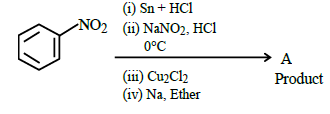
Molar mass of the product formed (A) is _________$\mathrm{g} \mathrm{mol}^{-1}$.
| A. |
|
| B. |
|
| C. |
|
| D. |
|
$2.8 \times 10^{-3} \mathrm{~mol}$ of $\mathrm{CO}_2$ is left after removing $10^{21}$ molecules from its ' $x$ ' mg sample. The mass of $\mathrm{CO}_2$ taken initially is
Given : $\mathrm{N}_{\mathrm{A}}=6.02 \times 10^{23} \mathrm{~mol}^{-1}$
| A. |
|
| B. |
|
| C. |
|
| D. |
|
What amount of bromine will be required to convert 2 g of phenol into 2, 4, 6-tribromophenol ? (Given molar mass in $\mathrm{g} \mathrm{mol}^{-1}$ of $\mathrm{C}, \mathrm{H}, \mathrm{O}, \mathrm{Br}$ are $12,1,16,80$ respectively)
| A. |
|
| B. |
|
| C. |
|
| D. |
|
When 81.0 g of aluminium is allowed to react with 128.0 g of oxygen gas, the mass of aluminium oxide produced in grams is ______ . (Nearest integer)
Given :
Molar mass of Al is $27.0 \mathrm{~g} \mathrm{~mol}^{-1}$
Molar mass of O is $16.0 \mathrm{~g} \mathrm{~mol}^{-1}$
| A. |
|
| B. |
|
| C. |
|
| D. |
|
Xg of benzoic acid on reaction with aq. $\mathrm{NaHCO}_3$ release $\mathrm{CO}_2$ that occupied 11.2 L volume at STP. X is _____g.
| A. |
|
| B. |
|
| C. |
|
| D. |
|
Consider the following reaction occurring in the blast furnace.
$$
\mathrm{Fe}_3 \mathrm{O}_{4(\mathrm{~s})}+4 \mathrm{CO}_{(\mathrm{g})} \rightarrow 3 \mathrm{Fe}_{(\mathrm{l})}+4 \mathrm{CO}_{2(\mathrm{~g})}
$$
' $x$ ' kg of iron is produced when $2.32 \times 10^3 \mathrm{~kg}$ $\mathrm{Fe}_3 \mathrm{O}_4$ and $2.8 \times 10^2 \mathrm{~kg} \mathrm{CO}$ are brought together in the furnace. The value of ' $x$ ' is _____.(nearest integer)
\{Given :
Molar mass of $\mathrm{Fe}_3 \mathrm{O}_4=232 \mathrm{~g} \mathrm{~mol}^{-1}$
Molar mass of $\mathrm{CO}=28 \mathrm{~g} \mathrm{~mol}^{-1}$
| A. |
|
| B. |
|
| C. |
|
| D. |
|
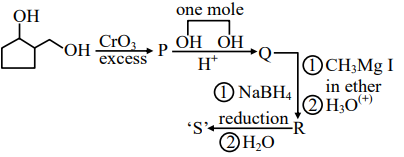
0.1 mole of compound 'S' will weigh $\qquad$ _______g.
(Given molar mass in $\mathrm{g} \mathrm{mol}^{-1} \mathrm{C}: 12, \mathrm{H}: 1, \mathrm{O}: 16$ )
| A. |
|
| B. |
|
| C. |
|
| D. |
|
The density of $\mathrm{NH}_4 \mathrm{OH}$ solution is 0.6 g/ml. It contains 35% by weight of $\mathrm{NH}_4 \mathrm{OH}$. The normality of the solution is ____ N
| A. |
|
| B. |
|
| C. |
|
| D. |
|
The diameter of a zinc atom is 2.6 Å. The total number of atoms present in a length of 1.6 cm if the zinc atoms are arranged side by side length-wise is _____$\times 10^7$
| A. |
|
| B. |
|
| C. |
|
| D. |
|
One mole of oxygen gas at STP is equal to ________
| A. |
|
| B. |
|
| C. |
|
| D. |
|
What is the mass percent of carbon in carbon dioxide?
| A. |
|
| B. |
|
| C. |
|
| D. |
|
Which of the following pairs have the same number of atoms ?
| A. |
|
| B. |
|
| C. |
|
| D. |
|
Which of the following terms are unitless?
(i) Molality
(ii) Molarity
(iii) Mole fraction
(iv) Mass percent
| A. |
|
| B. |
|
| C. |
|
| D. |
|
KMnO4 acts as an oxidising agent in acidic medium. The number of moles of KMnO4 that will be needed to react with one mole of sulphide ions in acidic solution is
| A. |
|
| B. |
|
| C. |
|
| D. |
|
Methylation of 10 g of Benzene gave 9.2 g of toluene. Calculate the percentage yield of toluene _______. (Nearest integer)
| A. |
|
| B. |
|
| C. |
|
| D. |
|
Molar mass of the hydrocarbon $(\mathrm{X})$ which on ozonolysis consumes one mole of $O_3$ per mole of $(\mathrm{X})$ and gives one mole each of ethanol and propanone is ___________$\qquad$ $\mathrm{g} \mathrm{mol}^{-1}$ (Molar mass of $C=12 \mathrm{~g} \mathrm{~mol}^{-1}, H=1 \mathrm{~g} \mathrm{~mol}^{-1}$ )
| A. |
|
| B. |
|
| C. |
|
| D. |
|
The mass of ammonia in grams produced when 2.8 kg of dinitrogen quantitatively reacts with 1 kg of dihydrogen is_________
| A. |
|
| B. |
|
| C. |
|
| D. |
|
The minimum number of moles of O2 required for complete combustion of 1 mole of propane and 2 moles of butane is ______
| A. |
|
| B. |
|
| C. |
|
| D. |
|
8g of oxygen has same number of atoms in:
| A. |
|
| B. |
|
| C. |
|
| D. |
|
An impure sample of NaOH is weighed 40g and is dissolved in water to get 1.0 litre solution. This solution is completely neutralized by 0.75 litre of 0.5M H2SO4. The purity of NaOH is ____ %
| A. |
|
| B. |
|
| C. |
|
| D. |
|
Calculate the molality(m) of KCl solution prepared by dissolving 7.45g of KCl in 500 ml of the solution $\left(d_{\text {sol }}=1.2{g m l^{-1}}\right)$
| A. |
|
| B. |
|
| C. |
|
| D. |
|
How many moles of electrons weigh 2 kilogram?
| A. |
|
| B. |
|
| C. |
|
| D. |
|
The mass of calcium oxide required when it reacts with 852g of the P4O10 is ____g
| A. |
|
| B. |
|
| C. |
|
| D. |
|
The density of a liquid (molar mass 70) is 1.2g/ml. If 2ml of liquid contains 35 drops, the number of molecules of liquid is one drop are:
| A. |
|
| B. |
|
| C. |
|
| D. |
|
The mass of one molecule of SO2 will be ____$\times 10^{-22} \mathrm{~g}$
| A. |
|
| B. |
|
| C. |
|
| D. |
|
The ratio of masses of oxygen and nitrogen in a particular gaseous mixture is 1 : 4. The ratio of number of their molecules is:
| A. |
|
| B. |
|
| C. |
|
| D. |
|
The total number of protons, neutrons and electrons in 12g of ${ }_6^{12} C$ is ____$\times 10^{25}$
| A. |
|
| B. |
|
| C. |
|
| D. |
|
An 0.8M solution of ethanol has density 0.99gcm-3. The molality of the solution is
| A. |
|
| B. |
|
| C. |
|
| D. |
|
An aqueous solution of 2% non-volatile solute exerts a pressure of 1.004 bar at the normal boiling point of the solvent. The molar mass of the solute is g/mol is ____ $\times$10−2
| A. |
|
| B. |
|
| C. |
|
| D. |
|
The volume (in mL ) of $0.1 \mathrm{M} \mathrm{AgNO}_3$ required for complete precipitation of chloride ions present in 20 mL of 0.01 M solution of $\left[\mathrm{Cr}\left(\mathrm{H}_2 \mathrm{O}\right)_5 \mathrm{Cl}\right] \mathrm{Cl}_2$ as silver chloride is $\qquad$ .
| A. |
|
| B. |
|
| C. |
|
| D. |
|
16 g of oxygen has same of molecules as in
(i) 16 g of CO
(ii) 28 g of $N_2$
(iii) 14 g of $N_2$
(iv)) 1.0 g of $\mathrm{H}_2$
| A. |
|
| B. |
|
| C. |
|
| D. |
|
A solution of $\mathrm{Fe}_2\left(\mathrm{SO}_4\right)_3$ is electrolyzed for X min with a current of 2.3 A to deposit 0.8371 g of Fe. Value of X in min is.
| A. |
|
| B. |
|
| C. |
|
| D. |
|
Which of the following figures does not represent 1 mole of dioxygen gas at STP?
(i) 16 grams of gas
(ii) 22.7 litres of gas
(iii) 6.022 × 10²³ dioxygen molecules
(iv) 11.2 litres of gas
| A. |
|
| B. |
|
| C. |
|
| D. |
|
0.1 mol of the following given antiviral compound
$(\mathrm{P})$ will weigh ___________ $\times 10^{-1} \mathrm{~g}$
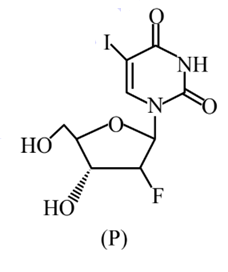
(Given : molar mass in $\mathrm{g} \mathrm{mol}^{-1} \mathrm{H}: 1, \mathrm{C}: 12, \mathrm{~N}: 14$, O:16, F: 19, I : 127)
| A. |
|
| B. |
|
| C. |
|
| D. |
|
Among $10^{-9} \mathrm{~g}$ (each) of the following elements, which one will have the highest number of atoms?
Element : $\mathrm{Pb}, \mathrm{Po}, \mathrm{Pr}$ and Pt
| A. |
|
| B. |
|
| C. |
|
| D. |
|
Mass of magnesium required to produce 220 mL of hydrogen gas at STP on reaction with excess of dil. HCl is
Given : Molar mass of Mg is $24 \mathrm{~g} \mathrm{~mol}^{-1}$.
| A. |
|
| B. |
|
| C. |
|
| D. |
|
Fortification of food with iron is done using $\mathrm{FeSO}_4 \cdot 7 \mathrm{H}_2 \mathrm{O}$. The mass in grams of the $\mathrm{FeSO}_4 \cdot 7 \mathrm{H}_2 \mathrm{O}$ required to achieve 12 ppm of iron in 150 kg of wheat is _________ (Nearest integer)
[Given : Molar mass of $\mathrm{Fe}, \mathrm{S}$ and O respectively are 56,32 and $\left.16 \mathrm{~g} \mathrm{~mol}^{-1}\right]$
| A. |
|
| B. |
|
| C. |
|
| D. |
|
The amount of calcium oxide produced on heating 150 kg limestone ( $75 \%$ pure) is ______ kg. (Nearest integer)
Given : Molar mass (in $\mathrm{g} \mathrm{mol}^{-1}$ ) of $\mathrm{Ca}-40, \mathrm{O}-16, \mathrm{C}-12$
| A. |
|
| B. |
|
| C. |
|
| D. |
|
x mg of $\mathrm{Mg}(\mathrm{OH})_2($ molar mass $=58)$ is required to be dissolved in 1.0 L of water to produce a pH of 10.0 at 298 K . The value of x is ______ mg. (Nearest integer)
(Given : $\mathrm{Mg}(\mathrm{OH})_2$ is assumed to dissociate completely in $\mathrm{H}_2 \mathrm{O}$ )
| A. |
|
| B. |
|
| C. |
|
| D. |
|
Butane reacts with oxygen to produce carbon dioxide and water following the equation given below
$\mathrm{C}_4 \mathrm{H}_{10}(\mathrm{~g})+\frac{13}{2} \mathrm{O}_2(\mathrm{~g}) \rightarrow 4 \mathrm{CO}_2(\mathrm{~g})+5 \mathrm{H}_2 \mathrm{O}(\mathrm{l})$
If 174.0 kg of butane is mixed with 320.0 kg of $\mathrm{O}_2$, the volume of water formed in litres is__________ (Nearest integer)
[Given : (a) Molar mass of $\mathrm{C}, \mathrm{H}, \mathrm{O}$ are 12, 1, $16 \mathrm{~g} \mathrm{~mol}^{-1}$ respectively, (b) Density of water $\left.=1 \mathrm{~g} \mathrm{~mL}^{-1}\right]$
| A. |
|
| B. |
|
| C. |
|
| D. |
|
What is the mole fraction of the solute in a 1.00 m aqueous solution ?
| A. |
|
| B. |
|
| C. |
|
| D. |
|
What is the in the final solution prepared by mixing 20.0 mL of 0.050 M HCl with 30.0 mL of 0.10 M Ba(OH)2?
| A. |
|
| B. |
|
| C. |
|
| D. |
|
A mixture of 2.3 g formic acid and 4.5 g oxalic acid is treated with conc. H2SO4. The evolved gaseous mixture is passed through KOH pellets. Weight (in g) of the remaining product at STP will be
| A. |
|
| B. |
|
| C. |
|
| D. |
|