
-
Engineering and Architecture
Exams
Colleges
Predictors
Resources
-
Computer Application and IT
Quick Links
Colleges
-
Pharmacy
Colleges
Resources
-
Hospitality and Tourism
Colleges
Resources
Diploma Colleges
-
Competition
Other Exams
Resources
-
School
Exams
Top Schools
Products & Resources
-
Study Abroad
Top Countries
Resources
-
Arts, Commerce & Sciences
Colleges
Upcoming Events
Resources
-
Management and Business Administration
Exams
Colleges & Courses
Predictors
-
Learn
Law Preparation
MBA Preparation
Engineering Preparation
Medical Preparation
-
Online Courses and Certifications
Top Streams
Specializations
- Digital Marketing Certification Courses
- Cyber Security Certification Courses
- Artificial Intelligence Certification Courses
- Business Analytics Certification Courses
- Data Science Certification Courses
- Cloud Computing Certification Courses
- Machine Learning Certification Courses
- View All Certification Courses
Resources
-
Medicine and Allied Sciences
Colleges
Predictors
Resources
-
Law
Resources
Colleges
-
Animation and Design
Exams
Predictors & Articles
Colleges
Resources
-
Media, Mass Communication and Journalism
Colleges
Resources
-
Finance & Accounts
Top Courses & Careers
Colleges
Bohr's Model for Hydrogen Atom - (Concept)
Bohr's model and its postulates:
1. The electron in the hydrogen atom can move around the nucleus in a circular path of fixed radius and energy. These paths are called orbits, stationary states or allowed energy states and are arranged concentrically around the nucleus. Force of attraction between the nucleus and an electron provides the centripetal force required by the electron to carry out the circular motion.
2. The energy of an electron in the orbit does not change with time. However, the electron will move from a lower stationary state to a higher stationary state when required amount of energy is absorbed by the electron or energy is emitted when electron moves from higher stationary state to lower stationary state
3. Energy can be absorbed or emitted when electron transitions between two different orbits and the frequency of photon involved can be calculated using the formula:
$\left|E_1-E_2\right|=h \nu$
4. The angular momentum of an electron is quantised. In a given stationary state it can be expressed as
L= mvr= nh/2$\pi$, n = orbit number
So only those energy states (or orbits) are allowed in which the above equation holds true for the angular momentum.
Note: Bohr's model is only valid for Hydrogen like species or unielectronic species which contain only a single electron
| Exam | Chapter |
| JEE MAIN | Atomic Structure |
When electron moves a transition from (n-1) to n states, the frequency of emitted radiation is related to n according to (n >>1)
| A. |
|
| B. |
|
| C. |
|
| D. |
|
When an electron jumps from n = 4 to n = 2 then the change in angular momentum is approximately.
| A. |
|
| B. |
|
| C. |
|
| D. |
|
Which of the following statement is incorrect for Bohr's model of an atom?
| A. |
|
| B. |
|
| C. |
|
| D. |
|
Given below are two statements. One is labelled as Assertion A and the other is labelled as Reason R.
Assertion A: Energy of orbital of hydrogen atom is greater than that of
orbital of lithium.
Reason R: Energies of the orbitals in the same subshell decrease with increase in the atomic number.
In the light of the above statements, choose the correct answer from the options given below.
| A. |
|
| B. |
|
| C. |
|
| D. |
|
Which of the following is incorrect for Bohr's model of an atom ?
| A. |
|
| B. |
|
| C. |
|
| D. |
|
According to Bohr’s theory, the angular momentum (in h/)of an electron in 5th orbit is
| A. |
|
| B. |
|
| C. |
|
| D. |
|
Which of the following statements in relation to the hydrogen atom is correct?
| A. |
|
| B. |
|
| C. |
|
| D. |
|
In Bohr's series of lines of hydrogen spectrum, the third line from the red end corresponds to which one of the following inter orbit jumps of the electron for Bohr orbits in an atom of hydrogen?
| A. |
|
| B. |
|
| C. |
|
| D. |
|
If the wave number of 1st line of Balmer series of H-atom is ‘x’ then the wave number of 1st line of lyman series of the He+ ion will be
| A. |
|
| B. |
|
| C. |
|
| D. |
|
When an electron jumps from n=4 to n=2 then change in angular momentum is approximately:
| A. |
|
| B. |
|
| C. |
|
| D. |
|
When an electron moves a transition from (n-1) to n states, the frequency of emitted radiation is related to n according to (n >>1):
| A. |
|
| B. |
|
| C. |
|
| D. |
|
The radius of the second Bohr orbit for hydrogen atom is:
(Planck’s Constant H = 6.6262×10⁻³⁴ Js; mass of electron =9.1091×10⁻³¹ kg; charge of electron e = 1.60210×10⁻¹⁹ C; permittivity of vacuum = 8.854185×10⁻¹² kg−1m−3A2)
| A. |
|
| B. |
|
| C. |
|
| D. |
|
Calculate the principal quantum number of the hydrogen atom when its radius after collision with an electron was found to be . Also, in the fist excited state its radius was found to be
.
| A. |
|
| B. |
|
| C. |
|
| D. |
|
In helium ion, transition of electrons to n1 shell from n2 shell takes place m way such that
$\begin{array}{r}2 n_2+3 n_1=9 \\ 2 n_2-3 n_1=3\end{array}$
In the given transition, find the number of photons emitted.
| A. |
|
| B. |
|
| C. |
|
| D. |
|
The kinetic energy of an electron in the second Bohr orbit of a hydrogen atom is equal to $\frac{\mathrm{h}^2}{\mathrm{xma}_0^2}$. The value of 2x is
| A. |
|
| B. |
|
| C. |
|
| D. |
|
The radius of a gold nucleus is . Calculate the volume of the nucleus.
| A. |
|
| B. |
|
| C. |
|
| D. |
|
Which is correct relationship
| A. |
|
| B. |
|
| C. |
|
| D. |
|
Which of the following is not a correct value of angular momentum in any shell of an atom
| A. |
|
| B. |
|
| C. |
|
| D. |
|
The ratio of the energy of the electron in the ground state of hydrogen to the electron in the first excited state of $B e^{3+}$ is
| A. |
|
| B. |
|
| C. |
|
| D. |
|
For a hypothetical H like atom which follows Bohr’s model, some spectral lines were observed as shown. If it is known that line ‘E’ belongs to the visible region, then the lines possibly belonging to the ultraviolet region will be (n1 is not necessarily ground state).
[Assume for this atom, no spectral series shows overlaps with other series in the emission spectrum]

| A. |
|
| B. |
|
| C. |
|
| D. |
|
If the velocity of the revolving electron of $H e^{+}$in the first orbit $(n=1)$ is $v$, the velocity of the electron in the second orbit is:
(A) v (B) 0.5 v
(C) 2v (D) 0.25 v
| A. |
|
| B. |
|
| C. |
|
| D. |
|
If the number of revolutions made by electron in $1.0 \mathrm{~s}$ in $\mathrm{H}$ atom in its $n^{\text {th }}$ orbit is twice of the number of revolutions made by electron in $1.0 \mathrm{~s}$ in the $2^{\text {nd }}$ orbit of $\mathrm{He}^{+}$ion atom, then $n$ is
| A. |
|
| B. |
|
| C. |
|
| D. |
|
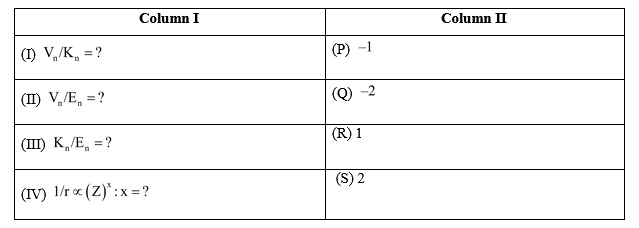
In the following,$\mathrm{V}_{\mathrm{n},} \mathrm{K}_{\mathrm{n}}$, and $\mathrm{E}_{\mathrm{n}}$ represent potential energy, kinetic energy and total energy of an electron in the nth Bohr orbit (radius: r) of hydrogen like species (nuclear charge: Z). Match entries in Column I with those given in Column II.
| A. |
|
| B. |
|
| C. |
|
| D. |
|
According to Bohr’s model of hydrogen atom, which of the following statement is incorrect?
| A. |
|
| B. |
|
| C. |
|
| D. |
|
Which of the following postulates of Bohr's model of the hydrogen atom is not in agreement with the quantum mechanical model of an atom ?
| A. |
|
| B. |
|
| C. |
|
| D. |
|
Which one of the following about an electron occupying the 1 s orbital in a hydrogen atom is incorrect ? (Bohr's radius is represented by $\mathrm{a}_0$ )
| A. |
|
| B. |
|
| C. |
|
| D. |
|
For hydrogen like species, which of the following graphs provides the most appropriate representation of E vs Z plot for a constant n ?
[E : Energy of the stationary state,
Z : atomic number, $\mathrm{n}=$ principal quantum number]
| A. |
|
| B. |
|
| C. |
|
| D. |
|

Neils Bohr (1913) was the first to explain quantitatively the general features of the structure of hydrogen atom and its spectrum. He used Planck’s concept of quantisation of energy. Though the theory is not the modern quantum mechanics,
-
- Atomic Models
- Developments leading to the Bohr’s model of atom
- Particle Nature of electromagnetic radiation
- Photoelectric Effect
- Line Spectrum of hydrogen
- Bohr model for hydrogen atom
- Dual behavior of matter
- Heisenberg’s uncertainty principle
- Elementary ideas of quantum mechanics
- Quantum mechanical model of atom
- Quantum Numbers (Concept)
- Shape of Orbitals (Concept)
- Radial nodes and planar nodes (Concept)
- Aufbau Principle, Pauli Exclusion Principle and Hund's Rule of Maximum Multiplicity (Concept)
- Electronic configuration of any element (Concept)
- Stability of Completely filled and Half-filled Subshells (Concept)
