
-
Engineering and Architecture
Exams
Colleges
Predictors
Resources
-
Computer Application and IT
Quick Links
Colleges
-
Pharmacy
Colleges
Resources
-
Hospitality and Tourism
Colleges
Resources
Diploma Colleges
-
Competition
Other Exams
Resources
-
School
Exams
Top Schools
Products & Resources
-
Study Abroad
Top Countries
Resources
-
Arts, Commerce & Sciences
Colleges
Upcoming Events
Resources
-
Management and Business Administration
Exams
Colleges & Courses
Predictors
-
Learn
Law Preparation
MBA Preparation
Engineering Preparation
Medical Preparation
-
Online Courses and Certifications
Top Streams
Specializations
- Digital Marketing Certification Courses
- Cyber Security Certification Courses
- Artificial Intelligence Certification Courses
- Business Analytics Certification Courses
- Data Science Certification Courses
- Cloud Computing Certification Courses
- Machine Learning Certification Courses
- View All Certification Courses
Resources
-
Medicine and Allied Sciences
Colleges
Predictors
Resources
-
Law
Resources
Colleges
-
Animation and Design
Exams
Predictors & Articles
Colleges
Resources
-
Media, Mass Communication and Journalism
Colleges
Resources
-
Finance & Accounts
Top Courses & Careers
Colleges
Line spectrum of hydrogen - (Concept)
When an electric discharge is passed through gaseous hydrogen, the H2 molecules dissociate and the energetically excited hydrogen atoms produced emit electromagnetic radiation of discrete frequencies. These radiations are emitted because of electronic transitions upon de-excitation to different energy levels and on the basis of the final energy level of transition, the hydrogen spectrum consists of several series of lines named after their discoverers like Lyman series, Balmer Series, Paschen Series, Bracket Series, Pfund Series.
Line Spectrum of Hydrogen-like atoms
$\frac{1}{\lambda}=R Z^2\left(\frac{1}{n_1^2}-\frac{1}{n_2^2}\right)$
Where R is called Rydberg constant, R = 109677cm-1, Z is atomic number
n1= final orbit occupied after de-excitation= 1, 2, 3….
n2= initial orbit occupied before de-excitation
Lyman Series spectrum:
Transition of electrons from higher orbits to n=1 result in the Lyman Series
n1= 1 and n2= 2, 3, 4....
For H atom, this lies in Ultraviolet region. For elements with higher Z, the Balmer lines lie in the Ultraviolet region
Balmer Series Spectrum:
Transition of electrons from higher orbits to n=2 result in the Balmer Series
Where n1= 2 and n2= 3, 4, 5, 6....
For H atom, this generally lies in visible region.
Paschen, Bracket and Pfund Series spectrums:
Transition of electrons from higher orbits to n=3, 4 and 5 respectively result in the Paschen, Bracket and the Pfund Series
These lines lie in the Infrared Region for H atom.
Discovery of the line spectrum gave the evidence for quantised electronic energy levels in atoms and laid the foundation for the development of the Bohr's model.
| Exam | Chapter |
| JEE MAIN | Atomic Structure |
Heat treatment of muscular pain involves radiation of wavelength of about 900 nm. Which spectral line of H-atom is suitable for this purpose ?
| A. |
|
| B. |
|
| C. |
|
| D. |
|
For emission line of atomic hydrogen from the plot of wave number
against
will be (The Rydberg constant is in wave number unit)
| A. |
|
| B. |
|
| C. |
|
| D. |
|
For any given series of spectral lines of atomic hydrogen, let be the difference in maximum and minimum frequencies in
The ratio is :
| A. |
|
| B. |
|
| C. |
|
| D. |
|
Pfund series wavelength of H-atom lies in which part of EM waves:
| A. |
|
| B. |
|
| C. |
|
| D. |
|
The ratio of the shortest wavelength of two spectral series of hydrogen spectrum is found to be about 9. The spectral series are :
| A. |
|
| B. |
|
| C. |
|
| D. |
|
Visible range of hydrogen spectrum will contain which of the following series?
| A. |
|
| B. |
|
| C. |
|
| D. |
|
In Bohr series of lines of hydrogen spectrum, the third line from the red end corresponds to the inter-orbit jumps of the electron for Bohr orbits in an atom of hydrogen is ____ $\rightarrow$ ____
| A. |
|
| B. |
|
| C. |
|
| D. |
|
The region in the electromagnetic spectrum where the Balmer series lines appear is:
| A. |
|
| B. |
|
| C. |
|
| D. |
|
The shortest wavelength of H atom in the Lyman series is . The longest wavelength in the Balmer series He+ is:
| A. |
|
| B. |
|
| C. |
|
| D. |
|
When the excited electron of a H atom from $\mathrm{n}=5$ drops to the ground state, the maximum number of emission lines observed are ________________.
| A. |
|
| B. |
|
| C. |
|
| D. |
|
The electron in the hydrogen atom undergoes a transition from higher orbitals to the orbital of radius 211.6 pm. This transition is associated with :
| A. |
|
| B. |
|
| C. |
|
| D. |
|
If the shortest wavelength of the spectral line of He+ in the Layman series is x then the longest wavelength of the line in Balmer series of Li2+ is: (in terms of x)
| A. |
|
| B. |
|
| C. |
|
| D. |
|
If the wavelength of the first line in Balmer series is 6300A0, the wavelength (in A0) of the second line in the same series will be
| A. |
|
| B. |
|
| C. |
|
| D. |
|
The wavelength (in nm) of the radiation emitted, when in a hydrogen atom electron falls from infinity to stationary state 1, would be
$\left(\right.$ Rydberg constant $\left.=1.097 \times 10^7 \mathrm{~m}^{-1}\right)$
| A. |
|
| B. |
|
| C. |
|
| D. |
|
The ratio of the shortest wavelength of two spectral series of hydrogen spectrum is found to be about 
| A. |
|
| B. |
|
| C. |
|
| D. |
|
8th January, Morning Session ( 9:30 am to 12:30 pm)
Q1) For the Balmer series in the spectrum of H atom, the correct statements among (I) to (IV) are:
(1) As wavelength decreases, the lines in the series converge
(II) The integer n1 is equal to 2
(III) The lines of longest wavelength corresponds to n2 = 3
(IV) The ionization energy of hydrogen can be calculated from wavenumber of these lines
Solution
Since, so for wavelength to be longest or maximum the energy gap should be minimum. For Balmer series, transition for longest wavelength is from n = 3 to n = 2. Thus clearly, n1 value for Balmer series is 2. Further, as wavelength decreases, the lines in the series converge
Therefore, Option(3) is correct.
Q2) The strength of an aqueous NaOH solution is most accurately determined by titrating:
(Note: consider that an appropriate indicator is used)
Solution
To calculate the strength of NaOH, it is titrated against oxalic acid. For this purpose, NaOH is kept in a burette and oxalic acid in a conical flask.
Therefore, Option(4) is correct.
Q3) The most suitable reagent for the given conversion is:

Solution
B2H6 is very selective and usually used to reduce acid to alcohol.
Therefore, Option(1) is correct.
Q4) The number of bonds between sulphur and oxygen atoms in S2O82- and the number of bonds between sulphur and sulphur atoms in rhombic sulphur, respectively, are:
Solution
The structure of S2O82– is given below:

Rhombic sulphur

Thus, the number of S-S bonds is 8 and the number of S-O bonds is also 8.
Therefore, Option(3) is correct.
Q5) The decreasing order of reactivity towards dehydrohalogenation (E) reaction of the following compounds is:
Solution
E1 reaction proceeds via carbocation formation, therefore greater the stability of carbocation, faster the E1 reaction.
Therefore, Option(4) is correct.
Q6) A flask contains a mixture of isohexane and 3-methylpentane. One of the liquids boils at 63oC while the other boils at 60oC. What is the best way to separate the two liquids and which one will be distilled out first?
Solution
Liquid having lower boiling point comes out first in fractional distillation. Simple distillation can't be used as boiling point difference is very small.
Therefore, Option(1) is correct.
Q7) The third ionization enthalpy is minimum for:
Solution
The third ionisation potential data for the given element is given below:
Co3+ - 3237
Mn3+ - 3258
Fe3+ - 2967
Ni3+ - 3400
The electronic configuration of Fe2+ is [Ar]3d6. Thus it is easier to remove one electron to get [Ar]3d5 electronic configuration as it is half-filled and thus it is stable.
Therefore, Option(4) is correct.
Q8) As per Hardy-Schulze formulation, the flocculation values of the following for ferric hydroxide sol are in the order:
Solution
According to hardy-schultz rule,
Therefore, Option(3) is correct.
Q9) The major product of the following reaction is:

Solution

Therefore, Option(3) is correct.
Q10) The first ionization energy (in kJ\mol) of Na, Mg, Al and Si respectively, are:
Solution
The correct ionization enthalpy values is given below:
496,737,577,786
Therefore, Option(1) is correct.
Q11) Arrange the following compounds in increasing order of C-OH bond length:
methanol, phenol, p-ethoxyphenol
Solution
The correct order of bond length is given below:
Phenol < p-ethoxyphenol < methanol
Therefore, Option(3) is correct.
Q12) Among the gases (a) - (e), the gases that cause greenhouse effect are:
(a) CO2
(b) H2O
(c) CFCs
(d) O2
(e) O3
Solution
The gases that cause greenhouse gases are: CO2, O3 and H2O.
Therefore, Option(4) is correct.
Q13) The predominant intermolecular forces present in ethyl acetate, a liquid, are:
Solution
Ethyl acetate is polar molecule so London dispersion and dipole-dipole interaction will be present there.
Therefore, Option(4) is correct.
Q14) When gypsum is heated to 393K, it forms:
Solution
The reaction occurs as follows:
Gypsum Plaster of Paris
Therefore, Option(1) is correct.
Q15) Which of the following statement is not true for glucose?
Solution
Glucose does not react with Schiff's test because Schiff's reagent is used for aldehydes.
Therefore, Option(3) is correct.
Q16) The stoichiometry and solubility product of a salt with the solubility curve given below, respectively:

Solution
2 x 10⁻³ 10-3
Ksp = [X+ ] [Y– ]
Ksp = 2 × 10–3 × 10–3
Ksp = 2 × 10⁻⁶
Therefore, Optioin(3) is correct.
Q17) The major products A and B in the following reactions are:
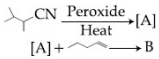
Solution
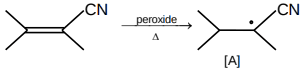
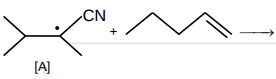

Therefore, Option(1) is correct.
Q18) The rate of a certain biochemical reaction at physiological temperature(T) occurs 106 times faster with enzyme than without. The change in the activation energy upon adding enzyme is:
Solution
The equation for activation energy is given as follows:
Catalyst decrease the activation energy require for a reaction to proceed and thus increase the reaction rate.
Therefore, Option(2) is correct.
Q19) The graph of vapour pressure and temperature for three different liquids X, Y, and Z is shown below:

Solution
At a particular temperature as intermolecular force of attraction increases vapour pressure decreases.
Therefore, Option(3) is correct.
Q20) The complex that can show fac- and mer- isomers is:
Solution
Complexes of the type MA3B3 exist in tow geometrical forms which are named as facial (fac-) and meridional (mer-). [Co(NH3)3(NO2)3]+ can be represented in fac- and mer- isomeric forms as follows:
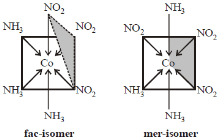
Therefore, Option(1) is correct.
Q21) The magnitude of work done by a gas that undergoes a reversible expansion along the path ABC shown in the figure is

Solution
Q22) Ferrous sulphate heptahydrate is used to fortify foods with iron. The amount (in grams) of the salt required to achieve 10ppm of iron in 100kg of wheat is:
(Atomic weight of Fe = 55.85; S = 32.00; O = 16.00
Solution
Fe = 1 gram
56 g of Fe in 1 mol of FeSO4.7H2O (molar mass 278 gram /mol)
Therefore 1 gram of Fe is present in = (1/56) moles of FeSO4.7H2O
mass of FeSO4.7H2O =
Q23) The number of chiral centres in penicillin is:
Solution
As shown in the figure below, there are 3 chiral carbons in penicillin.

Q24) The volume (in ml) of 0.125 M AgNO3 required to quantitatively precipitate chloride ions in 0.3g of [Co(NH3)6]Cl3 is:
Solution
The reaction occurs as follows:
Molecular weight of [Co(NH3)6]Cl3 = 267.48g/mol
Number of moles of [Co(NH3)6]Cl3 = 0.3/267.48 = 1.125 x 10⁻³ moles.
1 mole of [Co(NH3)6]Cl3 gives 3 moes of AgCl.
Thus, moles of AgCl = 3 x 1.125 x 10-3 moles
Now, 3 moles of AgNO3 reacts with 3 moles of AgCl
Thus, moles off AgNO3 = 3 x 1.125 x 10-3 moles
Now, volume(L) of AgNO3 = (3 x 1.125 x 10-3)/0.125 = 27 x 10-3 L
volume(in mL) of AgNO3 = 27ml
Q25) What would be the electrode potential for the given half cell reaction at pH = 5?
Solution
| A. |
|
| B. |
|
| C. |
|
| D. |
|
For the Balmer series in the spectrum of H atom, the correct statements among (I) to (IV) are:
(1) As the wavelength decreases, the lines in the series converge
(II) The integer n1 is equal to 2
(III) The lines of longest wavelength correspond to n2 = 3
(IV) The ionization energy of hydrogen can be calculated from the number of these lines
| A. |
|
| B. |
|
| C. |
|
| D. |
|
The electron make its transition from lower to higher orbit only after absorbing energy.
| A. |
|
| B. |
|
| C. |
|
| D. |
|
If wavelength of the first line of the Paschen series of hydrogen atom is ,then the wavelength of the second line of this series is
. (Nearest integer)
| A. |
|
| B. |
|
| C. |
|
| D. |
|
The number of following statements which is/are incorrect is_________
(1) Line emission spectra are used to study the electronic structure
(2) The emission spectra of atoms in the gas phase show a continuous spread of wavelength from red to violet
(3) An absorption spectrum is like the photographic negative of an emission spectrum
(4) The element helium was discovered in the sun by spectroscopic method
| A. |
|
| B. |
|
| C. |
|
| D. |
|
UV radiation will be obtained in the transition in a hydrogen like atom from to
In which transition, IV will get
radiation.
| A. |
|
| B. |
|
| C. |
|
| D. |
|
Match List I with List II :
| List I (Spectral Series for Hydrogen) | List II (Spectral Region/Higher Energy State) | ||
| A. | Lyman | I. | Infrared region |
| B. | Balmer | II. | UV region |
| C. | Paschen | III. | Infrared region |
| D. | Pfund | IV. | Visible region |
Choose the correct answer from the options given below :
| A. |
|
| B. |
|
| C. |
|
| D. |
|
Number of spectral lines obtained in $\mathrm{He}^{+}$spectra, when an electron makes transition from fifth excited state to first excited state will be
| A. |
|
| B. |
|
| C. |
|
| D. |
|
The wavelength of the last line of the Lyman series for hydrogen?
| A. |
|
| B. |
|
| C. |
|
| D. |
|
What will be the wavelength of a photon emitted when an electron in the H -atom moves from $n=2$ to $n=1$
| A. |
|
| B. |
|
| C. |
|
| D. |
|
The maximum number of emission lines when the excited electron of an H atom in n=5 drops to the ground state is _____
| A. |
|
| B. |
|
| C. |
|
| D. |
|
The wave number of the spectral line corresponding to the transition from $n_1=2$ to $n_2=4$ is _____ per cm
| A. |
|
| B. |
|
| C. |
|
| D. |
|
Which of the following is not correctly matched?
| A. |
|
| B. |
|
| C. |
|
| D. |
|
Minimum energy released in balmer series (H) will be corresponding to following wavelength
| A. |
|
| B. |
|
| C. |
|
| D. |
|
Paschen series and Bracket series lies in region
| A. |
|
| B. |
|
| C. |
|
| D. |
|
Heat treatment of muscular pain involves radiation of wavelength of about 900 nm . Which spectral line of H atom is suitable for this ?
Given: Rydberg constant
$\left.\mathrm{R}_{\mathrm{H}}=10^5 \mathrm{~cm}^{-1}, \mathrm{~h}=6.6 \times 10^{-34} \mathrm{~J} \mathrm{~s}, \mathrm{c}=3 \times 10^8 \mathrm{~m} / \mathrm{s}\right)$
| A. |
|
| B. |
|
| C. |
|
| D. |
|
It is observed that characteristic X-ray spectra of elements show regularity. When frequency to the power n i.e. $v^n$ of X - rays emitted is plotted against atomic number " Z ", following graph is obtained.
The value of "n" is
| A. |
|
| B. |
|
| C. |
|
| D. |
|
The energy absorbed in the transition of the electron from n=2 to 1 in H-atom will be ____$\times$ 10−1meV
| A. |
|
| B. |
|
| C. |
|
| D. |
|
When an electron in a hydrogen atom falls directly from an excited energy level to the ground state, it emits radiation of wavelength λ/2 and returns in the ground state, the principal quantum number of excited state is given by:
| A. |
|
| B. |
|
| C. |
|
| D. |
|
The ratio of the wavelengths of the light absorbed by a Hydrogen atom when it undergoes $\mathrm{n}=2 \rightarrow \mathrm{n}=3$ and $\mathrm{n}=4 \rightarrow \mathrm{n}=6$ transitions, respectively, is 1:n. Find the value of n?
| A. |
|
| B. |
|
| C. |
|
| D. |
|
When an electric discharge is passed through gaseous hydrogen, the H2 molecules dissociate and the energetically excited hydrogen atoms produced emit electromagnetic radiation of discrete frequencies.
-
- Atomic Models
- Developments leading to the Bohr’s model of atom
- Particle Nature of electromagnetic radiation
- Photoelectric Effect
- Line Spectrum of hydrogen
- Bohr model for hydrogen atom
- Dual behavior of matter
- Heisenberg’s uncertainty principle
- Elementary ideas of quantum mechanics
- Quantum mechanical model of atom
- Quantum Numbers (Concept)
- Shape of Orbitals (Concept)
- Radial nodes and planar nodes (Concept)
- Aufbau Principle, Pauli Exclusion Principle and Hund's Rule of Maximum Multiplicity (Concept)
- Electronic configuration of any element (Concept)
- Stability of Completely filled and Half-filled Subshells (Concept)
