
-
Engineering and Architecture
Exams
Colleges
Predictors
Resources
-
Computer Application and IT
Quick Links
Colleges
-
Pharmacy
Colleges
Resources
-
Hospitality and Tourism
Colleges
Resources
Diploma Colleges
-
Competition
Other Exams
Resources
-
School
Exams
Top Schools
Products & Resources
-
Study Abroad
Top Countries
Resources
-
Arts, Commerce & Sciences
Colleges
Upcoming Events
Resources
-
Management and Business Administration
Exams
Colleges & Courses
Predictors
-
Learn
Law Preparation
MBA Preparation
Engineering Preparation
Medical Preparation
-
Online Courses and Certifications
Top Streams
Specializations
- Digital Marketing Certification Courses
- Cyber Security Certification Courses
- Artificial Intelligence Certification Courses
- Business Analytics Certification Courses
- Data Science Certification Courses
- Cloud Computing Certification Courses
- Machine Learning Certification Courses
- View All Certification Courses
Resources
-
Medicine and Allied Sciences
Colleges
Predictors
Resources
-
Law
Resources
Colleges
-
Animation and Design
Exams
Predictors & Articles
Colleges
Resources
-
Media, Mass Communication and Journalism
Colleges
Resources
-
Finance & Accounts
Top Courses & Careers
Colleges
Planck's quantum theory - (Concept)
Atom and molecules could emit (or absorb) energy only in discrete quantities known as quanta and not in a continuous manner. The following are certain phenomenon which could not be explained by the wave nature of electromagnetic radiation and are explained by the particle nature:
-
The nature of emission of radiation from hot bodies (black -body radiation).
-
Ejection of electrons from a metal surface when radiation strikes it (photoelectric effect).
-
Variation of heat capacity of solids as a function of temperature.
-
Line spectra of atoms with special reference to hydrogen.
Max Planck suggested that the energy which is emitted or absorbed by the black body is not continuous but discontinuous in the form of small discrete packets of energy. Each such packet of energy is called a ‘quantum’. In case of light, the quantum of energy is called a ‘photon’. The energy of radiation is proportional to its frequency ($\nu$) and is expressed by the following equation:
$E=h \nu=\frac{h c}{\lambda}$
where h is the Planck's constant and it has a value equal to 6.63 $\times$ 10-34 J-s
| Exam | Chapter |
| JEE MAIN | Atomic Structure |
The energy of one quantum of light with a wavelength of 6500 Ao (1 Ao = 10-10m) is
| A. |
|
| B. |
|
| C. |
|
| D. |
|
Which of the following combination of statements is true regarding the interpretation of the atomic orbitals?
(a) An electron in an orbital of high angular momentum stays away from the nucleus than an electron in orbital of lower angular momentum.
(b) For a given value of the principal quantum number, the size of the orbit is inversely proportional to the azimuthal quantum number.
(c) According to wave mechanics, the ground state angular momentum is equal to .
(d) The plot of for various azimuthal quantum numbers, shows peak shifting towards higher r-value.
| A. |
|
| B. |
|
| C. |
|
| D. |
|
which one of the following is not the characteristics of planck's quantum theory of radiation
| A. |
|
| B. |
|
| C. |
|
| D. |
|
The energy of radiation of wavelength is
and energy of radiation of wavelength
is
. What is the relation between these two
| A. |
|
| B. |
|
| C. |
|
| D. |
|
The energy of one mole of photons of radiation of wavelength 300 nm is:
(Given : )
| A. |
|
| B. |
|
| C. |
|
| D. |
|
The longest wavelength of light that can be used for the ionization of ion in its ground state is
. The value of x is____________ . (Nearest Integer)
(Given: Energy of the electron in the first shell of the hydrogen atom is )
| A. |
|
| B. |
|
| C. |
|
| D. |
|
The number of photons emitted in 10 hours by a 60 W sodium lamp ( of photon =6000
) is
. Find the value of x
| A. |
|
| B. |
|
| C. |
|
| D. |
|
A gas absorbs a photon of 355 nm and emits at two wavelengths. If one of the emission is at 680 nm, the other is at
| A. |
|
| B. |
|
| C. |
|
| D. |
|
Which of the following statements is false ?
| A. |
|
| B. |
|
| C. |
|
| D. |
|
The energy required to break one mole of bonds in
. The longest wave-length of light capable of breaking a single
bond is
| A. |
|
| B. |
|
| C. |
|
| D. |
|
According to Planck's quantum theory, the energy of a quantum of radiation is given by:
| A. |
|
| B. |
|
| C. |
|
| D. |
|
The value of wavelength of a photon with energy $3.0 \times 10^{-19} \mathrm{~J}$, according to Planck's quantum theory is $n \times 10^{-7} \mathrm{~m}$. Find the value of n?
| A. |
|
| B. |
|
| C. |
|
| D. |
|
Find out the difference in energy between levels in
if it was observed that
emission line of this atom is formed at
.
| A. |
|
| B. |
|
| C. |
|
| D. |
|
The number of photons of light with the wavelength of 4000 pm that provides 1 J of energy is _____$\times 10^{16}$
| A. |
|
| B. |
|
| C. |
|
| D. |
|
The number of quanta of radiation of $V=4.67 \times 10^{13} \mathrm{~Hz}$ that must be absorbed in order to melt 5g of ice is (the energy required to melt 1g of ice is 333 J) ____$\times 10^{20}$
| A. |
|
| B. |
|
| C. |
|
| D. |
|
Wavenumber for a radiation having $5800 A$ wavelength is $x \times 10 \mathrm{~cm}^{-1}$. The value of $x$ is
| A. |
|
| B. |
|
| C. |
|
| D. |
|
The energy of a photon (in $10^{-25} \mathrm{~J}$) of wavelength $\lambda$ = 1 meter is (Planck's constant = 6.625 × 10⁻³⁴ Js, speed of light = 3 × 10⁸ m/s)
| A. |
|
| B. |
|
| C. |
|
| D. |
|
A certain metal has a work function of $\Phi=2 e \mathrm{~V}$. It is irradiated first with 1 W of 400 nm light and later with 1 W of 800 nm light. Among the following, the correct statement is :
[Given : Planck constant $(h)=6.626 \times 10^{-34} \mathrm{~m}^2 \mathrm{kgs}^{-1}$ .Speed of light $(c)=3 \times 10^8 \mathrm{~ms}^{-1}$ ]
| A. |
|
| B. |
|
| C. |
|
| D. |
|
A hypothetical electromagnetic wave is show below.
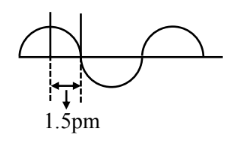
The frequency of the wave is $\mathrm{x} \times 10^{19} \mathrm{~Hz}$. $x=$ $\qquad$ (nearest integer)
| A. |
|
| B. |
|
| C. |
|
| D. |
|
Radiation having $\lambda=200 A^{\circ}$ falls on metal surface having work function $5 \mathrm{eV}$. If threshold frequency of metal is $x \times 10^{14} \mathrm{~sec}^{-1}$, value of $x$ is (nearest integer)
| A. |
|
| B. |
|
| C. |
|
| D. |
|
The figure that is not a direct manifestation of the quantumnature of atom is :
| A. |
|
| B. |
|
| C. |
|
| D. |
|
The number of incorrect statement/s about the black body from the following is_________
(1) Emit or absorb energy in the form of electromagnetic radiation.
(2) Frequency distribution of the emitted radiation depends on temperature.
(3) At a given temperature, intensity vs frequency curve passes through a maximum value.
(4) The maximum of the intensity vs frequency curve is at a higher frequency at higher temperature compared to that at lower temperature.
| A. |
|
| B. |
|
| C. |
|
| D. |
|
Wavelength of electron moving with $\left(\frac{1}{3}\right)^{r d}$ velocity of light ____$\times 10^{-12} \mathrm{~m}$
| A. |
|
| B. |
|
| C. |
|
| D. |
|
Which of the following statement is not true for radioactive decay?
| A. |
|
| B. |
|
| C. |
|
| D. |
|

Some of the experimental phenomenon such as diffraction and interference can be explained by the wave nature of the electromagnetic radiation.
-
- Atomic Models
- Developments leading to the Bohr’s model of atom
- Particle Nature of electromagnetic radiation
- Photoelectric Effect
- Line Spectrum of hydrogen
- Bohr model for hydrogen atom
- Dual behavior of matter
- Heisenberg’s uncertainty principle
- Elementary ideas of quantum mechanics
- Quantum mechanical model of atom
- Quantum Numbers (Concept)
- Shape of Orbitals (Concept)
- Radial nodes and planar nodes (Concept)
- Aufbau Principle, Pauli Exclusion Principle and Hund's Rule of Maximum Multiplicity (Concept)
- Electronic configuration of any element (Concept)
- Stability of Completely filled and Half-filled Subshells (Concept)
