
-
Engineering and Architecture
Exams
Colleges
Predictors
Resources
-
Computer Application and IT
Quick Links
Colleges
-
Pharmacy
Colleges
Resources
-
Hospitality and Tourism
Colleges
Resources
Diploma Colleges
-
Competition
Other Exams
Resources
-
School
Exams
Top Schools
Products & Resources
-
Study Abroad
Top Countries
Resources
-
Arts, Commerce & Sciences
Colleges
Upcoming Events
Resources
-
Management and Business Administration
Exams
Colleges & Courses
Predictors
-
Learn
Law Preparation
MBA Preparation
Engineering Preparation
Medical Preparation
-
Online Courses and Certifications
Top Streams
Specializations
- Digital Marketing Certification Courses
- Cyber Security Certification Courses
- Artificial Intelligence Certification Courses
- Business Analytics Certification Courses
- Data Science Certification Courses
- Cloud Computing Certification Courses
- Machine Learning Certification Courses
- View All Certification Courses
Resources
-
Medicine and Allied Sciences
Colleges
Predictors
Resources
-
Law
Resources
Colleges
-
Animation and Design
Exams
Predictors & Articles
Colleges
Resources
-
Media, Mass Communication and Journalism
Colleges
Resources
-
Finance & Accounts
Top Courses & Careers
Colleges
Quantum Numbers - (Concept)
Quantum numbers:
They are the set of four numbers which explain the state of electron i.e., location, energy, type of orbital, orientation of orbital, etc. in an atom. Various quantum numbers are as follows:
-
Principal quantum number(n)
-
Azimuthal quantum number(l)
-
Magnetic quantum number(m)
-
Spin quantum number(s)
Principal quantum number(n):
It represents the principal shell of an atom. It can have integral values except zero like 1,2,3,.... Also denoted as K,L,M,.....etc.
Maximum number of electrons in a principal shell can be 2n2 where n is principal quantum number.
This quantum number gives information about :
- Distance of electron from nucleus i.e., size of electron cloud.
- Energy of electron in any shell in unielectronic species
$\mathrm{E}_{\mathrm{n}}=-\frac{1312 \times \mathrm{Z}^2}{\mathrm{n}^2} \mathrm{~kJ} / \mathrm{mol}$
Where, Z is atomic number and n is principal quantum number.
- In case of multielectronic species, the energy of an electron is given by Aufbau's Principle, which we shall be studying later.
Azimuthal quantum number(l):
It gives us an idea of the three dimensional shape of the orbitals.
Azimuthal quantum number represents the subshell or subenergy shell in an atom.
l has values from 0 to (n-1).
e.g. for n=2 ; l= 0, 1
Subshell notation for l = 0, 1, 2, ..... is s, p, d ...
Maximum number of electrons that can be accomodated in a subshell with azimuthal quantum number 'l' is given by [2(2l+1)]:
e.g. for s subshell = 2; for p subshell = 6.
Magnetic quantum number(m):
It gives us information about the spatial orientation of the orbitals in the subshell with respect to the standard set of coordinate axes.
Every value of m represents a possible orientation of the orbital
It represents the number of orbitals present in a subshell.
m has values ranging from -l to +l including zero.
For eg: for ‘s’ subshell :
-
The value of l is 0
-
m has value=0
It means that there is only one possible orientation for the s orbital
For ‘p’ subshell :
-
Value of l is 1
-
m has value= -1, 0, +1
It means that there are three possible orientation for the p orbital
Spin quantum number(s):
Electron in an orbital can spin in either clockwise or anticlockwise direction. The spin quantum number has no classical analogue and any spin direction can be assigned +1/2 and the opposite spin will be automatically assigned -1/2. These values of +1/2 or -1/2 are not fixed for a particular spin direction.
Thus, an electron can have only two possible values of this quantum number, either $+\frac{1}{2}$ or $-\frac{1}{2}$ respectively.
| Exam | Chapter |
| JEE MAIN | Atomic Structure |
The energy of an electron in a hydrogenic ion depends on
| A. |
|
| B. |
|
| C. |
|
| D. |
|
Which of the following combination of statements is true regarding the interpretation of the atomic orbitals?
(a) An electron in an orbital of high angular momentum stays away from the nucleus than an electron in orbital of lower angular momentum.
(b) For a given value of the principal quantum number, the size of the orbit is inversely proportional to the azimuthal quantum number.
(c) According to wave mechanics, the ground state angular momentum is equal to .
(d) The plot of for various azimuthal quantum numbers, shows peak shifting towards higher r-value.
| A. |
|
| B. |
|
| C. |
|
| D. |
|
The electrons identified by quantum numbers n and l :
(1) n = 4, l = 1 (2) n = 4, l = 0 (3) n = 3, l = 2 (4) n = 3 , l = 1
Can be placed in order of increasing energy as :
| A. |
|
| B. |
|
| C. |
|
| D. |
|
The correct set of four quantum numbers for the valence electrons of rubidium atom (Z=37) is :
| A. |
|
| B. |
|
| C. |
|
| D. |
|
The quantum number of four electrons are given below:
The correct order of their increasing energies will be :
| A. |
|
| B. |
|
| C. |
|
| D. |
|
If n and l are respectively the principal and azimuthal quantum number then the expression for the calculation of the total no. of electrons in any energy level is:
| A. |
|
| B. |
|
| C. |
|
| D. |
|
The number of electrons in Al having an azimuthal quantum number (l) zero, is__________ -
| A. |
|
| B. |
|
| C. |
|
| D. |
|
The number of orbitals associated with quantum numbers
is:
| A. |
|
| B. |
|
| C. |
|
| D. |
|
Given
Then maximum number of electron(s) in an atom that can have quantum numbers as given in (a) and (b) are respectively:
| A. |
|
| B. |
|
| C. |
|
| D. |
|
In an atom how many orbital (s) will have the quantum numbers; and
?
| A. |
|
| B. |
|
| C. |
|
| D. |
|
The quantum number which specifies the location of an electron as well as energy is
| A. |
|
| B. |
|
| C. |
|
| D. |
|
Which of the following sets of quantum numbers represent an impossible arrangement
| A. |
|
| B. |
|
| C. |
|
| D. |
|
For energy level, the number of possible orbitals (all kinds) are
| A. |
|
| B. |
|
| C. |
|
| D. |
|
For azimuthal quantum number , the maximum number of electrons will be
| A. |
|
| B. |
|
| C. |
|
| D. |
|
Five valence electrons of $p^{15}$ are labelled as

If the spin quantum of B and Z is $+\frac{1}{2}$, the group of electrons with only three of the quantum number same are
| A. |
|
| B. |
|
| C. |
|
| D. |
|
The number of orbitals with n=5, is ______ (Round off to the nearest integer)
| A. |
|
| B. |
|
| C. |
|
| D. |
|
The number of subshells associated with and
quantum numbers is:
| A. |
|
| B. |
|
| C. |
|
| D. |
|
Consider the hypothetical situation where the azimuthal quantum number, l, takes values $0,1,2, \ldots . . n+1$, where n is the principal quantum number. Then, the element with atomic number :
| A. |
|
| B. |
|
| C. |
|
| D. |
|
Consider the following pairs of electrons
The pairs of electrons present in degenerate orbitals is / are :
| A. |
|
| B. |
|
| C. |
|
| D. |
|
Consider the following set of quantum numbers.
The number of correct sets of quantum numbers is __________.
| A. |
|
| B. |
|
| C. |
|
| D. |
|
Consider the following statements:
(A) The principle quantum number 'n' is a positive integer with values of
(B) The azimuthal quantum number 'l' for a given 'n' ( principal quantum number) can have values as
(C) Magnetic orbital quantum number 'm' for a particular 'l' ( azimuthal quantum number) has value.
(D) are the two possible orientations of electron spin.
(E) there will be a total of 9 orbital
Which of the above statement are correct ?
| A. |
|
| B. |
|
| C. |
|
| D. |
|
Which of the following sets of quantum numbers is not allowed?
| A. |
|
| B. |
|
| C. |
|
| D. |
|
Identify the incorrect statement from the following.
| A. |
|
| B. |
|
| C. |
|
| D. |
|
Given below are the quantum numbers for electrons.
A.
B.
C.
D.
The correct order of increasing energy is
| A. |
|
| B. |
|
| C. |
|
| D. |
|
The Azimuthal quantum number for the valence electrons of ion is _________.
(Atomic number of )
| A. |
|
| B. |
|
| C. |
|
| D. |
|
The value of the magnetic quantum number of the outermost electron is ____________. (Integer answer)
| A. |
|
| B. |
|
| C. |
|
| D. |
|
Based on the equation : the wavelength of the light that must be absorbed to excite hydrogen electron from level n=1 to level n=2 will be :
(h = 6.625x10⁻³⁴ Js, C= 3 X 10⁸ ms-1)
| A. |
|
| B. |
|
| C. |
|
| D. |
|
Which of the following is Incorrect for two electrons of a atom?
| A. |
|
| B. |
|
| C. |
|
| D. |
|
The orbital angular momentum for an electron revolving in an orbit is given by This momentum for an s- electron will be given by
| A. |
|
| B. |
|
| C. |
|
| D. |
|
The correct set of four quantum numbers for the valence electron of rubidium atom (Z = 37) is :
| A. |
|
| B. |
|
| C. |
|
| D. |
|
The total number of orbitals associated with the principal quantum number 5 is :
| A. |
|
| B. |
|
| C. |
|
| D. |
|
Which of the following sets of quantum numbers is correct for an electron in 4f orbital?
| A. |
|
| B. |
|
| C. |
|
| D. |
|
Consider the ground state of Cr atom .The numbers of electrons with the azimuthal quantum numbers
are, respectively
| A. |
|
| B. |
|
| C. |
|
| D. |
|
In a multi-electron atom, which of the following orbitals described by the three quantum numbers will have the same energy in the absence of magnetic and electric fields?
| A. |
|
| B. |
|
| C. |
|
| D. |
|
Which of the following sets of quantum numbers represents the highest energy of an atom?
| A. |
|
| B. |
|
| C. |
|
| D. |
|
Chloro compound of Vanadium has only spin magnetic moment of 1.73 BM. This Vanadium chloride has the formula:
(Atomic number of V=23)
| A. |
|
| B. |
|
| C. |
|
| D. |
|
The electrons identified by quantum numbers n and l:
(1) n = 4, l = 1 (2) n = 4, l = 0 (3) n = 3, l = 2 (4) n = 3, l = 1
can be placed in order of increasing energy as:
| A. |
|
| B. |
|
| C. |
|
| D. |
|
How many electrons can fit in the orbital for which n = 3 and I = 1?
| A. |
|
| B. |
|
| C. |
|
| D. |
|
Maximum number of electrons that can be accommodated in the shell with n=4
| A. |
|
| B. |
|
| C. |
|
| D. |
|
Arrange the following orbitals in decreasing order of energy.
A. n = 3, l = 0, m = 0
B. n = 4, l = 0, m = 0
C. n = 3, l = 1, m = 0
D. n = 3, l = 2, m = 1
The correct option for the order is :
| A. |
|
| B. |
|
| C. |
|
| D. |
|
The orbital angular momentum of an electron in 3s orbital is The value of x is ____. (nearest integer)
| A. |
|
| B. |
|
| C. |
|
| D. |
|
For elements having Atomic Numbers 11, 19 & 37 respectively, for valence electrons values of $n+l+m$ (quantum Numbers) are $x, y \; $&$ \; z$.
find $x+y+z$.
| A. |
|
| B. |
|
| C. |
|
| D. |
|
If the Aufbau principle is not followed, the first three quantum numbers (n, l and m) for the valence electron of K atom may take value
| A. |
|
| B. |
|
| C. |
|
| D. |
|
The correct set of four quantum numbers for the valence electron of rubidium atom (Z = 37) is :
| A. |
|
| B. |
|
| C. |
|
| D. |
|
The four quantum numbers for the electron in the outer most orbital of potassium (atomic no. 19) are
| A. |
|
| B. |
|
| C. |
|
| D. |
|
Compare the energies of following sets of quantum numbers for multielectron system.
(A) $\mathrm{n}=4,1=1$
(B) $\mathrm{n}=4,1=2$
(C) $\mathrm{n}=3,1=1$
(D) $\mathrm{n}=3,1=2$
(E) $n=4,1=0$
Choose the correct answer from the options given below :
| A. |
|
| B. |
|
| C. |
|
| D. |
|
What is the sum of principal Quantum No (n) and Azimuthal Quantum number (l) for electrons in 2p orbital?
| A. |
|
| B. |
|
| C. |
|
| D. |
|
Total No. of electrons in "Ne" having " $m=0$ "
| A. |
|
| B. |
|
| C. |
|
| D. |
|
Which of the following is not possible subshell
| A. |
|
| B. |
|
| C. |
|
| D. |
|
Which of the following sets of quantum no. is not possible?
| A. |
|
| B. |
|
| C. |
|
| D. |
|
If a principal quantum shell, n=2 , max number of electrons it can have ?
| A. |
|
| B. |
|
| C. |
|
| D. |
|
Maximum No. of electron in Ar having $ s=+\frac{1}{2} $
| A. |
|
| B. |
|
| C. |
|
| D. |
|
Maximum possible electrons having n=2, l=1
| A. |
|
| B. |
|
| C. |
|
| D. |
|
Maximum possible orbitals for $n=4$ and $l=0,1$
| A. |
|
| B. |
|
| C. |
|
| D. |
|
Principle quantum no. is related to
| A. |
|
| B. |
|
| C. |
|
| D. |
|
For a one -electron atom ,the set of allowed quantum numbers is
| A. |
|
| B. |
|
| C. |
|
| D. |
|
The allowed set of quantum numbers for an electron in a hydrogen atom is
| A. |
|
| B. |
|
| C. |
|
| D. |
|
Among the following, the INCORRECT statement is:
| A. |
|
| B. |
|
| C. |
|
| D. |
|
For a multi-electron atom,the highest energy level among the following is
A. $n=5, l=0, m=0, s=+1 / 2$
B. $n=4, l=2, m=0, s=+1 / 2$
C. $n=4, l=1, m=0, s=+1 / 2$
D. $n=5, l=1, m=0, s=+1 / 2_{\mathrm{A}}$
| A. |
|
| B. |
|
| C. |
|
| D. |
|
Maximum number of electrons that can be accommodated in the subshell with azimuthal quantum number l=4, is
| A. |
|
| B. |
|
| C. |
|
| D. |
|
The correct set of quantum numbers for the unpaired electron of Cu atom is :
| A. |
|
| B. |
|
| C. |
|
| D. |
|
The maximum number of electrons that can be filled in the shell with the principal quantum number n=4 is:
| A. |
|
| B. |
|
| C. |
|
| D. |
|
The maximum number of electrons that can be filled in the shell with the principal quantum number n=3 is:
| A. |
|
| B. |
|
| C. |
|
| D. |
|
The set of principal, azimuthal, and magnetic quantum numbers that do not allow for the electron in the H atom is
| A. |
|
| B. |
|
| C. |
|
| D. |
|
Given below are two statements:
Statement (I) : For a given shell, the total number of allowed orbitals is given by $\mathrm{n}^2$.
Statement (II) : For any subshell, the spatial orientation of the orbitals is given by $-l$ to $+l$ values including zero.
In the light of the above statements, choose the correct answer from the options given below:
| A. |
|
| B. |
|
| C. |
|
| D. |
|
In a multielectron atom, which of the following orbitals described by three quantum numbers with have same energy in absence of electric and magnetic fields?
A. $\mathrm{n}=1,1=0, \mathrm{~m}_l=0$
B. $\mathrm{n}=2,1=0, \mathrm{~m}_l=0$
C. $\mathrm{n}=2,1=1, \mathrm{~m}_l=1$
D. $\mathrm{n}=3,1=2, \mathrm{~m}_l=1$
E. $\mathrm{n}=3, \mathrm{l}=2, \mathrm{~m}_1=0$
Choose the correct answer from the options given below:
| A. |
|
| B. |
|
| C. |
|
| D. |
|
For the electrons of oxygen atom, which of the following statements is correct?
| A. |
|
| B. |
|
| C. |
|
| D. |
|
Orbital angular momentum depends on
| A. |
|
| B. |
|
| C. |
|
| D. |
|
Out of the following pairs of electrons, identify the pairs of electrons present in degenerate orbitals :
${ }_{\text {i) (a) }} n=3, l=2, m_l=-2, m_s=-\frac{1}{2}$
(b) $n=3, l=2, m_l=-1, m_s=-\frac{1}{2}$
ii) (a) $n=3, l=1, m_l=1, m_s=+\frac{1}{2}$
(b) $n=3, l=2, m_l=1, m_s=+\frac{1}{2}$
iii) (a) $n=4, l=1, m_l=1, m_s=+\frac{1}{2}$
(b) $n=3, l=2, m_l=1, m_s=+\frac{1}{2}$
iv) (a) $n=3, l=2, m_l=+2, m_s=-\frac{1}{2}$
(b) $n=3, l=2, m_l=+2, m_s=+\frac{1}{2}$
| A. |
|
| B. |
|
| C. |
|
| D. |
|
Total number of orbitals associated with third shell will be _______.
| A. |
|
| B. |
|
| C. |
|
| D. |
|
Which of the following sets of quantum numbers are correct?
n l m1
(i) 1 1 +2
(ii) 2 1 +1
(iii) 3 2 -2
(iv) 3 4 -2
| A. |
|
| B. |
|
| C. |
|
| D. |
|
Which of the following statements concerning the quantum numbers are correct?
(i) Angular quantum number determines the three dimensional shape of the orbital.
(ii) The principal quantum number determines the orientation and energy of the orbital.
(iii) Magnetic quantum number determines the size of the orbital.
(iv) Spin quantum number of an electron determines the orientation of the spin of electron relative to the chosen axis.
| A. |
|
| B. |
|
| C. |
|
| D. |
|
The maximum number of orbitals which can be identified with $\mathrm{n}=4$ and $\mathrm{m}_l=0$ is _______
| A. |
|
| B. |
|
| C. |
|
| D. |
|
Which of the following statements are true?
(A) The subsidiary quantum number $l$ describes the shape of the orbital occupied by the electron.
(B) 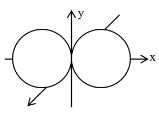 is the boundary surface diagram of the $2 p_x$ orbital.
(C) The + and - signs in the wave function of the $2 \mathrm{p}_{\mathrm{x}}$ orbital refer to charge.
(D) The wave function of $2 p_x$ orbital is zero everywhere in the xy plane.
| A. |
|
| B. |
|
| C. |
|
| D. |
|
Consider the ground state of chromium atom $(Z=24)$. How many electrons are with Azimuthal quantum number $l=1$ and $l=2$ respectively ?
| A. |
|
| B. |
|
| C. |
|
| D. |
|
What is the maximum numbers of electrons that can be associated with the following set of quantum numbers?
n = 3, l = 1 and m = -1.
| A. |
|
| B. |
|
| C. |
|
| D. |
|
What is the maximum number of orbitals that can be identified with the following quantum numbers?
n= 3, l = 1, ml = 0
| A. |
|
| B. |
|
| C. |
|
| D. |
|
Maximum number of electrons in a subshell with : l= 3 and n = 4 is :
| A. |
|
| B. |
|
| C. |
|
| D. |
|

A large number of orbitals are possible in an atom. Qualitatively these orbitals can be distinguished by their size, shape and orientation. An orbital of smaller size means there is more chance of finding the electron near the nucleus.
