
-
Engineering and Architecture
Exams
Colleges
Predictors
Resources
-
Computer Application and IT
Quick Links
Colleges
-
Pharmacy
Colleges
Resources
-
Hospitality and Tourism
Colleges
Resources
Diploma Colleges
-
Competition
Other Exams
Resources
-
School
Exams
Top Schools
Products & Resources
-
Study Abroad
Top Countries
Resources
-
Arts, Commerce & Sciences
Colleges
Upcoming Events
Resources
-
Management and Business Administration
Exams
Colleges & Courses
Predictors
-
Learn
Law Preparation
MBA Preparation
Engineering Preparation
Medical Preparation
-
Online Courses and Certifications
Top Streams
Specializations
- Digital Marketing Certification Courses
- Cyber Security Certification Courses
- Artificial Intelligence Certification Courses
- Business Analytics Certification Courses
- Data Science Certification Courses
- Cloud Computing Certification Courses
- Machine Learning Certification Courses
- View All Certification Courses
Resources
-
Medicine and Allied Sciences
Colleges
Predictors
Resources
-
Law
Resources
Colleges
-
Animation and Design
Exams
Predictors & Articles
Colleges
Resources
-
Media, Mass Communication and Journalism
Colleges
Resources
-
Finance & Accounts
Top Courses & Careers
Colleges
Radial nodes and planar nodes - (Concept)
Nodes:
Total number of nodes = (n - 1)
Radial node is a spherical surface where the probability of finding an electron is zero. The number of radial nodes increases with the principle quantum number (n).
No. of radial nodes = (n- l- 1)
where n is the principal quantum number, l is the azimuthal quantum number.
Angular node is also called nodal plane. Angular node is a plane that passes through the nucleus. Angular node is equal to the azimuthal quantum number (l).
no. of planar nodes = l
where l is the azimuthal quantum number.

| Exam | Chapter |
| JEE MAIN | Atomic Structure |
The number of radial nodes of 3s and 2p orbital are respectively
| A. |
|
| B. |
|
| C. |
|
| D. |
|
Number of planar nodes in dx-y is
| A. |
|
| B. |
|
| C. |
|
| D. |
|
The plots of radial distribution functions for various orbitals of hydrogen atom against 'r' are given below:

The correct plot for 3s orbital is:
| A. |
|
| B. |
|
| C. |
|
| D. |
|
The orbital having two radial as well as two angular nodes is ____d
| A. |
|
| B. |
|
| C. |
|
| D. |
|
The number of radial nodes of and
orbitals are respectively
| A. |
|
| B. |
|
| C. |
|
| D. |
|
A certain orbital has n =4 and mL = -3. The number of radial nodes in this orbital is ____________. (Round off to the Nearest Integer).
| A. |
|
| B. |
|
| C. |
|
| D. |
|
A certain orbital has no angular nodes and two radial nodes. The orbital is :
| A. |
|
| B. |
|
| C. |
|
| D. |
|
The number of radial and angular nodes in 4d orbital are, respectively
| A. |
|
| B. |
|
| C. |
|
| D. |
|
Which of the following statements are correct?
(A) The electronic configuration of
(B) The magnetic quantum number may have a negative value.
(C) In the ground state of an atom, the orbitals are filled in order of their increasing energies.
(D) The total number of nodes is given by n-2.
Choose the most appropriate answer from the options given below:
| A. |
|
| B. |
|
| C. |
|
| D. |
|
Which of the following is the correct plot for the probability density $\Psi^2(\mathrm{r})$ as a function of distance 'r' of the electron from the nucleus for 2s orbital?
| A. |
|
| B. |
|
| C. |
|
| D. |
|
The wave function of
is given by
At , the radial node is formed. Thus,
in terms of
| A. |
|
| B. |
|
| C. |
|
| D. |
|
The number of atomic orbitals from the following having 5 radial nodes is_________
| A. |
|
| B. |
|
| C. |
|
| D. |
|
The number of correct statements from the following is
A. For 1 s orbital, the probability density is maximum at the nucleus
B. For 2 s orbital, the probability density first increases to maximum and then decreases sharply to zero.
C. Boundary surface diagrams of the orbitals encloses a region of 100% probability of finding the electron.
D. p and d-orbitals have 1 and 2 angular nodes respectively
E. probability density of p-orbital is zero at the nucleus
| A. |
|
| B. |
|
| C. |
|
| D. |
|
Which of the following curves correspond to is orbital ?
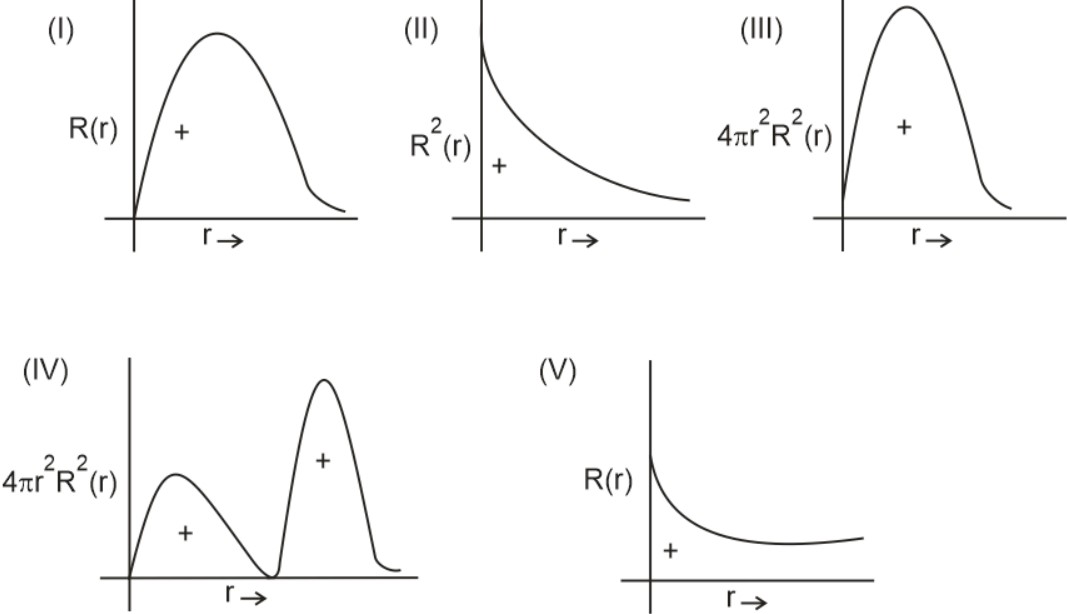
| A. |
|
| B. |
|
| C. |
|
| D. |
|
The number of radial node/s for 3p orbital is:
| A. |
|
| B. |
|
| C. |
|
| D. |
|
The number of the nodal plane in a px – orbital is
| A. |
|
| B. |
|
| C. |
|
| D. |
|
$\psi_{\text {radial }}=\frac{1}{9 \sqrt{2}}\left(\frac{Z}{a}\right)^{\frac{3}{2}}\left[\left(\sigma^2-4 \sigma+3\right)\right] \exp \left(-\frac{\sigma}{2}\right)$
where $a_0$ & $ Z$ are constants & $\sigma=\frac{2 Z r}{a_0}$ the given orbital function contains
| A. |
|
| B. |
|
| C. |
|
| D. |
|
No. of angular nodes and total nodes for 2p orbital will be
| A. |
|
| B. |
|
| C. |
|
| D. |
|
For a 4p orbital, the number of radial and angular nodes, respectively, are
| A. |
|
| B. |
|
| C. |
|
| D. |
|
Number of angular nodes for 4d orbital is __________ .
| A. |
|
| B. |
|
| C. |
|
| D. |
|
The number of radial nodes for 3p orbital is
| A. |
|
| B. |
|
| C. |
|
| D. |
|
The electrons are more likely to be found:

| A. |
|
| B. |
|
| C. |
|
| D. |
|
A 3-p orital has:
| A. |
|
| B. |
|
| C. |
|
| D. |
|
For electrons in ' 2 s ' and ' 2 p ' orbitals, the orbital angular momentum values, respectively, are
| A. |
|
| B. |
|
| C. |
|
| D. |
|
Correct statements for an element with atomic number 9 are
A. There can be 5 electrons for which $\mathrm{m}_{\mathrm{s}}=+\frac{1}{2}$ and 4 electrons for which $\mathrm{m}_{\mathrm{s}}=-\frac{1}{2}$
B. There is only one electron in $p_z$ orbital
C. The last electron goes to orbital with $\mathrm{n}=2$ and $l=1$
D. The sum of angular nodes of all the atomic orbitals is 1 .
Choose the correct answer from the options given below:
| A. |
|
| B. |
|
| C. |
|
| D. |
|

The region where this probability density function reduces to zero is called nodal surfaces or simply nodes. In general, it has been found that ns-orbital has (n – 1)
nodes, that is the number of nodes increases with increase of principal quantum number n. In other words, the number of nodes for 2s orbital is one, two for 3s and so on.
-
- Atomic Models
- Developments leading to the Bohr’s model of atom
- Particle Nature of electromagnetic radiation
- Photoelectric Effect
- Line Spectrum of hydrogen
- Bohr model for hydrogen atom
- Dual behavior of matter
- Heisenberg’s uncertainty principle
- Elementary ideas of quantum mechanics
- Quantum mechanical model of atom
- Quantum Numbers (Concept)
- Shape of Orbitals (Concept)
- Radial nodes and planar nodes (Concept)
- Aufbau Principle, Pauli Exclusion Principle and Hund's Rule of Maximum Multiplicity (Concept)
- Electronic configuration of any element (Concept)
- Stability of Completely filled and Half-filled Subshells (Concept)
