
-
Engineering and Architecture
Exams
Colleges
Predictors
Resources
-
Computer Application and IT
Quick Links
Colleges
-
Pharmacy
Colleges
Resources
-
Hospitality and Tourism
Colleges
Resources
Diploma Colleges
-
Competition
Other Exams
Resources
-
School
Exams
Top Schools
Products & Resources
-
Study Abroad
Top Countries
Resources
-
Arts, Commerce & Sciences
Colleges
Upcoming Events
Resources
-
Management and Business Administration
Exams
Colleges & Courses
Predictors
-
Learn
Law Preparation
MBA Preparation
Engineering Preparation
Medical Preparation
-
Online Courses and Certifications
Top Streams
Specializations
- Digital Marketing Certification Courses
- Cyber Security Certification Courses
- Artificial Intelligence Certification Courses
- Business Analytics Certification Courses
- Data Science Certification Courses
- Cloud Computing Certification Courses
- Machine Learning Certification Courses
- View All Certification Courses
Resources
-
Medicine and Allied Sciences
Colleges
Predictors
Resources
-
Law
Resources
Colleges
-
Animation and Design
Exams
Predictors & Articles
Colleges
Resources
-
Media, Mass Communication and Journalism
Colleges
Resources
-
Finance & Accounts
Top Courses & Careers
Colleges
Hydrogen Bonding - (Concept)
Hydrogen Bonding
Hydrogen bonds are strong forces which occurs when a hydrogen atom bonded to an electronegative atom approaches a nearby electronegative atom such as O, N, F, etc.. Greater the electronegativity of the atom will result in an increase in hydrogen-bond strength. The hydrogen bond is stronger intermolecular force, but it is weaker than a covalent or an ionic bond. Hydrogen bonds are responsible for holding together DNA, proteins, and other macromolecules.
Formation of Hydrogen Bond
A hydrogen bond is the electromagnetic attraction that occurs between a partially positively charged hydrogen atom attached to a highly electronegative atom and another nearby electronegative atom. A hydrogen bond is a type of dipole-dipole interaction; it is not a true chemical bond. This hydrogen bond attraction can occur between the different molecules (intermolecularly) or within different parts of a single molecule (intramolecularly).
Types of Hydrogen Bonding
There are two types of hydrogen bonding, i.e:
-
Intermolecular Hydrogen Bonding: Intermolecular hydrogen bonding occurs when the H-atom of one molecule and an electronegative atom of another molecule are close to each other. For example, hydrogen bond between the molecules of hydrogen fluoride. Intermolecular hydrogen bonding results into association of molecules. Thus, it increases the melting point, boiling point, solubility, etc.
-
Intramolecular Hydrogen Bonding: Intramolecular hydrogen bonding occurs the hydrogen atom and an electronegative atom of the same molecule are close to each other. Intramolecular hydrogen bonding results in the cyclization of the molecules and prevents their association. Thus, the properties of these compounds like melting point, boiling point, etc. are usually low. For example, intramolecular hydrogen bonding is present in molecules such as o-nitrophenol, o-nitrobenzoic acid, etc.
| Exam | Chapter |
| JEE MAIN | Chemical Bonding and Molecular Structure |
Which of the following compound has the least tendency to form H- bonds?
| A. |
|
| B. |
|
| C. |
|
| D. |
|
HF has the highest boiling point among hydrogen halides because it has :
| A. |
|
| B. |
|
| C. |
|
| D. |
|
Which of the following hydrogen bonds is the strongest?
| A. |
|
| B. |
|
| C. |
|
| D. |
|
The reason for exceptionally high boiling point of water is :
| A. |
|
| B. |
|
| C. |
|
| D. |
|
Methanol and ethanol are miscible in water due to:
| A. |
|
| B. |
|
| C. |
|
| D. |
|
The high density of water compared to ice is due to :
| A. |
|
| B. |
|
| C. |
|
| D. |
|
In which of the compound intramolecular hydrogen bond is present?
| A. |
|
| B. |
|
| C. |
|
| D. |
|
Which is most viscous?
| A. |
|
| B. |
|
| C. |
|
| D. |
|
Hydrogen bonding is not present in
| A. |
|
| B. |
|
| C. |
|
| D. |
|
Given below are two statements: one is labelled as Assertion A and the other is labelled as Reason R.
Assertion A : Dipole-dipole interactions are the only non-covalent interactions, resulting in hydrogen bond formation.
Reason R : Fluorine is the most electronegative element and hydrogen bonds in HF are symmetrical.
In the light of the above statements, choose the most appropriate answer from the options given below:
| A. |
|
| B. |
|
| C. |
|
| D. |
|
Consider the following molecules and statements related to them :

(a) (B) is more likely to be crystalline than (A)
(b) (B) has higher boiling point than (A)
(C) (B) dissolves more readily than (A) in water
Identify the correct option from below :
| A. |
|
| B. |
|
| C. |
|
| D. |
|
Contrary to other hydrogen halides, hydrogen fluoride is a liquid because
| A. |
|
| B. |
|
| C. |
|
| D. |
|
Which contains strongest H - bond
| A. |
|
| B. |
|
| C. |
|
| D. |
|
The correct order of increasing intermolecular hydrogen bond strength is
| A. |
|
| B. |
|
| C. |
|
| D. |
|
The compound/s which will show significant intermolecular H-bonding is/are :

| A. |
|
| B. |
|
| C. |
|
| D. |
|
High viscosity of water can be explained on the basis of :
| A. |
|
| B. |
|
| C. |
|
| D. |
|
Which concept best expain that O-nitrophenol is more volite than P- nitrophenol?
| A. |
|
| B. |
|
| C. |
|
| D. |
|
At what temperature (in degrees Celsius) is the density of water maximum
| A. |
|
| B. |
|
| C. |
|
| D. |
|
The number of water molecule(s) not coordinated to copper ion directly in
$\mathrm{CuSO}_4 \cdot 5 \mathrm{H}_2 \mathrm{O}$ is :
| A. |
|
| B. |
|
| C. |
|
| D. |
|
In an ice crystal, each water molecule is hydrogen bonded to_____ neighbouring molecules.
| A. |
|
| B. |
|
| C. |
|
| D. |
|
Which among the following has highest boiling point ?
| A. |
|
| B. |
|
| C. |
|
| D. |
|
Select the compound from the following that will show intramolecular hydrogen bonding.
| A. |
|
| B. |
|
| C. |
|
| D. |
|
The correct order of boiling point
| A. |
|
| B. |
|
| C. |
|
| D. |
|
The correct order of H-bond strength is following compound is :
| A. |
|
| B. |
|
| C. |
|
| D. |
|
the strength of hydrogen bonding depends
| A. |
|
| B. |
|
| C. |
|
| D. |
|
Which of the following is the correct relation
| A. |
|
| B. |
|
| C. |
|
| D. |
|
Why does intermolecular H-bonding decrease melting and boiling points
| A. |
|
| B. |
|
| C. |
|
| D. |
|
Why hydrides of many elements of P block have high boiling and melting points
| A. |
|
| B. |
|
| C. |
|
| D. |
|
Why ice has lower density than water
| A. |
|
| B. |
|
| C. |
|
| D. |
|
Which of following molecule is not soluble in water
| A. |
|
| B. |
|
| C. |
|
| D. |
|
Which of the following bonds is responsible for holding complementary strands of DNA to gather
| A. |
|
| B. |
|
| C. |
|
| D. |
|
Which of the following does not show H- bonding
| A. |
|
| B. |
|
| C. |
|
| D. |
|
Water molecule can form maximum of
| A. |
|
| B. |
|
| C. |
|
| D. |
|
Choose the correct option regarding H-bond
| A. |
|
| B. |
|
| C. |
|
| D. |
|
Due to hydrogen bonding in water, what will be correct
| A. |
|
| B. |
|
| C. |
|
| D. |
|
At 40C, what happens to H2O molecules
| A. |
|
| B. |
|
| C. |
|
| D. |
|
Which of the following order of the strength of hydrogen bonding is correct for the given pairs of molecules?
| A. |
|
| B. |
|
| C. |
|
| D. |
|
Which of the following has the lowest boiling point?
| A. |
|
| B. |
|
| C. |
|
| D. |
|
Among i-iii

the boiling point follows the order
| A. |
|
| B. |
|
| C. |
|
| D. |
|
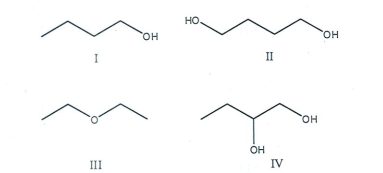
Among the compounds I-IV, the compound having the lowest boiling point is
| A. |
|
| B. |
|
| C. |
|
| D. |
|
The steam volatile compounds among the following are :
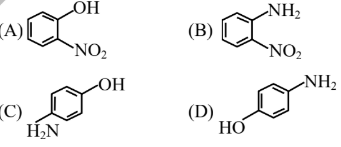
Choose the correct answer from the options given below :
| A. |
|
| B. |
|
| C. |
|
| D. |
|
How many hydrogen-bonded water molecules are associated with CuSO4.5H2O?
| A. |
|
| B. |
|
| C. |
|
| D. |
|
In which of the following substances will hydrogen bond be strongest?
| A. |
|
| B. |
|
| C. |
|
| D. |
|
Assertion (A): Ortho and para-nitrophenols can be separated by steam distillation.
Reason (R): Ortho isomer associates through intermolecular hydrogen bonding while Para isomer associates through intramolecular hydrogen bonding.
| A. |
|
| B. |
|
| C. |
|
| D. |
|
Low volatile nature of $\mathrm{H}_2 \mathrm{SO}_4$ is due to
| A. |
|
| B. |
|
| C. |
|
| D. |
|
Number of molecules from the following which can exhibit hydrogen bonding is $\qquad$ . (nearest integer)

| A. |
|
| B. |
|
| C. |
|
| D. |
|
Ortho–Nitrophenol is less soluble in water than p– and m– Nitrophenols because :
| A. |
|
| B. |
|
| C. |
|
| D. |
|
The increasing order of the boiling points for the following compounds is :

| A. |
|
| B. |
|
| C. |
|
| D. |
|
The number of hydrogen bonded water molecule(s) associated with stoichiometry $\mathrm{CuSO}_4 \cdot 5 \mathrm{H}_2 \mathrm{O}$ is___________.
| A. |
|
| B. |
|
| C. |
|
| D. |
|
Among the given molecules/ions, what is the number of species that can undergo hydrogen bonding?
$\mathrm{NH}_3, \mathrm{CH}_4, \mathrm{H}_2 \mathrm{O}, \mathrm{HI}, \mathrm{HF}, \mathrm{HCOOH}, \mathrm{B}(\mathrm{OH})_3, \mathrm{CH}_3 \mathrm{COOH}, \mathrm{HCO}_2^{-}$ion
| A. |
|
| B. |
|
| C. |
|
| D. |
|
The molecule which does not exhibit strong hydrogen bonding is:
| A. |
|
| B. |
|
| C. |
|
| D. |
|
Assertion A : Enol form of acetone $\left[\mathrm{CH}_3 \mathrm{COCH}_3\right]$ exists in $<0.1 \%$ quantity. However, the enol form of acetyl acetone $\left.\left[\mathrm{CH}_3 \mathrm{COCH}_2 \mathrm{OCCH}\right]_3\right]$ exists in approximately $15 \%$ quantity.
Reason R : Enol form of acetyl acetone is stabilized by intramolecular hydrogen bonding, which is not possible in enol form of acetone.
Choose the correct statement :
| A. |
|
| B. |
|
| C. |
|
| D. |
|
Consider the following reactions
$\begin{aligned} & \mathrm{NiS}+\mathrm{HNO}_3+\mathrm{HCl} \rightarrow \mathrm{A}+\mathrm{NO}+\mathrm{S}+\mathrm{H}_2 \mathrm{O} \\ & \mathrm{A}+\mathrm{NH}_4 \mathrm{OH}+\mathrm{H}_3 \mathrm{C}-\mathrm{C}=\mathrm{N}-\mathrm{OH} \longrightarrow \mathrm{B}+\mathrm{NH}_4 \mathrm{Cl}+\mathrm{H}_2 \mathrm{O} \\ & \end{aligned}$
The number of protons that do not involve in hydrogen bonding in the product $\mathrm{B}$ is $\qquad$
| A. |
|
| B. |
|
| C. |
|
| D. |
|

Nitrogen, oxygen and fluorine are the higly electronegative elements. When they are attached to a hydrogen atom to form covalent bond, the electrons of the covalent bond are shifted towards the more electronegative atom. This partially positively charged hydrogen
atom forms a bond with the other more electronegative atom. This bond is known as hydrogen bond and is weaker than the covalent bond.
