
-
Engineering and Architecture
Exams
Colleges
Predictors
Resources
-
Computer Application and IT
Quick Links
Colleges
-
Pharmacy
Colleges
Resources
-
Hospitality and Tourism
Colleges
Resources
Diploma Colleges
-
Competition
Other Exams
Resources
-
School
Exams
Top Schools
Products & Resources
-
Study Abroad
Top Countries
Resources
-
Arts, Commerce & Sciences
Colleges
Upcoming Events
Resources
-
Management and Business Administration
Exams
Colleges & Courses
Predictors
-
Learn
Law Preparation
MBA Preparation
Engineering Preparation
Medical Preparation
-
Online Courses and Certifications
Top Streams
Specializations
- Digital Marketing Certification Courses
- Cyber Security Certification Courses
- Artificial Intelligence Certification Courses
- Business Analytics Certification Courses
- Data Science Certification Courses
- Cloud Computing Certification Courses
- Machine Learning Certification Courses
- View All Certification Courses
Resources
-
Medicine and Allied Sciences
Colleges
Predictors
Resources
-
Law
Resources
Colleges
-
Animation and Design
Exams
Predictors & Articles
Colleges
Resources
-
Media, Mass Communication and Journalism
Colleges
Resources
-
Finance & Accounts
Top Courses & Careers
Colleges
Shapes of Molecules - (Concept)
The ideal shapes of molecules, which are predicted on the basis of electron pairs and lone pairs of electrons are mentioned in the table below:

Predicting the geometry of molecules
The following procedure uses VSEPR theory to determine the geometry of the molecules:
-
Write the Lewis structure of the molecule or polyatomic ion.
-
Count the number of regions of electron density (lone pairs and bonds) around the central atom. A single, double, or triple bond counts as one region of electron density.
-
Identify the electron-pair geometry based on the number of regions of electron density: linear, trigonal planar, tetrahedral, trigonal bipyramidal, or octahedral
-
Use the number of lone pairs to determine the molecular structure. If more than one arrangement of lone pairs and chemical bonds is possible, choose the one that will minimize repulsions, remembering that lone pairs occupy more space than multiple bonds, which occupy more space than single bonds. In trigonal bipyramidal arrangements, repulsion is minimized when every lone pair is in an equatorial position. In an octahedral arrangement with two lone pairs, repulsion is minimized when the lone pairs are on opposite sides of the central atom.
For example, BCl3 has three electron pairs and no lone pairs of electrons. Thus these three electron pairs will arrange themselves in a trigonal planar geometry as shown below. The bond angle between each B-Cl bond is 120oC.

| Exam | Chapter |
| JEE MAIN | Chemical Bonding and Molecular Structure |
In which of the following molecules/ions are all the bonds not equal?
| A. |
|
| B. |
|
| C. |
|
| D. |
|
The maximum number of $90^{\circ}$ angles between bond- pair, bond pair of electrons is observed in
| A. |
|
| B. |
|
| C. |
|
| D. |
|
In which of the following pairs the two species are not isostructural ?
| A. |
|
| B. |
|
| C. |
|
| D. |
|
The pair of species having identical shapes for molecules of both species is
| A. |
|
| B. |
|
| C. |
|
| D. |
|
Which of the following statements is correct for $\mathrm{ClF}_3$ ?
| A. |
|
| B. |
|
| C. |
|
| D. |
|
The shape of $\mathrm{ClF}_3$ is
| A. |
|
| B. |
|
| C. |
|
| D. |
|
A central atom in a molecule has two lone pairs of electrons and forms three single bonds. The shape of this molecule is :
| A. |
|
| B. |
|
| C. |
|
| D. |
|
Amongst the following, the linear species is :
| A. |
|
| B. |
|
| C. |
|
| D. |
|
The electronic geometry of the ion formed by the combination of $\mathrm{H}^{+}$and $\mathrm{H}_2 \mathrm{O}$
| A. |
|
| B. |
|
| C. |
|
| D. |
|
Complexes $\left(M L_5\right)$ of metals $N i$ and $F e$ have ideal square pyramidal and trigonal bipyramidal geometries, respectively. The sum of the $90^{\circ}, 120^{\circ}$ and $180^{\circ} L-M-L$ angles in the two complexes is _________.
| A. |
|
| B. |
|
| C. |
|
| D. |
|
The shape/structure of $\left[\mathrm{XeF}_5\right]^{-}$and $\mathrm{XeO}_3 F_2$ respectively are:
| A. |
|
| B. |
|
| C. |
|
| D. |
|
Match List I with List II
| LIST I (molecules / ions) | LIST II (No.of lone pairs of |
||
| A. | I. | Three | |
| B. | II. | One | |
| C. | III. | Two | |
| D. | IV. | Zero |
Choose the correct answer from the options given below:
| A. |
|
| B. |
|
| C. |
|
| D. |
|
Match List I with List II

Choose the correct answer from the options given below :
| A. |
|
| B. |
|
| C. |
|
| D. |
|
Amongst the following, the number of species having the linear shape is
| A. |
|
| B. |
|
| C. |
|
| D. |
|
The number of species from the following which have square pyramidal structure is______
| A. |
|
| B. |
|
| C. |
|
| D. |
|
The number of species from the following carrying a single lone pair on central atom Xenon is_______
$\mathrm{XeF}_5^{+}, \mathrm{XeO}_3, \mathrm{XeO}_2 \mathrm{~F}_2, \mathrm{XeF}_5^{-}, \mathrm{XeO}_3 \mathrm{~F}_2, \mathrm{XeOF}_4, \mathrm{XeF}_4$
| A. |
|
| B. |
|
| C. |
|
| D. |
|
The number of bent-shaped molecule/s from the following is__________
| A. |
|
| B. |
|
| C. |
|
| D. |
|
The number of molecules from the following which contain only two lone pair of electrons is________
$\mathrm{H}_2 \mathrm{O}, \mathrm{N}_2, \mathrm{CO}, \mathrm{XeF}_4, \mathrm{NH}_3, \mathrm{NO}, \mathrm{CO}_2, \mathrm{~F}_2$
| A. |
|
| B. |
|
| C. |
|
| D. |
|
Match list with list
|
List $I$ Species |
List $I I$ Geometry/ Shape |
| A. $\mathrm{H}_3 \mathrm{O}^{+}$ |
$I$. Tetrahedral |
| $B$ Acetylide anion |
$I I$. Linear |
| C. $\mathrm{NH}_4^{+}$ |
$I I I$ Pyramidal |
| D. $\mathrm{ClO}_2^{-}$ |
$I V$ Bent |
Choose correct answer from the options given below:
| A. |
|
| B. |
|
| C. |
|
| D. |
|
The maximum number of lone pairs of electrons on the central atom from the following species is $\mathrm{ClO}_3^{-}, \mathrm{XeF}_4, \mathrm{SF}_4$ and $\mathrm{I}_3^{-}$
| A. |
|
| B. |
|
| C. |
|
| D. |
|
Consider the following statements:
(A) NF3 molecule has a trigonal planar structure.
(B) Bond length of N2 is shorter than O2
(C) Isoelectronic molecules or ions have an identical bond order
(D) Dipole moment of HS is higher than that of water molecule.
Choose the correct answer from the options given below:
| A. |
|
| B. |
|
| C. |
|
| D. |
|
Out of the given compounds, select the ones having planar as well as non planer bonds.
(I) $\mathrm{NH}_4 \mathrm{Cl}$
(II) HCN
(III) $\mathrm{H}_2 \mathrm{O}_2$
(IV) $\mathrm{CH}_4$
(V) $\mathrm{H}_2 \mathrm{O}$
| A. |
|
| B. |
|
| C. |
|
| D. |
|
Out of the given species, the number of species having V shaped and linear structure resp are :
$\mathrm{S}_3{ }^{2-}, \mathrm{I}_3{ }^{-}, \mathrm{N}_3{ }^{-}, \mathrm{NH}_4^{+}, \mathrm{BeCl}_2$
| A. |
|
| B. |
|
| C. |
|
| D. |
|
Out of the given options, mark the one which is correctly representing geometrical shapes of$\mathrm{XeF}_2, \mathrm{XeF}_5, \mathrm{XeF}_6$ and $\mathrm{XeF}_8^{2-}$ respectively.
| A. |
|
| B. |
|
| C. |
|
| D. |
|
Find the total number of planar species ${\mathrm{CH}^{+}_3}, \mathrm{\dot{C}H}_3, \mathrm{BF}_3$ $\mathrm{XeF}_4, \mathrm{H}_2 \mathrm{O}_2, \mathrm{SO}_3, \mathrm{C}_2 \mathrm{F}_4$, $\mathrm{XeO}_4$
| A. |
|
| B. |
|
| C. |
|
| D. |
|
Number of species which have $s p^3$ hybridisation of at least one atom?
$\mathrm{NaBH}_4, \quad \mathrm{~N}\left(\mathrm{CH}_3\right)_3, \quad \mathrm{P}\left(\mathrm{CH}_3\right)_3 \mathrm{F}_2, \mathrm{H}_3 \mathrm{PO}_4, \mathrm{C}_3 \mathrm{O}_2$
| A. |
|
| B. |
|
| C. |
|
| D. |
|
Number of compounds with one lone pair of electrons on central atom amongst following is__________ $\mathrm{O}_3, \mathrm{H}_2 \mathrm{O}, \mathrm{SF}_4, \mathrm{ClF}_3, \mathrm{NH}_3, \mathrm{BrF}_5, \mathrm{XeF}_4$
| A. |
|
| B. |
|
| C. |
|
| D. |
|
Aluminium chloride in acidified aqueous solution forms an ion having geometry :
| A. |
|
| B. |
|
| C. |
|
| D. |
|
Match List – I with List – II.
| List-I Molecule | List - II Shape |
| (A) $\mathrm{BrF}_5$ | (I) T-Shape |
| (B) $\mathrm{H_2O}$ | (II) See Saw |
| (C) $\mathrm{CIF}_3$ | (III) Bent |
| (D) $\mathrm{SF}_4$ | (IV) Square pyramidal |
Choose the correct answer from the options given below :
| A. |
|
| B. |
|
| C. |
|
| D. |
|
The molecule / ion with square pyramidal shape is
| A. |
|
| B. |
|
| C. |
|
| D. |
|
The number of molecules/ion/s having trigonal bipyramidal shape is_______ $\mathrm{PF}_5, \mathrm{BrF}_5, \mathrm{PCl}_5,\left[\mathrm{PtCl}_4\right]^{2-}, \mathrm{BF}_3, \mathrm{Fe}(\mathrm{CO})_5$
| A. |
|
| B. |
|
| C. |
|
| D. |
|
Shapes of certain interhalogen compounds are stated below. Which one of them is
not correctly stated?
| A. |
|
| B. |
|
| C. |
|
| D. |
|
Amongst the following compounds, the optically active alkane having lowest molecular mass is
| A. |
|
| B. |
|
| C. |
|
| D. |
|
Consider the species $\mathrm{CH}_4, \mathrm{NH}_4^{+}$and $\mathrm{BH}_4^{-}$. Choose the correct option with respect to the three species.
| A. |
|
| B. |
|
| C. |
|
| D. |
|
For $\mathrm{OF}_2$ molecule consider the following :
A. Number of lone pairs on oxygen is 2 .
B. FOF angle is less than $104.5^0$.
C. Oxidation state of O is -2 .
D. Molecule is bent ${ }^{\prime} \mathrm{V}^{\prime}$ shaped.
E. Molecular geometry is linear. correct options are:
| A. |
|
| B. |
|
| C. |
|
| D. |
|
Which of the following species have the same shape?(i) $\mathrm{CO}_2$
(ii) $\mathrm{CCl}_4$
(iii) $\mathrm{O}_3$
(iv) $\mathrm{NO}_2{ }^{-}$
| A. |
|
| B. |
|
| C. |
|
| D. |
|
Identify the pair in which the geometry of the species is T-shape and square pyramidal, respectively :
| A. |
|
| B. |
|
| C. |
|
| D. |
|
Bond angle in PH4+ is more than that of PH3. This is because
| A. |
|
| B. |
|
| C. |
|
| D. |
|
Which has trigonal bipyramidal shape?
| A. |
|
| B. |
|
| C. |
|
| D. |
|
Among CH4 , CO2 , H2O and SO2 , the bond angle is the highest in
| A. |
|
| B. |
|
| C. |
|
| D. |
|
Which of the following pairs have identical shapes?
| A. |
|
| B. |
|
| C. |
|
| D. |
|
The shape of the molecule CIF3 is
| A. |
|
| B. |
|
| C. |
|
| D. |
|
The shape of the molecule ClF3 is
| A. |
|
| B. |
|
| C. |
|
| D. |
|
The shape of $\mathrm{SCl}_4$ is best described as a
| A. |
|
| B. |
|
| C. |
|
| D. |
|
The number of molecules/ions that show linear geometry among the following is _____
$\mathrm{SO}_2, \mathrm{BeCl}_2, \mathrm{CO}_2, \mathrm{~N}_3^{-}, \mathrm{NO}_2, \mathrm{~F}_2 \mathrm{O}, \mathrm{XeF}_2, \mathrm{NO}_2^{+}, \mathrm{I}_3^{-}, \mathrm{O}_3$
| A. |
|
| B. |
|
| C. |
|
| D. |
|
The molecules having square pyramidal geometry are
(1) $\mathrm{BrF}_5 \& \mathrm{XeOF}_4$
(2) $\mathrm{SbF}_5 \& \mathrm{XeOF}_4$
(3) $\mathrm{SbF}_5 \& \mathrm{PCl}_5$
(4) $\mathrm{BrF}_5 \& \mathrm{PCl}_5$
| A. |
|
| B. |
|
| C. |
|
| D. |
|
Identify the incorrect statement for $
\mathrm{PCl}_5
$ from the following.
| A. |
|
| B. |
|
| C. |
|
| D. |
|
The linear shape of $C O_2$ is due to $\qquad$
(i) $s p^3$ hybridisation of carbon
(ii) sp hybridisation of carbon
(iii) $p \pi-p \pi$ bonding between carbon and oxygen
(iv) $s p^2$ hybridisation of carbon
| A. |
|
| B. |
|
| C. |
|
| D. |
|
Which of the following attain the linear structure:
| A. |
|
| B. |
|
| C. |
|
| D. |
|
Which of the following species has tetrahedral geometry?
| A. |
|
| B. |
|
| C. |
|
| D. |
|
In the structure of $\mathrm{SF}_4$, the lone pair of electrons on S is in.
| A. |
|
| B. |
|
| C. |
|
| D. |
|
Mark the option in which each atom contains same and different number of lone pair of electron on it respectively.
| A. |
|
| B. |
|
| C. |
|
| D. |
|
Match List - I with List - II.
| List - I | List - II. | ||
| (A) | $\mathrm{ICl}$ | (I) | T -Shape |
| (B) | $\mathrm{ICI}_3$ | (II) | Square pyramidal |
| (C) | $\mathrm{CIF}_5$ | (III) | Pentagonal bipyramidal |
| (D) | $\mathrm{IF}_7$ | (IV) | Linear |
Choose the correct answer from the options given below:
| A. |
|
| B. |
|
| C. |
|
| D. |
|
Match List - I with List - II :
|
List-I (Species) |
List-II (No.of lone pairs of electrons on the central atom) |
|
(a)$\mathrm{XeF}_2$ |
(i) $0$ |
|
(b) $\mathrm{XeO}_2 \mathrm{~F}_2$ |
(ii) $1$ |
|
(c)$\mathrm{XeO}_3 \mathrm{~F}_2$ |
(iii) $2$ |
|
(d)$\mathrm{XeF}_4$ |
(iv) $3$ |
Choose the most appropriate answer from the options given below :
| A. |
|
| B. |
|
| C. |
|
| D. |
|
Match List I with List II :
|
List I (Molecule/Speceis) |
List II (Property/Shape) |
||
| A. | $\mathrm{SO}_2 \mathrm{Cl}_2$ | I. | Paramagnetic |
| B. | NO | II. | Diamagnetic |
| C. | $\mathrm{NO}_2^{-}$ | III. | Tetrahedral |
| D. | $\mathrm{I}_3^{-}$ | IV. | Linear |
Choose the correct answer from the options given below :
| A. |
|
| B. |
|
| C. |
|
| D. |
|
Match List I with List II :
|
LIST I (Compound/Species) |
LIST II (Shape/Geometry) |
||
| A. | $\mathrm{SF}_4$ | I. | Tetrahedral |
| B. | $\mathrm{BrF}_3$ | II. | Pyramidal |
| C. | $\mathrm{BrO}_3^{-}$ | III. | Seesaw |
| D. | $\mathrm{NH}_4^{+}$ | IV. | Bent T- Shape |
Choose the correct answer from the options given below:
| A. |
|
| B. |
|
| C. |
|
| D. |
|
Match List I and with List II
| List-I (Molecule) | List-II(Shape) |
| A $\mathrm{NH}_3$ | I. Square pyramid |
| B $\mathrm{BrF}_5$ | II.Tetrahedral |
| C $\mathrm{PCl}_5$ | III Trigonal pyramidal |
| D $\mathrm{CH}_4$ | IV Trigonal bipyramidal |
Choose the correct answer from the option below :
| A. |
|
| B. |
|
| C. |
|
| D. |
|
Match List I with List II :
|
LIST I (Hybridization) |
LIST II (Orientation in Space) |
||
| A. | $\mathrm{sp}^3$ | I. | Trigonal bipyramidal |
| B. | $\mathrm{dsp}^2$ | II. | Octahedral |
| C. | $\mathrm{sp}^3 \mathrm{~d}$ | III. | Tetrahedral |
| D. | $\mathrm{sp}^3 \mathrm{~d}^2$ | IV. | Square planar |
Choose the correct answer from the options given below:
| A. |
|
| B. |
|
| C. |
|
| D. |
|
Shape and hybridisation of NH3 is
| A. |
|
| B. |
|
| C. |
|
| D. |
|
Shape of $X e F_2$ is
| A. |
|
| B. |
|
| C. |
|
| D. |
|
The bond angle of $\mathrm{SO}_2$ is -
| A. |
|
| B. |
|
| C. |
|
| D. |
|
The correct statement about $\mathrm{ICl}_5$ and $\mathrm{ICl}_4^{-}$is:
| A. |
|
| B. |
|
| C. |
|
| D. |
|
The hybridisations of the atomic orbitals of nitrogen in $\mathrm{NO}_2^{-}, \mathrm{NO}_2^{+}$and $\mathrm{NH}_4^{+}$ respectively are
| A. |
|
| B. |
|
| C. |
|
| D. |
|
The molecular geometry of $S F_6$ is octahedral . What is the geometry $S F_4$ of including lone pairs of electrons (if any)?
| A. |
|
| B. |
|
| C. |
|
| D. |
|
The number of species from the following that have pyramidal geometry around the central atom is________
$\mathrm{S}_2 \mathrm{O}_3^{2-}, \mathrm{SO}_4^{2-}, \mathrm{SO}_3^{2-}, \mathrm{S}_2 \mathrm{O}_7^{2-}$
| A. |
|
| B. |
|
| C. |
|
| D. |
|
The shape of $\mathrm{IF}_3$ is
| A. |
|
| B. |
|
| C. |
|
| D. |
|
The shape of $X e O F_2$ is
| A. |
|
| B. |
|
| C. |
|
| D. |
|
Among the given molecules/ions, the total number of species having tetrahedral geometry (arrangement of lone pairs and bond pairs around the central atom) is:
$\mathrm{MnO}_4^{2-}, \mathrm{CH}_3^{-}, \mathrm{AlCl}_3, \mathrm{SiH}_4, \mathrm{PO}_4^{3-}, \mathrm{NH}_4^{+}, \mathrm{AsH}_3, \mathrm{H}_2 \mathrm{~S}, \mathrm{ClO}_4^{-}, \mathrm{SF}_4$
| A. |
|
| B. |
|
| C. |
|
| D. |
|
The hybridization of the central atom and the shape of $\left[\mathrm{IO}_2 \mathrm{~F}_5\right]^{2-}$ion , respectively, are
| A. |
|
| B. |
|
| C. |
|
| D. |
|
The shape of $X e O F_4$ is
| A. |
|
| B. |
|
| C. |
|
| D. |
|
Given below are two statements :
Statement I: $\mathrm{SO}_2$ and $\mathrm{H}_2 \mathrm{O}$ both possess V-shaped structure.
Statement II : The bond angle of $\mathrm{SO}_2$ less than that of $\mathrm{H}_2 \mathrm{O}$
In the light of the above statements, choose the most appropriate answer from the options given below :
| A. |
|
| B. |
|
| C. |
|
| D. |
|
Given below are two statements:
Statement (I) : for $C \ell \mathrm{F}_3$, all three possible structures may be drawn as follows.
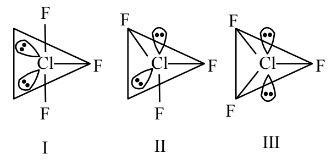
Statement (II) : Structure III is most stable, as the orbitals having the lone pairs are axial, where the $\ell \mathrm{p}-\mathrm{bp}$ repulsion is minimum.
In the light of the above statements, choose the most appropriate answer from the options given below:
| A. |
|
| B. |
|
| C. |
|
| D. |
|
Match the LIST - I with LIST - II.
| LIST - I Molecule/ion |
LIST - II |
||
| A. | $\mathrm{ICl}_2^{-}$ | I. | 4 : 2 |
| B. | $\mathrm{H}_2 \mathrm{O}$ | II. | 4 : 1 |
| C. | $\mathrm{SO}_2$ | III. | 2 : 3 |
| D. | $\mathrm{XeF}_4$ | IV. | 2 : 2 |
Choose the correct answer from the options given below :
| A. |
|
| B. |
|
| C. |
|
| D. |
|

Table 4.6 Geometry of Molecules in which the Central Atom has No Lone Pair of Electrons.
