-
Engineering and Architecture
Exams
Colleges
Predictors
Resources
-
Computer Application and IT
Quick Links
Colleges
-
Pharmacy
Colleges
Resources
-
Hospitality and Tourism
Colleges
Resources
Diploma Colleges
-
Competition
Other Exams
Resources
-
School
Exams
Top Schools
Products & Resources
-
Study Abroad
Top Countries
Resources
-
Arts, Commerce & Sciences
Colleges
Upcoming Events
Resources
-
Management and Business Administration
Exams
Colleges & Courses
Predictors
-
Learn
Law Preparation
MBA Preparation
Engineering Preparation
Medical Preparation
-
Online Courses and Certifications
Top Streams
Specializations
- Digital Marketing Certification Courses
- Cyber Security Certification Courses
- Artificial Intelligence Certification Courses
- Business Analytics Certification Courses
- Data Science Certification Courses
- Cloud Computing Certification Courses
- Machine Learning Certification Courses
- View All Certification Courses
Resources
-
Medicine and Allied Sciences
Colleges
Predictors
Resources
-
Law
Resources
Colleges
-
Animation and Design
Exams
Predictors & Articles
Colleges
Resources
-
Media, Mass Communication and Journalism
Colleges
Resources
-
Finance & Accounts
Top Courses & Careers
Colleges
Sign of Quadratic Expression - (Concept)
Let y = ax2 + bx + c = 0 be the quadratic equation, such that a is non-zero and a,b,c are real numbers, then
1. If D < 0 then we know quadratic equation has no real roots. So for all real value of x, the graph never intersects or touches x axis, so it is always above or below x-axis. This means that the value of y will always be positive or negative,
If a > 0 and D < 0:
The graph open upwards hence all values of y will be positive as graph can’t start from below x-axis (because if it happens then it will cut x - axis as it is opening upwards, but it has no solution) so it starts from above x-axis and hence y is +ve for all values of x.
In similar way if a < 0 and D < 0 then y is -ve for all values of x- axis.


2. If D = 0, then the quadratic equation y will have one real solution, so y = 0 for one particular value of x and for all rest value of x, y will be +ve or -ve depending upon value of a. If a > 0, then the graph will open upwards so y will be +ve otherwise if a < 0, then y will be -ve.


3. If D > 0, then the quadratic equation y will have two real solution 𝛂 and 𝜷, so if a > 0 then y = 0 on 𝛂 and 𝜷, and between the solution (𝛂 < x < 𝜷),, y will be -ve and left (for x < 𝛂 ) and right (x > 𝜷) part of the solution will give +ve value of y
If a < 0, exactly the opposite will happen, y = 0 on 𝛂 and 𝜷, and between the solution (𝛂 < x < 𝜷), y will be +ve and left (for x < 𝛂 ) and right (x > 𝜷) part of the solution will give -ve value of y.


Note
If f(x) = ax2 + bx + c, then linear expressions can be identified in terms of functions at some constant value
Eg,
- a + b + c = a.12 + b.1 + c = f(1)
- 9a + 3b + c = a.32 + b.3 + c = f(3)
- 4a - 2b + c = a.(-2)2 + b.(-2) + c = f(-2)
- c = a.02 + b.0 + c = f(0)
- 8a - 4b + 2c = 2(4a - 2b + c) = 2.f(-2)
| Exam | Chapter |
| JEE MAIN | Complex numbers and quadratic equations |
If $\\\mathrm{f(x) = x^2 + 2(a-1)x + (a+5)}$ , then the values of ‘a’ for which f(x) = 0 have two real and equal roots is
| A. |
|
| B. |
|
| C. |
|
| D. |
|
| . |
|
| . |
|
If $x^2+2(a-1) x+(a+5)>0$ for all $x$ in real numbers then a lies between
| A. |
|
| B. |
|
| C. |
|
| D. |
|
If
then for $x \in (a',b)$ , so the value of b is:
| A. |
|
| B. |
|
| C. |
|
| D. |
|
The values of for which
is a > n, then the value of n is
| A. |
|
| B. |
|
| C. |
|
| D. |
|
Values of for which
are:
| A. |
|
| B. |
|
| C. |
|
| D. |
|
Number of integer values of for which
is:
| A. |
|
| B. |
|
| C. |
|
| D. |
|
The number of integral values of m for which the quadratic expression, is always positive, is :
| A. |
|
| B. |
|
| C. |
|
| D. |
|
If are the length of the sides of a triangle, then r cannot be equal to:
| A. |
|
| B. |
|
| C. |
|
| D. |
|
Let p and q are two positive numbers such that and
. Then p and q are root of equation:
| A. |
|
| B. |
|
| C. |
|
| D. |
|
The number of integers which can take so that
is:
| A. |
|
| B. |
|
| C. |
|
| D. |
|
Let , then the value of
for which
is
| A. |
|
| B. |
|
| C. |
|
| D. |
|
If $a x^2+b x+c \geq 0$ for all $c \in R$, where $a=4, b=7$ then c belongs to
| A. |
|
| B. |
|
| C. |
|
| D. |
|
If $a x^2+b x+c \leq \delta$ for $x \epsilon R$; where 'a' is a negative real number and discriminant of the equation is non- positive real number. Then $\delta$ should be
| A. |
|
| B. |
|
| C. |
|
| D. |
|
If $c(4 a-2 b+c)<0$, then the roots of $a x^2+b x+c=0$ are $(a, b, c \in R)$
| A. |
|
| B. |
|
| C. |
|
| D. |
|
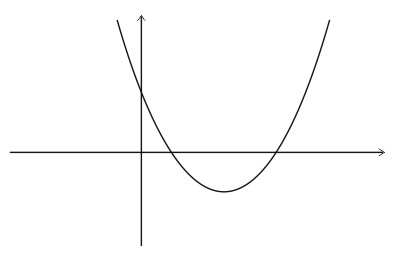
The signs of $a \: and\: c$ if the graph of $y=ax^{2}+bx+c$ is as follows
| A. |
|
| B. |
|
| C. |
|
| D. |
|
Find K such that both roots of the quadratic equation $K x^2+x-3=0$ are positive.
| A. |
|
| B. |
|
| C. |
|
| D. |
|