-
Engineering and Architecture
Exams
Colleges
Predictors
Resources
-
Computer Application and IT
Quick Links
Colleges
-
Pharmacy
Colleges
Resources
-
Hospitality and Tourism
Colleges
Resources
Diploma Colleges
-
Competition
Other Exams
Resources
-
School
Exams
Top Schools
Products & Resources
-
Study Abroad
Top Countries
Resources
-
Arts, Commerce & Sciences
Colleges
Upcoming Events
Resources
-
Management and Business Administration
Exams
Colleges & Courses
Predictors
-
Learn
Law Preparation
MBA Preparation
Engineering Preparation
Medical Preparation
-
Online Courses and Certifications
Top Streams
Specializations
- Digital Marketing Certification Courses
- Cyber Security Certification Courses
- Artificial Intelligence Certification Courses
- Business Analytics Certification Courses
- Data Science Certification Courses
- Cloud Computing Certification Courses
- Machine Learning Certification Courses
- View All Certification Courses
Resources
-
Medicine and Allied Sciences
Colleges
Predictors
Resources
-
Law
Resources
Colleges
-
Animation and Design
Exams
Predictors & Articles
Colleges
Resources
-
Media, Mass Communication and Journalism
Colleges
Resources
-
Finance & Accounts
Top Courses & Careers
Colleges
vector representation of complex number, rotation of complex number - (Concept)
Vector Notation
Let us take any complex number $z=x+i y$ so point P(x,y) represents it on the Argand Plane. Then OP can be represented as vector $\overrightarrow{O P}=x \hat{i}+y \hat{j}$, where $\hat{i}$ represents the x-axis while $\hat{j}$ represents the y-axis and O is the origin.
$|\overline{O P}|=\sqrt{x^2+y^2}=|z|$

Therefore complex number z can be represented as $\overrightarrow{O P}$
Similarly, a vector starting from point A (z1) and ending at B(z2) is represented by AB vector which equals (z2 - z1)
The length of AB is given by the modulus of this vector $\left|z_2-z_1\right|$
Rotation Theorem (Coni Method)

Let three points A, B and C in the Argand Plane whose affixes are z1, z2 and z3 respectively.
If we rotate AB to AC, then
$\frac{z_3-z_1}{z_2-z_1}=\frac{\left|z_3-z_1\right|}{\left|z_2-z_1\right|} e^{i \theta}$
Note: The final vector should be in the numerator and the starting vector in the denominator. is positive if rotation is anti-clockwise and negative if it is clockwise.
| Exam | Chapter |
| JEE MAIN | Complex numbers and quadratic equations |
The line joining the origin and the point represented by $z=1+i$ is rotated through an angle $\ \frac {3 \pi}{2}$ in an anticlockwise direction about the origin and stretched by additional $\sqrt{2}$ units. In the new position, the point is represented by the complex number.
| A. |
|
| B. |
|
| C. |
|
| D. |
|
Let $z_1$ and $z_2$ be two roots of the equation $z^2+a z+b=0, z_{\text {being complex }}$ further, assume that the origin, $z_1$ and $z_2$ form an equilateral triangle then
| A. |
|
| B. |
|
| C. |
|
| D. |
|
Let be the roots of the equation
and
form an equilateral triangle with origin. Then, the value of |a| is ____________.
| A. |
|
| B. |
|
| C. |
|
| D. |
|
The area of the triangle with vertices $A(z), B(i z)$ and $C(z+i z) {\text {is : }}$
| A. |
|
| B. |
|
| C. |
|
| D. |
|
The line joining the origin and the point represented by z=1+i is rotated through an angle in an anticlockwise direction about the origin and stretched by additional
units. The new position of the point is:
| A. |
|
| B. |
|
| C. |
|
| D. |
|
$A\left ( z_{1} \right ),B\left ( z_{2} \right ),O\left (O \right )$ are vertices of right-angled isosceles triangle, right-angled at O then (z1 - i.z2) equals
| A. |
|
| B. |
|
| C. |
|
| D. |
|
Let be the origin and
be the point
. If
is the point
, such that
is a right-angled isosceles triangle with
as hypotenuse, then which of the following is NOT true?
| A. |
|
| B. |
|
| C. |
|
| D. |
|
The point $P(a, b)$ undergoes the following three transformations successively:
(a) reflection about the line $y=x$.
(b) translation through 2 units along the positive direction of $\mathrm{X}-$ axis.
(c) rotation through angle $\frac{\pi}{4}$ about the origin in the anti-clockwise direction.
If the co-ordinates of the final position of the point $P$ are $\left(-\frac{1}{\sqrt{2}}, \frac{7}{\sqrt{2}}\right)$, then the value of $2 a+b$ is equal to
| A. |
|
| B. |
|
| C. |
|
| D. |
|
If complex numbers $z_1, z_2$ and $z_3$ represent the vertices $\mathrm{A}, \mathrm{B}$ and C respectively of an isosceles triangle ABC of which $\angle c$ is right angles, then correct statement is
| A. |
|
| B. |
|
| C. |
|
| D. |
|
' $A$ ' denotes the complex number $z=r(\cos \theta+i \sin \theta)$ on the argand plane, and $B$ denotes the complex number $2|z|\left(\cos \left(\theta+\frac{\pi}{3}\right)+i \sin \left(\theta+\frac{\pi}{3}\right)\right)$. If ' $O$ ' is the origin, then $\Delta A O B$ is
| A. |
|
| B. |
|
| C. |
|
| D. |
|
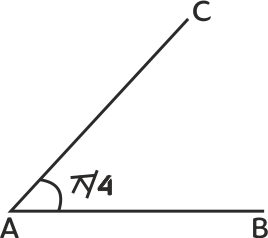
If $A B=2, A C=3, A \equiv 2-3 i, B \equiv-4+5 i$, then find the co-ordinates of C in the following figure.
| A. |
|
| B. |
|
| C. |
|
| D. |
|