-
Engineering and Architecture
Exams
Colleges
Predictors
Resources
-
Computer Application and IT
Quick Links
Colleges
-
Pharmacy
Colleges
Resources
-
Hospitality and Tourism
Colleges
Resources
Diploma Colleges
-
Competition
Other Exams
Resources
-
School
Exams
Top Schools
Products & Resources
-
Study Abroad
Top Countries
Resources
-
Arts, Commerce & Sciences
Colleges
Upcoming Events
Resources
-
Management and Business Administration
Exams
Colleges & Courses
Predictors
-
Learn
Law Preparation
MBA Preparation
Engineering Preparation
Medical Preparation
-
Online Courses and Certifications
Top Streams
Specializations
- Digital Marketing Certification Courses
- Cyber Security Certification Courses
- Artificial Intelligence Certification Courses
- Business Analytics Certification Courses
- Data Science Certification Courses
- Cloud Computing Certification Courses
- Machine Learning Certification Courses
- View All Certification Courses
Resources
-
Medicine and Allied Sciences
Colleges
Predictors
Resources
-
Law
Resources
Colleges
-
Animation and Design
Exams
Predictors & Articles
Colleges
Resources
-
Media, Mass Communication and Journalism
Colleges
Resources
-
Finance & Accounts
Top Courses & Careers
Colleges
Acceleration - (Concept)
-
Definition: Rate of change of velocity with time.
$$
\vec{a}=\frac{\text { change in velocity }}{\text { time taken }}=\frac{\vec{v}_f-\vec{v}_i}{t}
$$- Tips for Acceleration-
1. The body is said to have undergone acceleration if there is a change in velocity i.e., :
- Change in speed
- Change in direction
- Change in both
2. It is a vector quantity
3. Dimension $=L T^{-2}$
4. S.I unit $=m \mathrm{~s}^{-2}$Example: A car starting from rest accelerates uniformly to a speed of $75 \mathrm{~m} / \mathrm{s}$ in 12 seconds. What is the car's acceleration?
Solution: $v_i=0$ (starting from rest)$$
v_f=75 \mathrm{~m} / \mathrm{s}
$$
From the definition of acceleration we know that,$$
\begin{aligned}
a & =\frac{v_f-v_i}{t} \\
& =\frac{75-0}{12}
\end{aligned}
$$
$$
\mathrm{a}=6.25 \mathrm{~m} / \mathrm{s}^2
$$
There are four types of acceleration
- Average acceleration- Total change in velocity per unit time taken is the average acceleration$$
\text { Avg. acceleration }\left(\vec{a}_{a v g}\right)=\frac{\Delta \vec{v}}{\Delta t}
$$- Instantaneous acceleration - Infinitesimal change in velocity per unit time taken is the average acceleration
$$
\text { Inst. acceleration }\left(\vec{a}_{\text {inst }}\right)=\frac{d \vec{v}}{d t}
$$
- Uniform acceleration- Change in velocity per unit time is constant.
- Non-uniform acceleration- Change in velocity per unit time is not constant. If the velocity and acceleration are directed in the opposite direction
- Slowing down or deceleration If the change in velocity is directed towards a negative direction (right to left) then acceleration is positive.
- Speeding up or acceleration If the change in velocity is directed towards a positive direction (left to right) then acceleration is positive.
- Negative Acceleration- Important terms related to acceleration.
| Exam | Chapter |
| JEE MAIN | Kinematics |
How many type of reference frame are there?
| A. |
|
| B. |
|
| C. |
|
| D. |
|
The displacement vs time graph is given below which of the following conclusions is correct?

| A. |
|
| B. |
|
| C. |
|
| D. |
|
Three position Vs time graph is shown in the figure. In which case acceleration is zero

| A. |
|
| B. |
|
| C. |
|
| D. |
|
Four velocity time graphs (Namely I , II , III , IV ) are shown in the figure. In which case is the acceleration uniform and positive

| A. |
|
| B. |
|
| C. |
|
| D. |
|
The position of a particles as a function of time t is given by
where a,b, and c are constants. When the particle attains zero acceleration, then its velocity will be :
| A. |
|
| B. |
|
| C. |
|
| D. |
|
The velocity of a particle is . Its position is
at
; then its displacement after time
is :
| A. |
|
| B. |
|
| C. |
|
| D. |
|
A particle is moving with acceleration a = 5t + 4. Then its velocity (in m/s) after 4 second is ( initial velocity = 0 )
| A. |
|
| B. |
|
| C. |
|
| D. |
|
A particle starts with initial velocity u = 10 m/s and acceleration given by a = t - 4 . Then its velocity (in m/s ) after 4 second will be
| A. |
|
| B. |
|
| C. |
|
| D. |
|
The distance covered by a particle in one dimensional motion varies with time t as
. If the acceleration of the particle depends of
as
, where n is an integer, the value of n is ______
| A. |
|
| B. |
|
| C. |
|
| D. |
|
A particle is moving with its position as function of time is given as S = 4t2 +7t +10 m then its acceleration is:
| A. |
|
| B. |
|
| C. |
|
| D. |
|
A car moving with 72 km/hr comes to rest in 5 second its acceleration is: (in m/s2)
| A. |
|
| B. |
|
| C. |
|
| D. |
|
At time a particle starts travelling from a height
in a plane keeping
coordinate constant. At any instant of time, its position along the
directions are defined as
respectively. At
s acceleration of the particle will be
| A. |
|
| B. |
|
| C. |
|
| D. |
|
The relation between time and distance
for a moving body is given as
, where
are constants. The retardation of the motion is : (When
stands for velocity)
| A. |
|
| B. |
|
| C. |
|
| D. |
|
If the velocity of a body related to displacement is given by
, then the acceleration of the body is __________
| A. |
|
| B. |
|
| C. |
|
| D. |
|
The relation between time and distance
is
where
and
are constants. The acceleration is :
| A. |
|
| B. |
|
| C. |
|
| D. |
|
Acceleration of particles changes when
| A. |
|
| B. |
|
| C. |
|
| D. |
|
Match the following for the acceleration of a moving particle
P) Velocity increasing with time 1) zero
Q ) Velocity decreasing with time 2) positive
R )Velocity constant with time 3) Negative
| A. |
|
| B. |
|
| C. |
|
| D. |
|
A car starts from rest. Its velocity after 5 sec is 10 m/s then the average acceleration of the car is ____ ms-2
| A. |
|
| B. |
|
| C. |
|
| D. |
|
The position vector of a particle changes with time according to the relation. What is the magnitude of the acceleration at
?
| A. |
|
| B. |
|
| C. |
|
| D. |
|
A particle is moving with constant acceleration a Following graph shows $v^2$ versus x (displacement) plot. The acceleration of the particle is___________________$\mathrm{m} / \mathrm{s}^2$

| A. |
|
| B. |
|
| C. |
|
| D. |
|
The ratio of maximum acceleration to maximum velocity in a simple harmonic motion is 10 s−1. At, t=0 the displacement is 5 m. What is the maximum acceleration? The initial phase IS
| A. |
|
| B. |
|
| C. |
|
| D. |
|
A particle P slides along a hemispherical bowl without friction. It passes through point A at $t=0$. At this time, the horizontal component of its velocity is $v$. A pearl Q of the same mass as P is ejected from A at $t=0$ along the horizontal chord AB with a velocity $v$. The friction between the bead and the string is negligible.
| A. |
|
| B. |
|
| C. |
|
| D. |
|
A particle is moving eastwards with a velocity of 5 m/s. In 10 s the velocity changes to 5 m/s northwards. The average acceleration in this time is
| A. |
|
| B. |
|
| C. |
|
| D. |
|
A particle moving in a line with velocity . The average value of Acceleration of the particle between 1s to 2s is $n \mathrm{~m} / \mathrm{s}^2$ find the value of n?
| A. |
|
| B. |
|
| C. |
|
| D. |
|
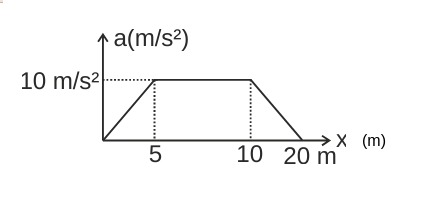
A particle starts from rest $(a t x=0)$ when an acceleration is applied to it. The acceleration of the particle changes with its coordinate as shown in the figure. Find the speed of the particle at $x=20 \mathrm{~m}$.
| A. |
|
| B. |
|
| C. |
|
| D. |
|
The relation between time ' $t$ ' and distance ' $x$ ' is $t=\alpha x^2+\beta x$, where $\alpha$ and $\beta$ are constants. The relation between acceleration (a) and velocity $(v)$ is :
| A. |
|
| B. |
|
| C. |
|
| D. |
|
A particle is moving in one dimension (along $\mathrm{x}$ axis) under the action of a variable force. Its initial position was $16 \mathrm{~m}$ right of origin. The variation of its position $(\mathrm{x})$ with time $(\mathrm{t})$ is given as $\mathrm{x}=-3 \mathrm{t}^3+18 \mathrm{t}^2+16 \mathrm{t}$, where $\mathrm{x}$ is in $\mathrm{m}$ and $\mathrm{t}$ is in $\mathrm{s}$. The velocity of the particle when its acceleration becomes zero is___________$\mathrm{m} / \mathrm{s}$.
| A. |
|
| B. |
|
| C. |
|
| D. |
|
A body of mass $4 \mathrm{~kg}$ experiences two forces $\vec{F}_1=5 \hat{i}+8 \hat{j}+7 \hat{k}$ and $\vec{F}_2=3 \hat{i}-4 \hat{j}-3 \hat{k}$. The acceleration acting on the body is:
| A. |
|
| B. |
|
| C. |
|
| D. |
|
A particle initially at rest starts moving from reference point $\mathrm{x}=0$ along $\mathrm{x}$-axis, with velocity $\mathrm{v}$ that varies as $\mathrm{v}=4 \sqrt{\mathrm{x}} \mathrm{m} / \mathrm{s}$. The acceleration of the particle is $\mathrm{ms}^{-2}$.
| A. |
|
| B. |
|
| C. |
|
| D. |
|
A body starts from rest and travel 120 cm in the 6th second then what is the acceleration of body
| A. |
|
| B. |
|
| C. |
|
| D. |
|
A bus is moving with speed of 20 m/s in a straight road , suddenly bus driver applies brake and the bus stops in 10 s then the acceleration of bus is
| A. |
|
| B. |
|
| C. |
|
| D. |
|
Acceleration of particles changes when
| A. |
|
| B. |
|
| C. |
|
| D. |
|
Match the following for the acceleration of a moving particle
P) Velocity increasing with time 1) zero
Q ) Velocity decreasing with time 2) positive
R )Velocity constant with time 3) Negative
| A. |
|
| B. |
|
| C. |
|
| D. |
|
A particle moves in a straight line so that its displacement $x$ at any time $t$ is given by $x^2=1+t^2$. Its acceleration at any time $\mathrm{t}$ is $\mathrm{x}^{-\mathrm{n}}$ where $\mathrm{n}$=___________.
| A. |
|
| B. |
|
| C. |
|
| D. |
|
A car starts from rest. Its velocity after 5 sec is 10 m/s then the average acceleration of the car is :
| A. |
|
| B. |
|
| C. |
|
| D. |
|
A Point P moves in counter-clockwise direction on a circular path as shown in the figure. The movement of P is such that it sweeps out a length $s=t^3+5$, where $s$ is in metres and $t$ is in seconds. The radius of the path is 20 m, The acceleration (in $\mathrm{m} / \mathrm{s}^2$ ) of $P$ When $t=2 s$ is nearly

| A. |
|
| B. |
|
| C. |
|
| D. |
|
Direction: In the following question, a statement of Assertion (A) is followed by a statement of reason (R). Mark the correct choice as :
Assertion: A body can have acceleration even if its velocity is zero at a given instant in time
Reason: A body is momentarily at rest when it reverses its direction of motion
| A. |
|
| B. |
|
| C. |
|
| D. |
|
For a body moving under constant instantaneous acceleration, its average acceleration will be?
| A. |
|
| B. |
|
| C. |
|
| D. |
|
If the body is moving along the x-axis with an initial velocity equal to 2 m/s is accelerated to a final velocity of -6 m/s in 2 seconds. The average acceleration of the body is?
| A. |
|
| B. |
|
| C. |
|
| D. |
|
Prior to beginning to penetrate a 50 cm-thick mud wall, a 100g bullet travels at a speed of 5 m/s. When a bullet emerges from the other side of a wall with a mean resistance of 4.0 x 10⁻³ N, its speed is approximately (in nearest integer):
| A. |
|
| B. |
|
| C. |
|
| D. |
|
If x denotes displacement in x and x=a cost, then acceleration is :
| A. |
|
| B. |
|
| C. |
|
| D. |
|
The position, velocity and acceleration of a particle moving with constant acceleration can be represented by :
| A. |
|
| B. |
|
| C. |
|
| D. |
|
A particle starts to move along $x$-axis from $x=-18$ with initial velocity $3 \mathrm{~m} / \mathrm{s}$ such that its acceleration as a function of time is given as $a=4-2 t$. Find out the time in seconds when particle crosses origin for the second time.
| A. |
|
| B. |
|
| C. |
|
| D. |
|
A particle starts to move along the x-axis from x = -18 with an initial velocity of 3m/s such that its acceleration as a function of time is given as a = 4 - 2t. Find out the time when the velocity is 6m/s towards the right.
| A. |
|
| B. |
|
| C. |
|
| D. |
|
Starting from rest, the acceleration of a particle is a=2(t-1). The velocity of the particle at t=5s is:
| A. |
|
| B. |
|
| C. |
|
| D. |
|
A particle is projected with velocity 'u' along the x-axis. The deceleration on the particle is directly proportional to the cube of the distance from the origin i.e.; $a=-\beta x^3$. The distance at which the particle stops is-
| A. |
|
| B. |
|
| C. |
|
| D. |
|
If the displacement of a particle is given by $X=-a+b t^2-c t^3$, then find the initial velocity and initial acceleration:
| A. |
|
| B. |
|
| C. |
|
| D. |
|
The acceleration of a particle starting from rest varies with time according to relation $a=\alpha t+2 \beta t^2$. The velocity after a time ' $t$ ' will be :-
| A. |
|
| B. |
|
| C. |
|
| D. |
|
There are two columns, column I and column II. Any given statement in column I can have correct matching with ONE OR MORE statement(s) in column II.
A particle moves along a straight line such that its displacement 'X' varies with time 't' as:-
$x=a+b t^2-c t^3$
Match the following:-
Column I Column II
(a) acceleration at $t=1 \mathrm{sec}$ $(p)-6 c$
(b) Velocity at $t=1 \mathrm{sec}$ $(q)(2 b-6 c)$
(c) Initial velocity $(r)(2 b-3 c)$
(d) jerk at $t=1 \mathrm{sec}$ $(s) 0$
| A. |
|
| B. |
|
| C. |
|
| D. |
|
A particle moves along the $\mathbf{x}$-axis such that its position at time $t$ is given by:$
x=t^3-6 t^2+9 t+5
$ where $x$ is in meters and $t$ is in seconds. The instantaneous acceleration (in $ \mathrm{~m} / \mathrm{s}^2$) of the particle at $t=3 \mathrm{~s}$ is:
| A. |
|
| B. |
|
| C. |
|
| D. |
|
In a metallic conductor,
| A. |
|
| B. |
|
| C. |
|
| D. |
|
Two cars, P and Q, are moving on a road in the same direction. Acceleration of car $P$ increases linearly with time, whereas car Q moves with a constant acceleration. Both cars cross each other at time $t=0$, for the first time. The maximum possible number of crossings (s) (including the crossing at $t=0$ ) is______.
| A. |
|
| B. |
|
| C. |
|
| D. |
|
The position vector of a particle is given as $\vec{r}=4 t^3 \hat{i}+3 t^2 \hat{j}+2 \hat{k}$. Then what is the average acceleration between time intervals from t=0 to t=3 sec?
| A. |
|
| B. |
|
| C. |
|
| D. |
|
The machine as shown has 2 rods of length 1 m connected by a pivot at the top. The end of one rod is connected to the floor by a stationary pivot and the end of the other rod has a roller that rolls along the floor in a slot. As the roller goes back and forth, a 2 kg weight moves up and down. If the roller is moving towards the right at a constant speed, the weight moves up with a :

| A. |
|
| B. |
|
| C. |
|
| D. |
|
A particle moves along the $x$-axis and has its displacement x varying with time t according to the equation
$
\mathrm{x}=\mathrm{c}_0\left(\mathrm{t}^2-2\right)+\mathrm{c}(\mathrm{t}-2)^2
$
where $c_0$ and $c$ are constants of appropriate dimensions. Then, which of the following statements is correct?
| A. |
|
| B. |
|
| C. |
|
| D. |
|
Acceleration is the rate of change of velocity with time.
The average acceleration over a time interval is defined as the change of velocity divided by the time interval :