-
Engineering and Architecture
Exams
Colleges
Predictors
Resources
-
Computer Application and IT
Quick Links
Colleges
-
Pharmacy
Colleges
Resources
-
Hospitality and Tourism
Colleges
Resources
Diploma Colleges
-
Competition
Other Exams
Resources
-
School
Exams
Top Schools
Products & Resources
-
Study Abroad
Top Countries
Resources
-
Arts, Commerce & Sciences
Colleges
Upcoming Events
Resources
-
Management and Business Administration
Exams
Colleges & Courses
Predictors
-
Learn
Law Preparation
MBA Preparation
Engineering Preparation
Medical Preparation
-
Online Courses and Certifications
Top Streams
Specializations
- Digital Marketing Certification Courses
- Cyber Security Certification Courses
- Artificial Intelligence Certification Courses
- Business Analytics Certification Courses
- Data Science Certification Courses
- Cloud Computing Certification Courses
- Machine Learning Certification Courses
- View All Certification Courses
Resources
-
Medicine and Allied Sciences
Colleges
Predictors
Resources
-
Law
Resources
Colleges
-
Animation and Design
Exams
Predictors & Articles
Colleges
Resources
-
Media, Mass Communication and Journalism
Colleges
Resources
-
Finance & Accounts
Top Courses & Careers
Colleges
Boat river Problem - (Concept)
-
Important terms
$d=$ width of river
$U=$ speed of river
$V=$ Speed of Boat w.r.t. River
and $V_b=$ Speed of boat w.r.t. Ground
So, the relation between $\mathrm{u}, \mathrm{v}$ and $V_b$ is$$
V_b=U+V
$$
Let's try to find out $V_b$ in some important casesI) When boat travels downstream (u and v have the same direction)


Then, $V_b=(U+V) \hat{i}$
II) When boat travels upstream (u and v has opposite direction)


Then, $V_b=(U-V) \hat{i}$
III) If boat travels at some angle
with river flow (u)


Now resolve v in two component
Component of v along $U=v_x=v \cos \theta \hat{i}$
Component of v perpendicular to $U=v_y=v \sin \theta \hat{j}$
$\mathrm{So}_{\mathrm{o}}, V_b=(v \cos \theta+u) \hat{i}+v \sin \theta \hat{j}$
and, $\left|V_b\right|=\sqrt{u^2+v^2+2 u v \cos \theta}$
Now if time taken to cross the river is $t$
Then, $t=\frac{d}{v \sin \theta}$
Here $x=$ drift
And, $x=(u+v \cos \theta) t=\frac{(u+v \cos \theta) d}{v \sin \theta}$2. Important cases
I) To cross the river in the shortest time


Means $v$ is perpendicular to u
Or $\operatorname{Sin} \theta=1 \Rightarrow \theta=90^{\circ}$
So, $\left|V_b\right|=\sqrt{u^2+v^2}$Time taken
$$
t_{\min }=\frac{d}{v}
$$
Drift along river flow, $\quad x=d\left(\frac{u}{v}\right)$II) To cross river in the shortest path


Means drift $=0$
$$
\begin{aligned}
& x=(u+v \cos \theta) t=0 \Rightarrow \cos \theta=\frac{-u}{v} \\
& \left|V_b\right|=\sqrt{v^2-u^2}
\end{aligned}
$$
Time taken to cross the river is$$
\begin{aligned}
t & =\frac{d}{v \sin \theta} \\
t & =\frac{d}{\sqrt{v^2-u^2}}
\end{aligned}
$$
| Exam | Chapter |
| JEE MAIN | Kinematics |
A man wishes to cross a river in a boat. If he crosses the river in a minimum time he takes 10 minutes with a drift of 120m. If he crosses the river taking the shortest route it takes 12.5 min. The velocity of the boat with respect to water is
| A. |
|
| B. |
|
| C. |
|
| D. |
|
The stream of a river is flowing with a speed of $2 \mathrm{~km} / \mathrm{h}$. A swimmer can swim at a speed of $2 \mathrm{~km} / \mathrm{h}$. What should be the direction of the swimmer concerning the flow of the river to cross the river straight?
| A. |
|
| B. |
|
| C. |
|
| D. |
|
A man can swim at 3 km/hr in a static river. If he wants to cross a river of width 500 m in shortest possible time, then at what angle with respect to the direction of motion of river he should move?
| A. |
|
| B. |
|
| C. |
|
| D. |
|
A man can swim with a speed of 4km/hr in still water. He crosses a river 1 km wide that flows steadily at 3 kmph. If he makes his stroke normal to the river current, how far (in meters) down the river does he go when he reaches the other bank?
| A. |
|
| B. |
|
| C. |
|
| D. |
|
A person is swimming at a speed of 10 m/s at an angle of $120^\circ$ with the flow and reaches a point directly opposite on the other side of the river. The speed of the flow is 'x' m/s.
The value of 'x' to the nearest integer is ________.
| A. |
|
| B. |
|
| C. |
|
| D. |
|
A swimmer can swim with a velocity of $12 \mathrm{~km} / \mathrm{h}$ in still water. Water flowing in a river has velocity $6 \mathrm{~km} / \mathrm{h}$. The direction with respect to the direction of flow of river water he should swim in order to reach the point on the other bank just opposite to his starting point is $\qquad$ ${ }^{\circ} \mathrm{C}$ (Rounded off to the nearest integer)
| A. |
|
| B. |
|
| C. |
|
| D. |
|
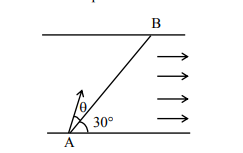
A swimmer wants to cross a river from point $A$ to point B. Line AB makes an angle of $30^{\circ}$ with the flow of river. The magnitude of the velocity of the swimmer is the same as that of the river. The angle $\theta$ with the line AB should be $\qquad$ swimmer reaches point $B$.
| A. |
|
| B. |
|
| C. |
|
| D. |
|
swimmer crosses the river along the line making an angle of 45º with the direction of flow. The velocity of the river is 5 m/s. A swimmer takes 6 seconds to cross the river of width 60 m. The velocity of the swimmer with respect to water will be $5 \sqrt{x}$ m/s. Find x.
| A. |
|
| B. |
|
| C. |
|
| D. |
|
When boat travels downstream then relation between $u$ (speed of river), $v$ (Speed of Boat w.r.t. River) and $V_b$ ( Speed of boat w.r.t. Ground)
| A. |
|
| B. |
|
| C. |
|
| D. |
|
A man who has a speed of 5km/h in still water crosses a river of width 1km along the shortest possible path in 15 minutes. The velocity of river water in km/h is :
| A. |
|
| B. |
|
| C. |
|
| D. |
|
A man can swim in still water of 1m/s. He swims across the river flowing at 0.6m/s. The width of the river is 100m. If he travels with the shortest possible time, then the time taken (in Sec) to cross the river is:
| A. |
|
| B. |
|
| C. |
|
| D. |
|
If the boat travels at some angle $\theta$ with river flow ( u ) having its Speed w.r.t. River=v Then the time taken to cross the river is
| A. |
|
| B. |
|
| C. |
|
| D. |
|
A man crosses the river perpendicular to river flow in time t seconds and travels an equal distance down the stream in T seconds. The ratio of man's speed in still water to the speed of river water will be :
| A. |
|
| B. |
|
| C. |
|
| D. |
|
A boat moves with the current from points A to B and returns at the same speed.
The speed of the boat relative to the water is η times the speed of the water. The speed of water is 1 m/s.
Find the average speed for the entire trip.
| A. |
|
| B. |
|
| C. |
|
| D. |
|
A boat takes 4 hours to travel a certain distance upstream and 3 hours to cover the same distance downstream. If the speed of the stream is 2 km/h, what is the speed (in km/h) of the boat in still water?
| A. |
|
| B. |
|
| C. |
|
| D. |
|
A man rows a boat upstream a distance of 24 km and downstream the same distance in 6 hours. If the speed of the stream is 4 km/h, what is the speed (in km/h) of the man in still water approximately?
| A. |
|
| B. |
|
| C. |
|
| D. |
|
A boat travels downstream a certain distance in 4 hours and returns the same distance in 5 hours. If the speed of the boat in still water is 12 km/h, what is the speed (km/h) of the stream?
| A. |
|
| B. |
|
| C. |
|
| D. |
|
Assertion: The time taken by a boat to cover a certain distance upstream is more than the time taken to cover the same distance downstream.
Reason: The speed of the boat is lesser while moving upstream as compared to downstream due to the speed of the stream.
| A. |
|
| B. |
|
| C. |
|
| D. |
|
The speed of a swimmer is $4 \mathrm{kmh}^{-1}$ in still water. If the swimmer makes his strokes normal to the flow of the river of width 1 km, he reaches a point 750 m down the stream on the opposite bank. The speed of the river water is _____ $\mathrm{kmh}^{-1}$
| A. |
|
| B. |
|
| C. |
|
| D. |
|
A man can swim in still water of 1m/s. He swim across the river flowing at 0.6m/s . The width of river is 100m. If he travels with the shortest possible time then time taken to cross the river is:
| A. |
|
| B. |
|
| C. |
|
| D. |
|
A man which has a speed of 5 km/h in still water crosses a river of width 1km along the shortest possible path in 15 minutes. The velocity of the river water in km/hr is
| A. |
|
| B. |
|
| C. |
|
| D. |
|
A man which has a speed of 5km/h in still water crosses a river of width 1km along the shortest possible path in 15 minutes. The velocity of river water in km/h is :
| A. |
|
| B. |
|
| C. |
|
| D. |
|
A man wish to cross a river in a boat if he crosses the river in minimum time,he takes 10 minutes to cross with a drift 120m. if the width of the river is 150m then the ratio of velocity of man with respect that of velocity of river is
| A. |
|
| B. |
|
| C. |
|
| D. |
|
A may only swim in still water at 1 m/s. He swims across a river flowing at 0.6 m/s. The width of the river is 100m. If he travels in the shortest possible time then the time taken to cross the river is
| A. |
|
| B. |
|
| C. |
|
| D. |
|
A boat that has a speed of 5 Km/hr in still water crosses a river of width 1 Km along the shortest possible path in 15 minutes. The velocity of river water in Km/hr is:
| A. |
|
| B. |
|
| C. |
|
| D. |
|
A boat crosses a river with a velocity of 12km/h. If the resulting velocity of a boat is 14 km/h, then velocity of river water is:
| A. |
|
| B. |
|
| C. |
|
| D. |
|
A Ship moves along the equator to the east with velocity $20 \mathrm{~km} / \mathrm{h}$. The south-eastern wind blows at an angle of $30^{\circ}$ to the equator with the velocity of $10 \mathrm{~km} / \mathrm{h}$. Find the wind velocity relative to the ship and the angle between the equator and the wind direction in the reference frame fixed to the ship.
| A. |
|
| B. |
|
| C. |
|
| D. |
|
A ship of mass $2 \times 10^6 \mathrm{~kg}$ initially at rest is pulled by a force of $10 \times 10^3 \mathrm{~N}$. through a distance of 25 m. Assume resistance offered by water is negligible. Find the speed of the ship.
| A. |
|
| B. |
|
| C. |
|
| D. |
|
| Column I | Column II |
|
(I) Two boats A and B are moving along perpendicular paths in a still lake at night. Boat A moves with a speed of 3 ms-1 and boat B moves with a speed of 4 ms-1 in a direction such that they collide after some time. At t=0 the boats are 300 m apart. The ratio of distance travelled by boat A to the distance travelled by boat B till the instant of collision is |
(P) $\frac{\sqrt{3}}{2}$ |
|
(II) A trolley is moving horizontally with a constant velocity of v ms-1 with respect to Earth. A man starts running from one end of the trolley with a velocity 1.5v m/s with respect to the trolley. After reaching the opposite end, the man turns back and continues running with a velocity of 1.5v m/s with respect to the trolley and reaches the original end. If the length of the trolley is L, then the displacement of the man with respect to Earth during the process will be xL. The value of x is
|
(Q) $\frac{3}{4}$ |
| (III) A particle moves with a constant speed v along a regular hexagon ABCDEF in the same order. Then, the ratio of the magnitude of the average velocity for its motion from A to C and its speed is | (R) $\frac{2}{3}$ |
| (IV) A particle moves with a constant speed v along a regular hexagon ABCDEF in the same order. Then, the ratio of the magnitude of the average velocity for its motion from A to D and its speed is | (S) $\frac{4}{}$ |
| A. |
|
| B. |
|
| C. |
|
| D. |
|
An aircraft Boeing 350 flies between Delhi and Patna separated by a distance D = 900 km. On 14th July 2019, the wind was blowing directly from Delhi to Patna with constant speed $V_A=50 \mathrm{~km} \mathrm{~h}^{-1}$ and the speed of the aircraft is $V_0=500 \mathrm{~km} \mathrm{~h}^{-1}$ relative to the air. Find the time in hours taken by the aircraft to make a round trip between Delhi and Patna. Assume that there is no halt at Patna airport.
| A. |
|
| B. |
|
| C. |
|
| D. |
|
An escalator at a metro station moves at a speed of 2 ms–1 and is 200m long. If a man steps on it and walks at 3 ms–1 relative to the escalator, then which of the following statement(s) is/are correct? (t is the time required by him to reach the opposite side)
| A. |
|
| B. |
|
| C. |
|
| D. |
|
A boat crossing a river moves with a velocity $v$ relative to still water. The river is flowing with a velocity of $v / 2$ with respect to the bank. The angle with respect to the flow direction with which the boat should move to minimize the drift is,
| A. |
|
| B. |
|
| C. |
|
| D. |
|
The maximum speed of a boat in still water is $27 \mathrm{~km} / \mathrm{h}$. Now this boat is moving downstream in a river flowing at $9 \mathrm{~km} / \mathrm{h}$. A man in the boat throws a ball vertically upwards with a speed of $ 10\mathrm {~m} / \mathrm{s}$. The range of the ball as observed by an observer at rest on the river bank is _______ cm.
(Take $\mathrm{g}=10 \mathrm{~m} / \mathrm{s}^2$ )
| A. |
|
| B. |
|
| C. |
|
| D. |
|
A river is flowing from west to east direction with speed of $9 \mathrm{~km} \mathrm{~h}^{-1}$. If a boat capable of moving at a maximum speed of $27 \mathrm{~km} \mathrm{~h}^{-1}$ in still water, crosses the river in half a minute, while moving with maximum speed at an angle of $150^{\circ}$ to direction of river flow, then the width of the river is :
| A. |
|
| B. |
|
| C. |
|
| D. |
|