-
Engineering and Architecture
Exams
Colleges
Predictors
Resources
-
Computer Application and IT
Quick Links
Colleges
-
Pharmacy
Colleges
Resources
-
Hospitality and Tourism
Colleges
Resources
Diploma Colleges
-
Competition
Other Exams
Resources
-
School
Exams
Top Schools
Products & Resources
-
Study Abroad
Top Countries
Resources
-
Arts, Commerce & Sciences
Colleges
Upcoming Events
Resources
-
Management and Business Administration
Exams
Colleges & Courses
Predictors
-
Learn
Law Preparation
MBA Preparation
Engineering Preparation
Medical Preparation
-
Online Courses and Certifications
Top Streams
Specializations
- Digital Marketing Certification Courses
- Cyber Security Certification Courses
- Artificial Intelligence Certification Courses
- Business Analytics Certification Courses
- Data Science Certification Courses
- Cloud Computing Certification Courses
- Machine Learning Certification Courses
- View All Certification Courses
Resources
-
Medicine and Allied Sciences
Colleges
Predictors
Resources
-
Law
Resources
Colleges
-
Animation and Design
Exams
Predictors & Articles
Colleges
Resources
-
Media, Mass Communication and Journalism
Colleges
Resources
-
Finance & Accounts
Top Courses & Careers
Colleges
Equation of motions - (Concept)
There are three equations of motion
-
The first kinematical equation of motion (velocity-time equation)
Formula
$
v=u+a t
$
$v=$ Final velocity
$\mathrm{u}=$ Initial velocity
$A=$ acceleration
$
\mathrm{T}=\text { time }
$
2. The second kinematical equation of motion (Position-time equation)
Formula
$s=u t+\frac{1}{2} a t^2$
$s \rightarrow$ Displacement
$u \rightarrow$ Initial velocity
$a \rightarrow$ acceleration
$t \rightarrow$ time
3. The third kinematical equation of motion (Velocity-displacement equation)
Formula
$
v^2-u^2=2 a s
$
$v \rightarrow $ Final Velocity
$s \rightarrow$ Displacement
$u \rightarrow$ Initial velocity
$a \rightarrow$ acceleration
Displacement in nth second
Formula: $S_n=u+\frac{a}{2}(2 n-1)$
Where $u=$ Initial velocity
$a=$ uniform acceleration
| Exam | Chapter |
| JEE MAIN | Kinematics |
A particle has an initial velocity and an acceleration of
Its speed after 10s is
| A. |
|
| B. |
|
| C. |
|
| D. |
|
An object is dropped from a height h from the ground. Every time it hits the ground it loses 50% of its kinetic energy. The total distance covered is as is :
| A. |
|
| B. |
|
| C. |
|
| D. |
|
A bullet of mass of 20 g has an initial speed of just before it starts penetrating a mud wall of thickness of 20 cm. If the wall offers a mean resistance of
, the speed of the bullet (in m/s) after emerging from the other side of the wall is close to :
| A. |
|
| B. |
|
| C. |
|
| D. |
|
A particle starts from the origin at t=0 with an initial velocity of and moves in the x-y plane with a constant acceleration
The x-coordinate of the particle at the instant when its y-coordinate is 32 m is D meters. The value of D is :
| A. |
|
| B. |
|
| C. |
|
| D. |
|
Starting from the origin at time t=0, with initial velocity , a particle moves in the x-y plane with constant acceleration of
. At time t, its coordinates are
. The values of t and
are, respectively:
| A. |
|
| B. |
|
| C. |
|
| D. |
|
A body of mass 2kg moves under a force of . It starts from rest and was at the origin initially. After 4s, its new coordination is (8,b,20). The value of b is _________
(Rounded off to the nearest integer)
| A. |
|
| B. |
|
| C. |
|
| D. |
|
A car accelerates from rest at a constant rate for some time after which it decelerates at a constant rate
to come to rest. If the total time elapsed is t seconds, the total distance traveled is :
| A. |
|
| B. |
|
| C. |
|
| D. |
|
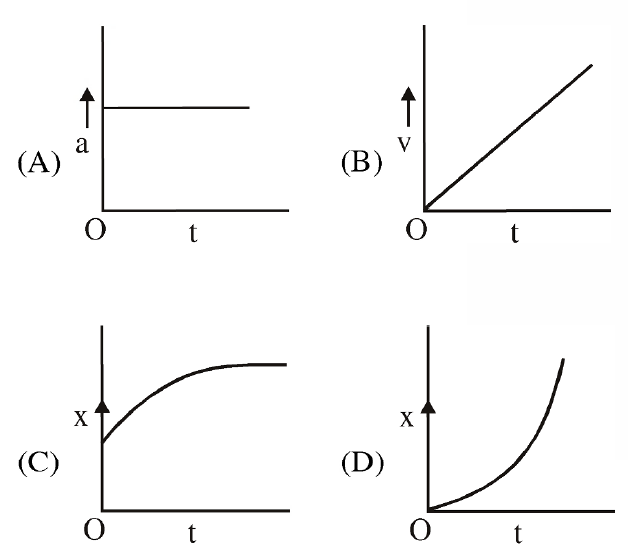
A particle starts from origin O from rest and moves with a uniform acceleration along the positive x-axis. Identify all figure that correctly represents the motion qualitatively. (a=acceleration, v=velocity,x=displacement,t=time)
| A. |
|
| B. |
|
| C. |
|
| D. |
|
In a car race straight road, car A takes a time t less than car B at the finish and passes the finishing point with a speed 'v' more than that of car B. Both the cars start from rest and travel with a constant acceleration a1 and a2 respectively. Then 'v' is equal to:
| A. |
|
| B. |
|
| C. |
|
| D. |
|
A particle moves from the point , at t = 0, with an initial velocity
. It is acted upon by a constant force which produces a constant acceleration
. What is the distance of the particle from the origin at time 2s?
| A. |
|
| B. |
|
| C. |
|
| D. |
|
Using the first equation of motion we can calculate :
| A. |
|
| B. |
|
| C. |
|
| D. |
|
The formula can be applied
| A. |
|
| B. |
|
| C. |
|
| D. |
|
A ball is thrown vertically upward with a velocity of 20 ms-1 from a top of a multistory building. The height of the point from where the ball is thrown is 25 m from the ground. The height to which the ball rises from the ground and time taken before the ball hits the ground is (g:=10 ms-2)
| A. |
|
| B. |
|
| C. |
|
| D. |
|
A stone is dropped from the top of a building. When it crosses a point 5 m below the top, another stone starts to fall from a point 25 m below the top. Both stones reach the bottom of the building simultaneously. The height of the building is :
| A. |
|
| B. |
|
| C. |
|
| D. |
|
A ball is dropped from the top of a 100 m high tower on a planet. In the last seconds before hitting the ground, it covers a distance of 19 m. Acceleration due to gravity (in ms-2) near the surface of that planet is _______.
| A. |
|
| B. |
|
| C. |
|
| D. |
|
An automobile traveling with a speed of 60 Km/h, can brake to stop within a distance of 20 m. If the car is going twice as fast i.e. 120 Km/h the stopping distance (in meters) will be:
| A. |
|
| B. |
|
| C. |
|
| D. |
|
A particle is travelling with a uniform acceleration A. if a, b and c are the distances covered by it during ,
and
second of its motion respectively then
| A. |
|
| B. |
|
| C. |
|
| D. |
|
An engine of the train, moving with uniform acceleration, passes the signal -post with velocity u and the last compartment with velocity v. The velocity with which the middle point of the train passes the signal post is:
| A. |
|
| B. |
|
| C. |
|
| D. |
|
A scooter accelerates from rest for time t1 at a constant rate and then retards at constant rate
for time
and comes to rest. The correct value of
will be:
| A. |
|
| B. |
|
| C. |
|
| D. |
|
Two buses P and Q start from a point at the same time and move in a straight line and their positions are represented by and
. At what time, do both the buses have the same velocity?
| A. |
|
| B. |
|
| C. |
|
| D. |
|
A small toy starts moving from the position of rest under constant acceleration. If it travels a distance of 10m in t s, the distance traveled by the toy in the next 't' s will be :
| A. |
|
| B. |
|
| C. |
|
| D. |
|
A particle is moving in a straight line such that its velocity is increasing at per meter. The acceleration of the particle is_________
, at a point where its velocity is
| A. |
|
| B. |
|
| C. |
|
| D. |
|
The velocity of the bullet becomes one-third after it penetrates 4 cm in a wooden block. Assuming that the bullet is facing constant resistance during its motion in the block. The bullet stops completely after traveling at $(4+x) \mathrm{cm}$ inside the block. The value of x is :
| A. |
|
| B. |
|
| C. |
|
| D. |
|
A ball is thrown up vertically with a certain velocity so that, it reaches a maximum height $h$.
Find the ratio of the times in which it is at height $\frac{h}{3}$ while going up and coming down respectively.
| A. |
|
| B. |
|
| C. |
|
| D. |
|
A force acts on a body of mass
. If the body starts from rest, its position vector
will be :
| A. |
|
| B. |
|
| C. |
|
| D. |
|
A ball is thrown up with a certain velocity so that it reaches a height $h$ Find the ratio of the two different times of the ball reaching $\frac{h}{3}$ in both the directions.
| A. |
|
| B. |
|
| C. |
|
| D. |
|
Two spherical balls having equal masses with a radius of 5 cm each are thrown upward along the same vertical direction at an interval of 3 seconds with the same initial velocity of 35 m/s, and then these balls collide at a height of ----- m.
(take g = 10 m/s2)
| A. |
|
| B. |
|
| C. |
|
| D. |
|
A car starts with constant acceleration a = 2m/s2 at t = 0. Two coins are released from the car at t = 3 & t = 4. Each coin takes 1 second to fall on the ground. Then the distance (in meters (m)) between the two coins will be : (Assume the coin sticks to the ground)
| A. |
|
| B. |
|
| C. |
|
| D. |
|
A car starts from rest with a constant acceleration of 5 m/s 2. Its instantaneous speed at the end of 10 sec is
| A. |
|
| B. |
|
| C. |
|
| D. |
|
Initially a car at rest accelerates uniformly to a speed of 144 Km/h in 20 sec . Then it covers a distance of ____m.
| A. |
|
| B. |
|
| C. |
|
| D. |
|
If a body loses half of its velocity on penetrating 3 cm in a wooden block, then how much will it penetrate more before coming to rest?
| A. |
|
| B. |
|
| C. |
|
| D. |
|
Speeds of two identical cars are and
at a specific instant. If the same deceleration is applied on both cars, the ratio of the respective distances in which the two cars are stopped from that instant is :
| A. |
|
| B. |
|
| C. |
|
| D. |
|
A car moving with a speed of 50 km/hr, can be stopped by brakes after at least 6 m. If the same car is moving at a speed of 100 km/hr, the minimum stopping distance is :
| A. |
|
| B. |
|
| C. |
|
| D. |
|
An automobile travelling with a speed of 60 km/h, can brake to stop within a distance of 20 m. If the car is going twice as fast, 120 km/h, the stopping distance will be :
| A. |
|
| B. |
|
| C. |
|
| D. |
|
A car, starting from rest, accelerates at the rate through a distance
, then continues at constant speed for time
and then decelerates at the rate
to come to rest. If the total distance traversed is 15
, then
| A. |
|
| B. |
|
| C. |
|
| D. |
|
A body is at rest at $x=0$. At $t=0$, it starts moving in the positive $ x$ direction with a constant acceleration. At the same instant, another body passes through $x=0$ moving in the positive $x$-direction with a constant speed. The position of the first body is given by $x_1(t)$ after time $t$ and that of the second body by $x_2(t)$ after the same time interval. Which of the following graphs correctly describes $\left(x_1-x_2\right)$ as a function of time $t$?
| A. |
|
| B. |
|
| C. |
|
| D. |
|
Two particles P and Q have position vectors respectively. If the velocity vector of particles P is
then the velocity of particle Q so that they collide after 5 seconds, in
is
| A. |
|
| B. |
|
| C. |
|
| D. |
|
A particle starts with a velocity of 2 m/s and moves in a straight line with retardation of 0.1 m/s2. The time (in seconds) at which the particle is 15 m from the starting point is
| A. |
|
| B. |
|
| C. |
|
| D. |
|
A car is moving with the speed of and after applying the break it will move
before it stops. If the same car is moving with a speed of one-third the reported speed then it will stop after traveling___________
distance.
| A. |
|
| B. |
|
| C. |
|
| D. |
|
A particle is moving with velocity is a constant. The general equation for its path is
| A. |
|
| B. |
|
| C. |
|
| D. |
|
A swimmer crossing a river is an example of
| A. |
|
| B. |
|
| C. |
|
| D. |
|
In the given figure the distance PQ is constant. SQ is a vertical line passing through point R. A particle is kept at R and the plane PR is such that angle θ can be varied such that R lies on line SQ. The time taken by a particle to come down varies, as the θ increases

| A. |
|
| B. |
|
| C. |
|
| D. |
|
A train is standing on a platform, and a man inside a compartment of a train drops a stone. At the same instant train starts to move with constant acceleration. The path of the particle as seen by the person who drops the stone is :
| A. |
|
| B. |
|
| C. |
|
| D. |
|
The position-time relation of a particle moving with constant acceleration is given by
| A. |
|
| B. |
|
| C. |
|
| D. |
|
True or False.
Motion in the plane is an example of 2-D motion.
| A. |
|
| B. |
|
A piece of wood with a mass of is dropped from the top of a
high building. At the same time, a ball with a mass of
is thrown vertically upwards from the ground at a speed of
The balls are driven into the wood. Then the maximum height that the combined system can reach above the top of the building before falling is
.
| A. |
|
| B. |
|
| C. |
|
| D. |
|
A car travelling at can be stopped at a distance of 40 m by braking. If the same car is travelling with the same acceleration at
the minimum stopping distance in metres is :
| A. |
|
| B. |
|
| C. |
|
| D. |
|
A car travelling at a speed of 60 km/hr can break and stop within a distance of 20 metres. If the car is travelling at twice the speed, i.e.,120 km/hr the stopping distance will be:
| A. |
|
| B. |
|
| C. |
|
| D. |
|
Two balls A and B are thrown from a building, A is thrown up and B is thrown down (both vertically). Let and
be their respective speeds when they reach the ground, then:
| A. |
|
| B. |
|
| C. |
|
| D. |
|
From a Building of height H, a particle is projected vertically upwards with a speed u. The time taken by the particle, to hit the ground is n times that taken by it to reach the highest point of its path. The relation of H, u, n is
| A. |
|
| B. |
|
| C. |
|
| D. |
|
The acceleration of a particle increases with time “t” as From the initial position with a velocity u; the distance travelled by the particle in time “t” is $\frac{a t^4}{x}+u t$. Find the value of x.
| A. |
|
| B. |
|
| C. |
|
| D. |
|
A car is moving with there is a bus stop driver needs to apply a break of 400 m before that to rest the car at the bus stop; now suppose the driver applied the break at half distance so the car will cross the bus stop with
velocity; the value of
:
| A. |
|
| B. |
|
| C. |
|
| D. |
|
The initial velocity of a particle is and acceleration of the particle is
so its speed after 2 sec is _____ units
| A. |
|
| B. |
|
| C. |
|
| D. |
|
Assertion: When the initial velocity is zero; then the final velocity value depends upon the acceleration and time taken by the particle.
Reason: The kinematical equation of motion relating initial velocity, final velocity, acceleration and time taken by the particle is .
| A. |
|
| B. |
|
| C. |
|
| D. |
|
The formula can be applied -
| A. |
|
| B. |
|
| C. |
|
| D. |
|
An automobile traveling with a speed of 60 Km/h, can brake to stop within a distance of 20m. If the car is going twice as fast i.e. 120 Km/h, then the stopping distance in metres is ?
| A. |
|
| B. |
|
| C. |
|
| D. |
|
A tennis ball is dropped on to the floor from a height of 9.8 m .It rebounds to a height 5.0 m . Ball comes in contact with the floor for 0.2 s . The average acceleration during contact is $\mathrm{ms}^{-2}$
(Given $\mathrm{g}=10 \mathrm{~ms}^{-2}$ )
| A. |
|
| B. |
|
| C. |
|
| D. |
|
A particle starts with an initial velocity of 10.0 ms-1 along the x-direction and accelerates uniformly at the rate of 2.0 ms-2. The time taken by the particle to reach the velocity of 60.0 ms-1 is __________.
| A. |
|
| B. |
|
| C. |
|
| D. |
|
A ball is thrown vertically upward with an initial velocity of $150 \mathrm{~m} / \mathrm{s}$. The ratio of velocity after $3 s$ and $5 s$ is $\frac{x+1}{x}$. The value of $x$ is _____________.
$\left\{\right.$ take,$\left.g=10 \mathrm{~m} / \mathrm{s}^2\right\}$
| A. |
|
| B. |
|
| C. |
|
| D. |
|
A stone dropped from a building of height reaches the ground after
seconds. From the same building if two stones are thrown (one upwards and the other downwards) with the same velocity
and they reach the ground after
and
seconds respectively, then the time interval
is
| A. |
|
| B. |
|
| C. |
|
| D. |
|
For a train engine to move with speed of , the driver must apply brakes at a distance of
before the station for the train to come to rest at the station. If the brakes were applied at half of this distance, the train engine would cross the station with speed
The value of
is ______________(Assuming the same retardation is produced by brakes)
| A. |
|
| B. |
|
| C. |
|
| D. |
|
An elevator is rising vertically up with the velocity of $10 \mathrm{~m} / \mathrm{s}$. A ball is projected up from the elevator with velocity $V$ (relative to the ground) The ball crosses the elevator in 4 seconds after its projection. Then find V:
| A. |
|
| B. |
|
| C. |
|
| D. |
|
A particle is moving along the east with an initial velocity of 10 m/s and acceleration is 3 m/s2 along the west. What is its velocity after 5 sec?
| A. |
|
| B. |
|
| C. |
|
| D. |
|
Given below are two statements:
Statement (I): The limiting force of static friction depends on the area of contact and is independent of materials.
Statement (II): The limiting force of kinetic friction is independent of the area of contact and depends on materials.
In the light of the above statements, choose the most appropriate answer from the options given below:
| A. |
|
| B. |
|
| C. |
|
| D. |
|
A body starts moving from rest with constant acceleration covers displacement $S_1$ in first (p-1) seconds and $S_2$ in the first p seconds. The displacement $S_1+S_2$ will be made in time:
| A. |
|
| B. |
|
| C. |
|
| D. |
|
The displacement and the increase in the velocity of a moving particle in the time interval of $t$ to $(t+1) s$ are $125 \mathrm{~m}$ and $50 \mathrm{~m} / \mathrm{s}$, respectively. The distance travelled by the particle in $(\mathrm{t}+2)^{\mathrm{th}} \mathrm{s}$ is ___________$\mathrm{m}$.
| A. |
|
| B. |
|
| C. |
|
| D. |
|
A particle starts from the origin at t=0 with a velocity and moves in an x-y plane under the action of a force which produces a constant acceleration of
. If the x-coordinate of the particle at that instant is 84 m, then the speed of the particle at this time is
. The value of
is ___.
| A. |
|
| B. |
|
| C. |
|
| D. |
|
A body travels $102.5 \mathrm{~m} \ \ {\text {in } \mathrm{n}^{\text {th }}}$ second and $115.0 \mathrm{~m}$ in $(\mathrm{n}+2)^{\mathrm{th}}$ second. The acceleration is :
| A. |
|
| B. |
|
| C. |
|
| D. |
|
From the top of a 64-metre-high tower, a stone is thrown upwards vertically with a velocity of 48 m/s. The greatest height (in metres) attained by the stone, assuming the value of the gravitational acceleration g=32 m/s2, is :
| A. |
|
| B. |
|
| C. |
|
| D. |
|
A car is moving with a speed of 50 Km /s hr can be stopped by applying brakes after 2 m . If the same car is moving with a speed of 100 Km/hr , what is the minimum stopping distance
| A. |
|
| B. |
|
| C. |
|
| D. |
|
For earth revolving around the sun, which of the statement is true -
| A. |
|
| B. |
|
| C. |
|
| D. |
|
For position time relation of a particle moving with constant acceleration is given by
| A. |
|
| B. |
|
| C. |
|
| D. |
|
If a particle is moving at a constant speed then
| A. |
|
| B. |
|
| C. |
|
| D. |
|
A bus moving along a straight highway with speed of $72 \mathrm{~km} / \mathrm{h}$ is brought to halt within $4 \mathrm{~s}$ after applying the brakes. The distance travelled by the bus during this time (Assume the retardation is uniform) is $\mathrm{m}$.
| A. |
|
| B. |
|
| C. |
|
| D. |
|
A child stands on the edge of the cliff 10 m above the ground and throws a stone horizontally with an initial speed of 5 $m s^{-1}$. Neglecting the air resistance, the speed with which the stone hits the ground will be $\mathrm{ms}^{-1}$ (given, $\mathrm{g}=10$ $m s^{-2}$ ).
| A. |
|
| B. |
|
| C. |
|
| D. |
|
A car starts from rest with a constant acceleration of 5 m/s 2. Its instantaneous speed at the end of 10 seconds is :
| A. |
|
| B. |
|
| C. |
|
| D. |
|
If a car is at rest accelerates uniformly and attains a speed of 72 Km/hr in 10 seconds,then it covers a distance of
| A. |
|
| B. |
|
| C. |
|
| D. |
|
If an iron ball and a wooden ball of the same radii are released from a height 'h' in the vacuum then the time taken to reach the ground will be
| A. |
|
| B. |
|
| C. |
|
| D. |
|
Initially, a car at rest accelerates uniformly to a speed of 144 Km/h in 20 sec. Then it covers a distance of
| A. |
|
| B. |
|
| C. |
|
| D. |
|
A particle has an initial velocity $3 \widehat{i}+4 \widehat{j} \mathrm{~m} / \mathrm{s}$ and acceleration of $0.4 \widehat{i}+0.3 \widehat{j} \mathrm{~m} / \mathrm{s}^2$. Its speed after 10 s is:
| A. |
|
| B. |
|
| C. |
|
| D. |
|
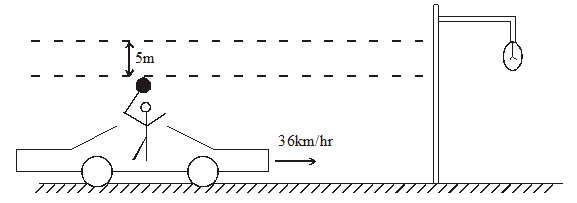
A boy is standing outside the sunroof of his car which is travelling at a speed of 36 km/hr, He wishes to throw a ball through a stationary hoop, 5m above the height of his hands in such a manner that the ball will move horizontally as it passes through the hoop. He throws the ball with the speed of 54 km/hr concerning himself, then marks the correct statement(s):
| A. |
|
| B. |
|
| C. |
|
| D. |
|
A car is moving with $40 \mathrm{~m} / \mathrm{s}$ and the driver applies brakes at $\mathrm{t}=0$ which gives retardation of $2 \mathrm{~m} / \mathrm{s}^2$. Find the correct option(s):
| A. |
|
| B. |
|
| C. |
|
| D. |
|
Two cars are travelling towards each other at a speed of $20 \mathrm{~m} \mathrm{~s}^{-1}$ each. When the cars are $300 \mathrm{~m}$ apart, both the drivers apply brakes and the cars retard at the rate of $2 \mathrm{~m} \mathrm{~s}^{-2}$. The distance between them when they come to rest is :
| A. |
|
| B. |
|
| C. |
|
| D. |
|
Two stones are thrown up simultaneously from the edge of a cliff 240 m high with initial speed of 10 m/s and 40 m/s respectively. Which of the following graph best represents the time variation of relative position of the second stone with respect to the first? (Assume stones do not rebound after hitting the ground and neglect air resistance, take g=10 m/s2
| A. |
|
| B. |
|
| C. |
|
| D. |
|
Water droplets are coming from an open tap at a particular rate. The spacing between a droplet observed at $4^{\text {th }}$ the second after its fall to the next droplet is 34.3 m. At what rate the droplets are coming from the tap? (Take
$
\mathrm{g}=9.8 \mathrm{~m} / \mathrm{s}_{\text {) }}^2
$
| A. |
|
| B. |
|
| C. |
|
| D. |
|
Water drops are falling from a nozzle of a shower onto the floor, from a height of 9.8 m. The drops fall at regular intervals of time. When the first drop strikes the floor, at that instant, the third drop begins to fall. Locate the position of the second drop from the floor when the first drop strikes the floor.
| A. |
|
| B. |
|
| C. |
|
| D. |
|
A man is 30 m behind the bus when the bus starts accelerating from rest with acceleration $3 \mathrm{~m} / \mathrm{s}^2$. with what minimum velocity (in m/s) should the man start running to catch the bus:- $($ use $\sqrt{5}=2.24)$
| A. |
|
| B. |
|
| C. |
|
| D. |
|
A juggler tosses a ball up in the air with initial speed u. At the instant it reaches its maximum height H, he tosses up a second ball with the same initial speed. The two balls will collide at a height.
| A. |
|
| B. |
|
| C. |
|
| D. |
|
A particle starts moving along a line from zero initial velocity and comes to rest after moving distance d. During its motion, it had a constant acceleration f over 2/3 of the distance, and covered the rest of the distance with constant retardation. The time taken to cover the distance is
| A. |
|
| B. |
|
| C. |
|
| D. |
|
Two stones of mass $m_1$ and $m_2$ (such that $m_1>m_2$ ) are dropped $\Delta t$ time apart from the same height towards the ground. At a later time, $t$ the difference in their speed is $\Delta V$ and their mutual separation is $\Delta S$. While both stones are in flight
| A. |
|
| B. |
|
| C. |
|
| D. |
|
A bullet fired into a fixed target loses half its velocity after penetrating 3 cm. How much further will it penetrate before coming to rest, assuming that it faces constant resistance to motion? (in cm)
| A. |
|
| B. |
|
| C. |
|
| D. |
|
Graph between the square of velocity (v) of a particle and the distance (s) moved is shown in figure. The magnitude of acceleration of the particle in kilometres per hour square is:

| A. |
|
| B. |
|
| C. |
|
| D. |
|
A body starts from rest with an acceleration of 5 m/s2 till it attains the maximum velocity, then retards to rest with 3 m/s2. If the total time taken is 8 seconds, then the maximum speed (in m/s) attained is:
| A. |
|
| B. |
|
| C. |
|
| D. |
|
If the velocity of an object is at t = 0 and
at time t, we have