-
Engineering and Architecture
Exams
Colleges
Predictors
Resources
-
Computer Application and IT
Quick Links
Colleges
-
Pharmacy
Colleges
Resources
-
Hospitality and Tourism
Colleges
Resources
Diploma Colleges
-
Competition
Other Exams
Resources
-
School
Exams
Top Schools
Products & Resources
-
Study Abroad
Top Countries
Resources
-
Arts, Commerce & Sciences
Colleges
Upcoming Events
Resources
-
Management and Business Administration
Exams
Colleges & Courses
Predictors
-
Learn
Law Preparation
MBA Preparation
Engineering Preparation
Medical Preparation
-
Online Courses and Certifications
Top Streams
Specializations
- Digital Marketing Certification Courses
- Cyber Security Certification Courses
- Artificial Intelligence Certification Courses
- Business Analytics Certification Courses
- Data Science Certification Courses
- Cloud Computing Certification Courses
- Machine Learning Certification Courses
- View All Certification Courses
Resources
-
Medicine and Allied Sciences
Colleges
Predictors
Resources
-
Law
Resources
Colleges
-
Animation and Design
Exams
Predictors & Articles
Colleges
Resources
-
Media, Mass Communication and Journalism
Colleges
Resources
-
Finance & Accounts
Top Courses & Careers
Colleges
Projectile Motion - (Concept)
-
Projectile Motion- Two dimesional motion under action of uniform force is called is called projectile motion.
E.g- A javelin thrown by an athlete

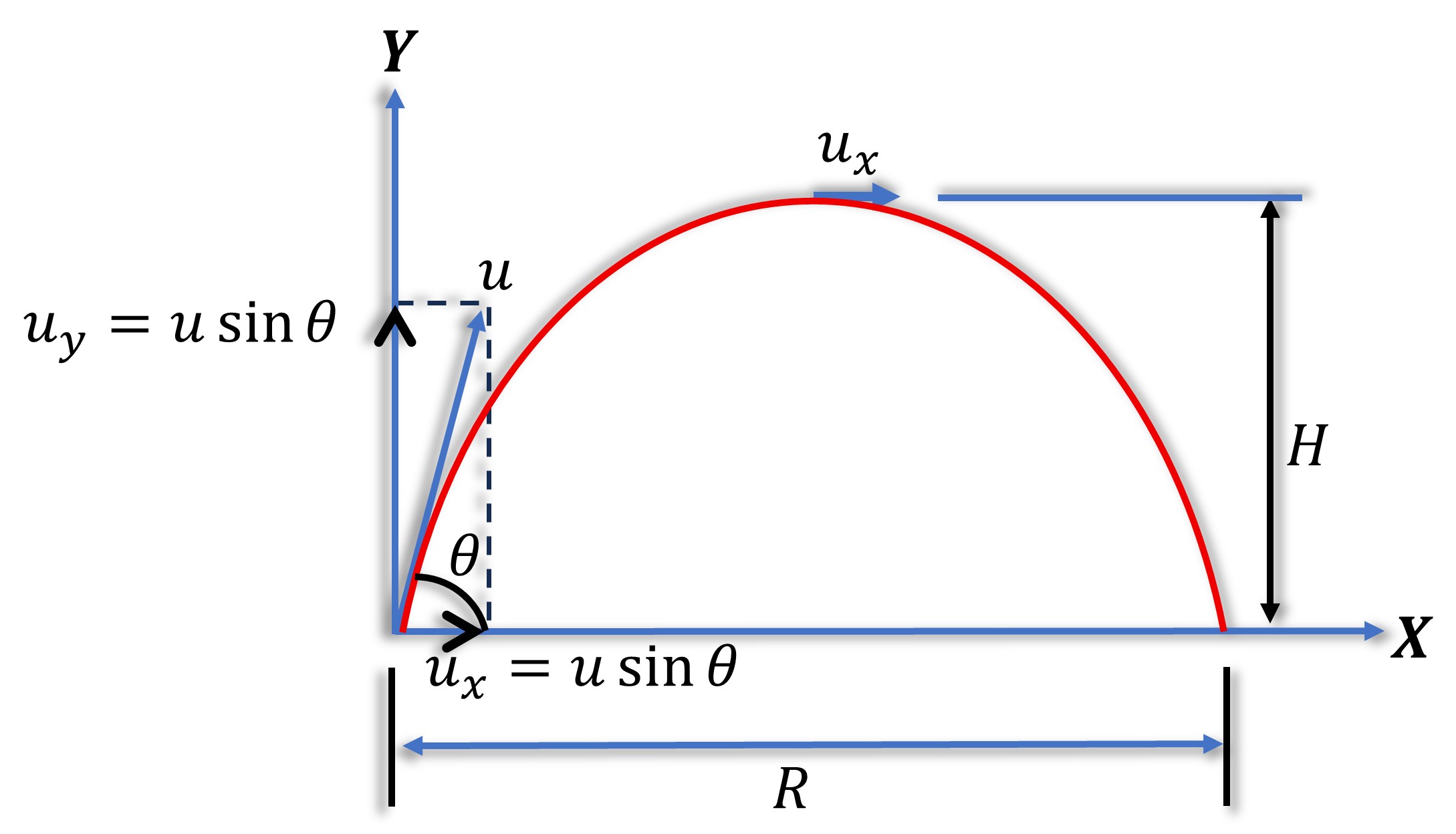
1. Projectile Projected at an angle $\theta$
- Initial Velocity- u
Horizontal component $=u_x=u \cos \theta$
Vertical component $=u_y=u \sin \theta$
- Final velocity $=\mathrm{V}$
Horizontal component $=V_x=u \cos \theta$
Vertical component $=V_y=u \sin \theta-g . t$
So,
$
V=\sqrt{V_x^2+V_y^2}
$
- Displacement $=\mathrm{S}$
Horizontal component $=S_x=u \cos \theta . t$
Vertical component $=S_y=u \sin \theta \cdot t-\frac{1}{2} \cdot g \cdot t^2$
and,
$
S=\sqrt{S_x^2+S_y^2}
$
- Acceleration $=\mathrm{a}$
Horizontal component $=0$
Vertical component $=-\mathrm{g}$
So, $a=-g$
Parameters in Projectile motion -
-
Maximum Height -
-
Maximum vertical distance attained by a projectile during its journey.
-
- Formula-
$
H=\frac{U^2 \sin ^2 \theta}{2 g}
$- When the velocity of projectile increases n time then Maximum height is increased by a factor of $n^2$
- Special Case-If U is doubled, H becomes four times provided $\theta \& \mathrm{~g}$ are constant.
2) Time of Flight
- Time for which projectile remains in the air above the horizontal plane.
- Formula-
1. $T=\frac{2 u \sin \theta}{g}$
2. Time of ascent $=$$
t_a=\frac{T}{2}
$3. Time of descent =
$
t_d=\frac{T}{2}
$
-
When the velocity of projectile increased n time then Time of ascent becomes n times
-
When the velocity of projectile increased n time then Time of descent becomes n times
-
When the velocity of the projectile increased n time then the time of flight becomes n times.
-
Horizontal Range
-
Horizontal distance travelled by projectile from the point of the projectile to the point on the ground where its hits.
-
Formula-
$
R=\frac{u^2 \sin 2 \theta}{g}
$
- Special case of horizontal range
1. For max horizontal range.
$
\begin{aligned}
\theta & =45^0 \\
R_{\max } & =\frac{u^2 \sin 2(45)}{g}=\frac{u^2 \times 1}{g}=\frac{u^2}{g}
\end{aligned}
$
2. Range remains the same whether the projectile is thrown at an angle $\theta$ with the horizontal or at an angle $\theta$ with vertical ( $90-\theta$ ) with horizontal
3. When the velocity of projectile increases $n$ time then the horizontal range is increased by a factor of $n^2$
4. When the horizontal range is $n$ times the maximum height then
$
\tan \theta=\frac{4}{n}
$
- Equation of trajectory-

- $y=x \tan \theta-\frac{g x^2}{2 u^2 \cos ^2 \theta}$
| Exam | Chapter |
| JEE MAIN | Kinematics |
A body is projected horizontally from a point above the ground and the motion of the body is described by the equation and
, where x and y are horizontal and vertical coordinates in meters after time t. The initial velocity of the body will be.
| A. |
|
| B. |
|
| C. |
|
| D. |
|
A projectile is given an initial velocity of , where
is along the ground and
is along the vertical. If
, the equation of its trajectory is
| A. |
|
| B. |
|
| C. |
|
| D. |
|
The equation of trajectory of a projectile is given by where x and y are in metres and x is along horizontal and y is vertically upward and particles are projected from origin. Then which of the following option is incorrect
| A. |
|
| B. |
|
| C. |
|
| D. |
|
A particle is moving with a velocity where K is a constant. The general equation for its path is:
| A. |
|
| B. |
|
| C. |
|
| D. |
|
The trajectory of a projectile near the surface of the earth is given as . If it were launched at an angle
with speed
then
:
| A. |
|
| B. |
|
| C. |
|
| D. |
|
A boy can throw a stone up to a maximum height of 10m . The maximum horizontal distance that the boy can throw the same stone up to will be :
| A. |
|
| B. |
|
| C. |
|
| D. |
|
Two projectiles are projected at two different angles. If $h_1$ and $h_2$ are maximum height when the range in the two cases is R , then the relation between R , $h_1$ and $h_2$ is
| A. |
|
| B. |
|
| C. |
|
| D. |
|
A projectile is thrown at an angle with vertical .It reaches a maximum height H . The time taken to reach the highest point of its path is $\sqrt{\frac{x H}{g}}$, then what will be the value of x?
| A. |
|
| B. |
|
| C. |
|
| D. |
|
A body of mass m is projected to describe a parabolic path in the vertical plane with velocity The time of flight (in seconds) of the body is about
| A. |
|
| B. |
|
| C. |
|
| D. |
|
A water fountain on the ground sprinkles water all around it. If the speed of water coming out of the fountain is v , the total area around the fountain that gets wet is
| A. |
|
| B. |
|
| C. |
|
| D. |
|
A body is projected at an angle $\alpha$ to the horizontal to clear two waves of equal height h at a distance of 2 h from each other, the horizontal range of a projectile is
| A. |
|
| B. |
|
| C. |
|
| D. |
|
Two guns A and B can fire bullets at speeds 1km/s and 2km/s respectively. From a point on a horizontal ground, they are fired in all possible directions. The ratio of maximum areas covered by the bullets fired by two guns, on the ground is:
| A. |
|
| B. |
|
| C. |
|
| D. |
|
A shell is fired from a fixed artillery gun with an initial speed $u$ such that it hits the target on the ground at a distance $R$ from it. If $t_1$ and $t_2$ are the values of the time taken by it to hit the target in two possible ways, the product $t_1 t_2$ is:
| A. |
|
| B. |
|
| C. |
|
| D. |
|
Two particles are projected from the same point with the same speed u such that they have the same rang R, but different maximum heights and
. Which of the following is correct?
| A. |
|
| B. |
|
| C. |
|
| D. |
|
Two stones were projected from the same point with the same speed making angles 45o + and 45o -
with the horizontal respectively. If
, then the horizontal ranges of the two stones are in the ratio of
| A. |
|
| B. |
|
| C. |
|
| D. |
|
The angle of projection when the range is 4 times that of maximum height is-
| A. |
|
| B. |
|
| C. |
|
| D. |
|
A projectile fired with initial velocity v at an angle . If the initial velocity is tripled at the same angle of projection, then the time of ascent becomes n times, find the value of n
| A. |
|
| B. |
|
| C. |
|
| D. |
|
A projectile is fired with initial velocity v at an angle , and has the time of descent T. If the initial velocity is reduced to half at the same angle of projection then the Time of descent becomes
| A. |
|
| B. |
|
| C. |
|
| D. |
|
A projectile is projected at an angle with speed v. By what factor does the time of flight change when the speed is increased to 5 times of original value?
| A. |
|
| B. |
|
| C. |
|
| D. |
|
A projectile is fired at an angle with an initial velocity of v and has a maximum height of H. If the initial velocity is tripled at the same angle of projection then its maximum height becomes
| A. |
|
| B. |
|
| C. |
|
| D. |
|
A projectile fired with initial velocity v at some angle , has a range of R. If the initial velocity is doubled at the same angle of the projectile, then the range will be
| A. |
|
| B. |
|
| C. |
|
| D. |
|
The maximum range of a bullet fired from a toy pistol mounted on a car at rest is What will be the acute angle of inclination of the pistol for maximum range when the car is moving in the direction of firing with uniform velocity on a horizontal surface?
| A. |
|
| B. |
|
| C. |
|
| D. |
|
The projectile motion of a particle of mass 5 g is shown in the figure.

The initial velocity of the particle is $5 \sqrt{2} \mathrm{~ms}^{-1}$ and the air resistance is assumed to be negligible. The magnitude of the change in the momentum between points A and B is $x \times 10^{-2} \mathrm{kgms}^{-1}$.
The value of $x$, to the nearest integer is $\qquad$
| A. |
|
| B. |
|
| C. |
|
| D. |
|
A projectile is projected with velocity of $25 \mathrm{~m} / \mathrm{s}$ at an angle of with the horizontal. After t seconds its inclination with horizontal becomes zero. If R represents horizontal range of the projectile, the value of $\theta$ will be : $\left[\right.$ use $\mathrm{g}=10 \mathrm{~m} / \mathrm{s}^2$ ]
| A. |
|
| B. |
|
| C. |
|
| D. |
|
An object of mass 5 kg is thrown vertically upwards from the ground. The air resistance produces a constant retarding force of 10 N throughout the motion. The ratio of time of ascent to the time of descent will be equal to : [Use g = 10ms-2].
| A. |
|
| B. |
|
| C. |
|
| D. |
|
Given below are two statements: One is labelled as Assertion A and the other is labelled as Reason Assertion A: Two identical balls A and B thrown with the same velocity ' $\mathrm{u}^{\prime}$ at two different angles with horizontal attained the same $h_{1 \text { range }} R$. If $A$ and $B$ reached the maximum height $h_1$ and $h_2$ respectively,then $R=4 \sqrt{h_1 h_2}$
Reason R: Product of said heights.
$
\mathrm{h}_1 \mathrm{~h}_2=\left(\frac{\mathrm{u}^2 \sin ^2 \theta}{2 \mathrm{~g}}\right) \cdot\left(\frac{\mathrm{u}^2 \cos ^2 \theta}{2 \mathrm{~g}}\right)
$
Question: Choose the correct answer:
| A. |
|
| B. |
|
| C. |
|
| D. |
|
A fighter jet is flying horizontally at a certain altitude with a speed of $200 \mathrm{~ms}^{-1}$. When it passes directly overhead an anti-aircraft gun, a bullet is fired from the gun, at an angle $\theta$ with the horizontal, to hit the jet. If the bullet speed is $400 \mathrm{~m} / \mathrm{s}$, the value of $\theta$ will be
| A. |
|
| B. |
|
| C. |
|
| D. |
|
A projectile is laughed at angle with horizontal with a velocity
. After
, its inclination with horizontal is
. The value of
will be :
| A. |
|
| B. |
|
| C. |
|
| D. |
|
A person can throw a ball up to a maximum range of 100 m. How high above the ground he can throw the same ball?
| A. |
|
| B. |
|
| C. |
|
| D. |
|
A ball is projected from the ground with a speed at an angle
with horizontal so that its range and maximum height are equal, then
will be equal to:
| A. |
|
| B. |
|
| C. |
|
| D. |
|
Two projectiles thrown at and
with the horizontal respectively, reach the maximum height at the same time. The ratio of their initial velocities is :
| A. |
|
| B. |
|
| C. |
|
| D. |
|
Two projectiles are thrown with the same initial velocity making an angle of and
with the horizontal respectively. The ratio of their respective ranges will be :
| A. |
|
| B. |
|
| C. |
|
| D. |
|
A ball of mass is thrown vertically upward. Another ball of mass
is thrown at an angle
with the vertical. Both the balls stay in the air for the same period. The ratio of the heights attained by the two balls respectively is
The value of
is ________.
| A. |
|
| B. |
|
| C. |
|
| D. |
|
A ball is projected with kinetic energy E, at an angle of $60^\circ$ to the horizontal. The kinetic energy of this ball at the highest point of its flight will become :
| A. |
|
| B. |
|
| C. |
|
| D. |
|
An object is projected in the air with initial velocity at an angle
. The projectile motion is such that the horizontal range
, is maximum. Another object is projected in the air with a horizontal range half of the range of first object. The initial velocity remains same in both the case. The value of the angle of projection, at which the second object is projected, will be________ degree.
| A. |
|
| B. |
|
| C. |
|
| D. |
|
A player kicks a football with an initial speed from the ground. What are the maximum height and the time taken by the football to reach the highest point during motion?
| A. |
|
| B. |
|
| C. |
|
| D. |
|
The ranges and heights for two projectiles projected with the same initial velocity at angles with the horizontal are
respectively. Choose the correct option:
| A. |
|
| B. |
|
| C. |
|
| D. |
|
A projectile can have the same range $R$ or two angles of projection. If $t_1$ and $t_2$ be the time of flights in the two cases, then the product of the two times of flights is proportional to
| A. |
|
| B. |
|
| C. |
|
| D. |
|
When particle is moving in projectile motion
| A. |
|
| B. |
|
| C. |
|
| D. |
|
A ball projected from the ground at an angle of $45^\circ$ just clears a wall in front. If the point of projection is 4m from the foot of the wall and the ball strikes the ground at a distance of 6m on the other side of the wall, the height of the wall is :
| A. |
|
| B. |
|
| C. |
|
| D. |
|
A particle is projected with an initial speed of 30 m/s at an angle of 30o with horizontal then the maximum height (in meters) attained by the particle is (g = 10 m/s2)
| A. |
|
| B. |
|
| C. |
|
| D. |
|
A particle is projected with an initial speed of 30 m/s at an angle of with horizontal, then the maximum height attained by the particle is ___ m. (
)
| A. |
|
| B. |
|
| C. |
|
| D. |
|
Which among the following does not represent the parabolic equation
| A. |
|
| B. |
|
| C. |
|
| D. |
|
If R =2H, then the angle of projection is $\theta = \tan^{-1}(x)$ then the value of x is
| A. |
|
| B. |
|
| C. |
|
| D. |
|
In the given figure below point A and B lie on the projectile trajectory POQ such that they are along the horizontal line at height 3h from the surface.
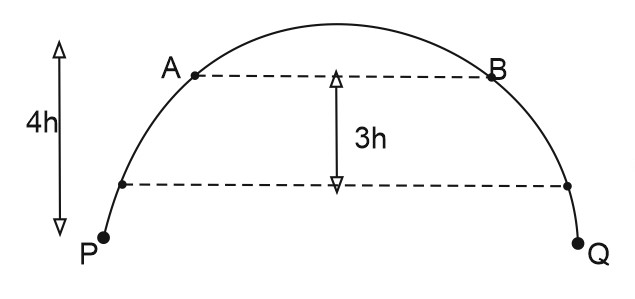
${ }_{\text {If }} T_{A B}=x T_{P Q}$ find x.
$T_{A B} \rightarrow$ Time of flight between point A and B
$T_{P Q} \rightarrow$ Time of flight between point P and Q
| A. |
|
| B. |
|
| C. |
|
| D. |
|
A particle is projected at an angle of projection $\alpha$ and after t seconds it appears to have an angle $\beta$ with the horizontal. The initial velocity is:
| A. |
|
| B. |
|
| C. |
|
| D. |
|
A particle projected with a velocity u making an angle $\theta$ with the horizontal. After time t its velocity becomes V which is perpendicular to the initial velocity u, find t.
| A. |
|
| B. |
|
| C. |
|
| D. |
|
A boy playing on the roof of a 10 m high building throws a ball with a speed of 10 m/s at an angle of 300 with the horizontal. How far from the throwing point will the ball be at the height of 10 m from the ground?
| A. |
|
| B. |
|
| C. |
|
| D. |
|
A projectile can have the same range R for two angles of projection. If t1 and t2 are the time of flights in the two cases, then the product of the two times of flights is directly proportional to:
| A. |
|
| B. |
|
| C. |
|
| D. |
|
If the value of acceleration due to gravity is 10 m/s2 and the time of flight is 5 seconds, then the maximum height (in m) reached by the projectile is nearly (give the answer as integer)
| A. |
|
| B. |
|
| C. |
|
| D. |
|
A cricketer can throw a ball to a maximum horizontal distance of 100 m. How much high above the ground can the cricketer throw the same ball? (Answer in meters)
| A. |
|
| B. |
|
| C. |
|
| D. |
|
A body is projected at t= 0 with a velocity 10ms-1 at an angle of 600 with the horizontal. The radius of curvature of its trajectory at t = 1s is R. Neglecting air resistance and taking acceleration due to gravity g = 10 ms-2, the value of R (in meters) is:
| A. |
|
| B. |
|
| C. |
|
| D. |
|
A body is projected from the ground at an angle of $45^{\circ}$ with the horizontal. Its velocity after 2 s is $20 \mathrm{~ms}^{-1}$. The maximum height (in m ) reached by the body during its motion is ________ m. (use $g=10 \mathrm{~ms}^{-2}$ )
| A. |
|
| B. |
|
| C. |
|
| D. |
|
If we increase the velocity of the projectile by 3 times, then its maximum height is increased by x times. Find x.
| A. |
|
| B. |
|
| C. |
|
| D. |
|
The train runs in a straight line with a constant acceleration "a". A girl standing in a train throws a ball forward at a speed of an angle of
degrees from the horizontal. The girl must advance
inside the train to catch the ball at the initial height. The acceleration of the train, in
is:
| A. |
|
| B. |
|
| C. |
|
| D. |
|
The equations of motion of a projectile are given by and
. The angle of projection is
| A. |
|
| B. |
|
| C. |
|
| D. |
|
The relation between the time of flight of the projectile and the time to reach the maximum height
is :
| A. |
|
| B. |
|
| C. |
|
| D. |
|
The distances and heights of two projectiles fired at the same initial velocity at angles and to
the horizontal respectively
and
.
| A. |
|
| B. |
|
| C. |
|
| D. |
|
Assertion: In the plane-to-plane motion of a projectile, the horizontal component of velocity remains constant.
Reason: In plane-to-plane projectile motion, the horizontal component of acceleration is zero.
| A. |
|
| B. |
|
| C. |
|
| D. |
|
A projectile fired with initial velocity at an angle
. If the initial velocity is tripled at the same angle of projection, then the time of ascent will become :
| A. |
|
| B. |
|
| C. |
|
| D. |
|
The maximum vertical height to which a man can throw a ball is 136 m. The maximum horizontal distance up to which he can throw the same ball is:
| A. |
|
| B. |
|
| C. |
|
| D. |
|
Two objects are projected with same velocity 'u' however at different angles$\alpha$ and $\beta$ with the horizontal. If $\alpha+\beta=90^{\circ}$ , the ratio of the horizontal range of the first object to the $2 n d$ object will be:
| A. |
|
| B. |
|
| C. |
|
| D. |
|
A stone is projected at angle $30^{\circ}$ to the horizontal. The ratio of the kinetic energy of the stone at the point of projection to its kinetic energy at the highest point of flight will be -
| A. |
|
| B. |
|
| C. |
|
| D. |
|
The initial speed of a projectile fired from ground is At the highest point during its motion, the speed of projectile is
. The time of flight of the projectile is :
| A. |
|
| B. |
|
| C. |
|
| D. |
|
Two bodies are projected from the ground at the same speeds at two different angles with respect to horizontal. The bodies were found to have the same range. If one of the bodies was projected at an angle of
, with horizontal then the sum of the maximum heights, attained by the two projectiles, is __________ m.
(Given )
| A. |
|
| B. |
|
| C. |
|
| D. |
|
Given below are two statements one is labelled as Assertion A and the other is labelled as Reason R.
Assertion A: When a body is projected at an angle , it’s range is maximum.
Reason R: For maximum range, the value of should be equal to one.
In the light of the above statements, choose the correct answer from the options given below :
| A. |
|
| B. |
|
| C. |
|
| D. |
|
Two projectiles and
are thrown with initial velocities of
and
at angles
° and
° with the horizontal respectively. The ratio of their ranges respectively is
| A. |
|
| B. |
|
| C. |
|
| D. |
|
Two projectiles are projected at and
with the horizontal the same speed. The ratio of the maximum height attained by the two projectiles respectively is:
| A. |
|
| B. |
|
| C. |
|
| D. |
|
A projectile fired at $30^{\circ}$ to the ground is observed to be at same height at time 3 s and 5 s after projection, during its flight. The speed of projection of the projectile is $\qquad$ $\mathrm{ms}^{-1}$. (Given $\mathrm{g}=10 \mathrm{~ms}^{-2}$ )
| A. |
|
| B. |
|
| C. |
|
| D. |
|
A projectile is projected at $30^{\circ}$ from horizontal with initial velocity $40 \mathrm{~ms}^{-1}$. The velocity of the projectile at $\mathrm{t}=2 \mathrm{~s}$ from the start will be :
$
\left(\text { Given } g=10 \mathrm{~m} / \mathrm{s}^2\right)
$
| A. |
|
| B. |
|
| C. |
|
| D. |
|
For a body projected at an angle with the horizontal from the ground, choose the correct statement.
| A. |
|
| B. |
|
| C. |
|
| D. |
|
The range of the projectile projected at an angle of with horizontal is 50 m. If the projectile is projected with the same velocity at an angle of
with horizontal, then its range will be :
| A. |
|
| B. |
|
| C. |
|
| D. |
|
An initial velocity of $(2 \hat{i}+\sqrt{3} \hat{j}) \mathrm{m} / \mathrm{s}$ is given to a projectile, which $\hat{i}$ is along the ground and $\hat{j}$ is along the vertical. The equation of its trajectory is if $g=10 \mathrm{~m} / \mathrm{s}^2$.
| A. |
|
| B. |
|
| C. |
|
| D. |
|
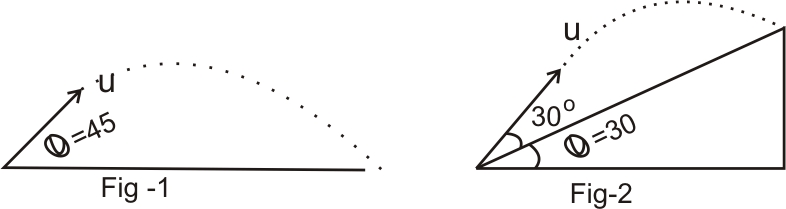
In the above figure $\mathrm{R}_1$ is the range for figure 1, while $\mathrm{R}_2$ is the range along the incline plane for figure 2.
Then find $\frac{R_2}{R_1}$ :
| A. |
|
| B. |
|
| C. |
|
| D. |
|
A ball is thrown from ground with velocity u and angle with horizontal then the horizontal range is 10m. If the ball is thrown with velocity 3u and with same angle of projection then the horizontal range will become
| A. |
|
| B. |
|
| C. |
|
| D. |
|
A ball thrown by one player reaches at other end in two sec. The maximum height attained by the ball is
| A. |
|
| B. |
|
| C. |
|
| D. |
|
If a particle is projected with initial velocity 20m/s. Then the time taken to come from the highest point to the same horizontal level in 4s. If the initial velocity 10m/s with same angle of projection the time to reach from the highest point to the ground will be:
| A. |
|
| B. |
|
| C. |
|
| D. |
|
When velocity of projectile is increased n times then the maximum height is increased by a factor of
| A. |
|
| B. |
|
| C. |
|
| D. |
|
A body of mass 10 kg is projected at an angle of $45^{\circ}$ with the horizontal. The trajectory of the body is observed to pass through a point $(20,10)$. If T is the time of flight, then its momentum vector, at time $\mathrm{t}=\frac{\mathrm{T}}{\sqrt{2}}$, is $\qquad$ [Take $g=10 \mathrm{~m} / \mathrm{s}^2$ ]
| A. |
|
| B. |
|
| C. |
|
| D. |
|
A particle is projected in horizontal direction from a height. The initial speed is 4m/s. Then the angle made by its velocity with horizontal direction after 1 second is
| A. |
|
| B. |
|
| C. |
|
| D. |
|
A particle just clears a wall of height b at a distance a and strikes the ground at a distance c from the point of projection. The angle of projection is:
| A. |
|
| B. |
|
| C. |
|
| D. |
|
A particle of mass $\mathrm{m}$ is projected with a velocity ' $\mathrm{u}$ ' making an angle of $30^{\circ}$ with the horizontal. The magnitude of angular momentum of the projectile about the point of projection when the particle is at its maximum height $\mathrm{h}$ is :
| A. |
|
| B. |
|
| C. |
|
| D. |
|
A projectile path has an equation of $y=0.8 x-0.05 x^2$; so the projectile's initial velocity is?
$
\left(g=10 \mathrm{~ms}^{-2}\right)
$
| A. |
|
| B. |
|
| C. |
|
| D. |
|
Direction : In the following question , a statement if Assertion (A) is followed by a statement of reason (R) , Mark the correct choice as
Assertion : when we project a body , the vertical velocity of the particle continuous decreases during its ascending motion
Reason : A constant downward acceleration always present in projectile motion
| A. |
|
| B. |
|
| C. |
|
| D. |
|
An aeroplane flying 490m above ground level at 100m/s, releases a block. After how much time it will hit the ground (g = 9.8 m/s2)
| A. |
|
| B. |
|
| C. |
|
| D. |
|
A projectile is fired from horizontal ground with speed $V$ and projection angle $\theta$. when the acceleration due to gravity is $g$ ', the range of the projectile enters a different region where the effective acceleration due to gravity is $g^{\prime}=g / 0.36$ then the range is $d^{\prime}=$ nd. The value of $n$ is
| A. |
|
| B. |
|
| C. |
|
| D. |
|
Direction : In the following question , a statement of Assertion (A) is followed by a statement of reason (R) . Mark the correct choice as :
Assertion : In projectile motion the projectile hits the ground with the speed with which it was thrown
Reason : In projectile motion horizontal velocity remains same but vertical velocity continuously change
| A. |
|
| B. |
|
| C. |
|
| D. |
|
The horizontal range of a projectile fired at an angle of $15^{\circ}$ is 50 m . If it is fired with the same speed at an angle of $45^{\circ}$, its range will be
| A. |
|
| B. |
|
| C. |
|
| D. |
|
Two particles are projected in the air with speed $v_0$, at angles $\theta_1$, and $\theta_2$ to the horizontal, respectively. If the height reached by the first particle is greater than that of the second, then tick the right choices
| A. |
|
| B. |
|
| C. |
|
| D. |
|
The maximum height reached by a projectile is 64 m. If the initial velocity is halved, the new maximum height of the projectile is ______ m.
| A. |
|
| B. |
|
| C. |
|
| D. |
|
The projectile is launched with a velocity $\mathrm{V}_0$ at an angle theta as shown in the figure. At the highest point in its trajectory, the radius of curvature of the path of the projectile is:
Given: $\theta=30^{\circ}, v_0=40 \mathrm{~m} / \mathrm{s}$ and $g=10 \mathrm{~m} / \mathrm{s}^2$.
| A. |
|
| B. |
|
| C. |
|
| D. |
|
A ball of mass 2 m is thrown from the ground with speed u at an angle $\theta$. At the highest point, it gets fragmented into two parts such that both parts are similar. The first part goes upward with speed $u$; find out the height attained by the first part from the ground when the second part hits the ground.
| A. |
|
| B. |
|
| C. |
|
| D. |
|
A stone of mass 1 kg is thrown with velocity $50 \mathrm{~ms}^{-1}$ at an angle of $53^\circ$ from a horizontal ground. Another stone of mass 1 kg is thrown with velocity $50 \mathrm{~ms}^{-1}$ in vertically upwards direction. Find out the kinetic energy of the first stone with respect to the second stone; when the first one has minimum kinetic energy.
| A. |
|
| B. |
|
| C. |
|
| D. |
|
A particle is projected such that its horizontal range is 4 times of its attained maximum height. Then the angle of projection should be
| A. |
|
| B. |
|
| C. |
|
| D. |
|
In the case of a projectile motion, the value of the maximum angle of projection $\theta_{max}$ such that the position of the particle is always increasing with respect to the point of projection is -
| A. |
|
| B. |
|
| C. |
|
| D. |
|
Johnny was whirling his yoyo (0.5 kg) in a horizontal circle of radius 1 m at a height of 5m above the ground. The string of yoyo suddenly breaks and the yoyo finally strikes the ground at a horizontal separation of 20 m. Find out the maximum tension(nearest integer in N) that the yoyo string can bear.
| A. |
|
| B. |
|
| C. |
|
| D. |
|
When a particle is projected the quantity that remains unchanged is
| A. |
|
| B. |
|
| C. |
|
| D. |
|
A firecracker is thrown with a velocity of $30 \mathrm{~m}. \mathrm{s}^{-1}$ in a direction which makes an angle of $75^0$ with the vertical axis. At some point on its trajectory, the firecracker splits into two identical pieces in such a way that one piece falls 27 m from the shooting point, Assuming that all trajectories are contained in the same plane, how far will the other pieces fall from the shooting point? ( take $\mathrm{g}=10 \mathrm{~m} . \mathrm{s}^{-2}$ and neglect air resistance)
| A. |
|
| B. |
|
| C. |
|
| D. |
|
A stone thrown down with a speed $u$ take time $t_1$ to reach the ground. while another stone thrown upward from the same point with the same speed take time $t_2$. The maximum height the second stone reaches from the ground is
| A. |
|
| B. |
|
| C. |
|
| D. |
|
Two balls are projected with the same velocity but with different angles with the horizontal. Their ranges are equal. If the angle of projection of one is 30o and its maximum height is h then the maximum height of the other will be nh, then the value of n will be
| A. |
|
| B. |
|
| C. |
|
| D. |
|
The angle of projection for a projectile to have same horizontal range and maximum height is :
| A. |
|
| B. |
|
| C. |
|
| D. |
|
A particle moving in a circle of radius $R$ with uniform speed takes time $T$ to complete half revolution. If this particle is projected with the same Speed at an angle $\theta$ to the horizontal, the maximum height obtained by it is equal to $2 R$. The angle of projection $\theta$ is given by:
| A. |
|
| B. |
|
| C. |
|
| D. |
|
A particle is projected at an angle of $30^{\circ}$ from horizontal at a speed of $60 \mathrm{~m} / \mathrm{s}$. The height traversed by the particle in the first second is $h_0$ and height traversed in the last second, before it reaches the maximum height, is $h_1$. Then $h_0: h_1$ is________.
$\left[\right.$ Take, $\left.g=10 \mathrm{~m} / \mathrm{s}^2\right]$
| A. |
|
| B. |
|
| C. |
|
| D. |
|
A ball of mass 100 g is projected with velocity $20 \mathrm{~m} / \mathrm{s}$ at $60^{\circ}$ with horizontal. The decrease in kinetic energy of the ball during the motion from point of projection to highest point is :
| A. |
|
| B. |
|
| C. |
|
| D. |
|
A ball having kinetic energy KE , is projected at an angle of $60^{\circ}$ from the horizontal. What will be the kinetic energy of ball at the highest point of its flight?
| A. |
|
| B. |
|
| C. |
|
| D. |
|
Two projectiles are fired with the same initial speed from the same point on the ground at angles of $\left(45^{\circ}-\alpha\right)$ and $\left(45^{\circ}+\alpha\right)$, respectively, in the horizontal direction. The ratio of their maximum heights attained is :
| A. |
|
| B. |
|
| C. |
|
| D. |
|
An aeroplane is flying horizontally with a velocity of 100m/s at a height of 500m when it is vertically at a point A on the ground a bomb is released from it. The bomb strikes the ground at point B. The distance (in km) AB is (g = 9.8 m/s2)
| A. |
|
| B. |
|
| C. |
|
| D. |
|
Two balls with same mass and initial velocity, are projected at different angles in such a way that maximum height reached by first ball is 8 times higher than that of the second ball. $T_1$ and $T_2$ are the total flying times of first and second ball, respectively, then the ratio of $T_1$ and $T_2$ is :
| A. |
|
| B. |
|
| C. |
|
| D. |
|
The angle of projection of a particle is measured from the vertical axis as $\phi$ and the maximum height reached by the particle is $h_m$. Here $h_m$ as function of $\phi$ can be presented as:
| A. |
|
| B. |
|
| C. |
|
| D. |
|
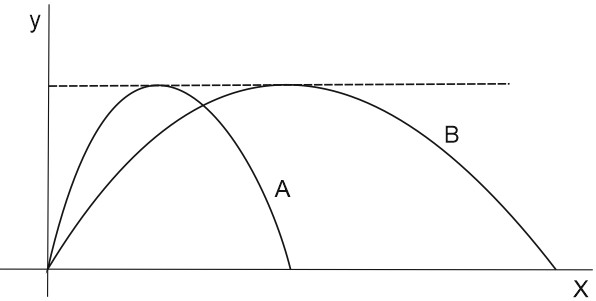
Two particles are projected at the same instant from a common point in the same vertical plane. As shown, point A lies just below the point of maximum height of the second particle's trajectory. The ratio of the horizontal components of the velocities of projection of particle B to particle A is:
| A. |
|
| B. |
|
| C. |
|
| D. |
|
A ball is thrown from a point with a speed at any angle of projection
. From the same point and at the same instant a person starts running at a constant speed
to catch the ball. Will the person be able to catch the ball? If yes, what should be The angle of projection?
| A. |
|
| B. |
|
| C. |
|
| D. |
|
An object that is in flight after being thrown or projected is called a projectile.