-
Engineering and Architecture
Exams
Colleges
Predictors
Resources
-
Computer Application and IT
Quick Links
Colleges
-
Pharmacy
Colleges
Resources
-
Hospitality and Tourism
Colleges
Resources
Diploma Colleges
-
Competition
Other Exams
Resources
-
School
Exams
Top Schools
Products & Resources
-
Study Abroad
Top Countries
Resources
-
Arts, Commerce & Sciences
Colleges
Upcoming Events
Resources
-
Management and Business Administration
Exams
Colleges & Courses
Predictors
-
Learn
Law Preparation
MBA Preparation
Engineering Preparation
Medical Preparation
-
Online Courses and Certifications
Top Streams
Specializations
- Digital Marketing Certification Courses
- Cyber Security Certification Courses
- Artificial Intelligence Certification Courses
- Business Analytics Certification Courses
- Data Science Certification Courses
- Cloud Computing Certification Courses
- Machine Learning Certification Courses
- View All Certification Courses
Resources
-
Medicine and Allied Sciences
Colleges
Predictors
Resources
-
Law
Resources
Colleges
-
Animation and Design
Exams
Predictors & Articles
Colleges
Resources
-
Media, Mass Communication and Journalism
Colleges
Resources
-
Finance & Accounts
Top Courses & Careers
Colleges
Projectile motion when projected horizontally - (Concept)
1. Important equations
-
Initial Velocity- u
Horizontal component $=u_x=u$
Vertical component $=u_y=0$
- Velocity ' $v$ ' after time ' $t$ ' sec-
Horizontal component $=v_x=u$
Vertical component $=v_y=g \cdot t$
and, $\quad v=\sqrt{v_x^2+v_y^2}$
i.e; $\quad v=\sqrt{u^2+(g t)^2}$
$\tan \beta=\frac{g t}{u}$
Where, $\beta=$ angle that velocity makes with horizontal
- Displacement=S
Horizontal component $=S_x=u . t$
Vertical component $=S_y=\frac{1}{2} g \cdot t^2$
and, $S=\sqrt{S_x^2+S_y^2}$
- Acceleration $=\mathrm{a}$
Horizontal component $=0$
Vertical component $=\mathrm{g}$
So, $a=g$
-
Equation of path of a projectile

$
y=\frac{g}{2 u^2} \cdot x^2
$
$g \rightarrow \quad$ Acceleration due to gravity
$u \rightarrow$ initial velocity
-
Important Terms

-
Time of flight
-
Formula
$
t=\sqrt{\frac{2 h}{g}}
$
where $t=$ time of flight
$h=$ Height from which projectile is projected
2. Range of projectile
- Formula
$
R=u \cdot \sqrt{\frac{2 h}{g}}
$
Where $R=$ Range of projectile
$u=$ horizontal velocity of projection from height h
3. Velocity at which projectile hit the ground.
$
v=\sqrt{u^2+2 g h}
$
Where $v=$ velocity at which projectile hit the ground.
| Exam | Chapter |
| JEE MAIN | Kinematics |
A particle is projected with a speed of 4m/s along a horizontal direction from a height. The equation of its path is
| A. |
|
| B. |
|
| C. |
|
| D. |
|
A particle is projected from a height along a horizontal direction with a speed of 5 m/s. Then its speed after 1.2 secin m/s is ? (g = 10 m/s2)
| A. |
|
| B. |
|
| C. |
|
| D. |
|
A particle is projected in horizontal direction from a height. The initial speed is 4m/s. Then the angle made by its velocity with horizontal direction after 1 second is
| A. |
|
| B. |
|
| C. |
|
| D. |
|
Two bullets are fired horizontally, simultaneously, and with different velocities from the same place. Which bullet will hit the ground earlier?
| A. |
|
| B. |
|
| C. |
|
| D. |
|
A stone is thrown at a speed of 19.6 m/s in the horizontal direction from a tower of height of 490 m. The distance (in meters) from the foot of the tower to the point where the stone hits the ground is
| A. |
|
| B. |
|
| C. |
|
| D. |
|
Two particles are projected from a height of h. One particle is projected along a horizontal direction and the other at an angle from horizontal. Which particle will hit the ground with a larger speed?
| A. |
|
| B. |
|
| C. |
|
| D. |
|
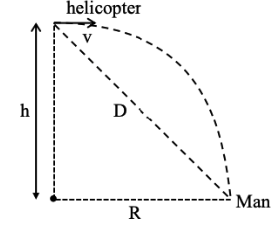
A helicopter is flying horizontally with a speed ${ }^{\prime} v^{\prime}$ at an altitude ' $h$ ' has to drop a food packet for a man on the ground. What is the distance of helicopter from the man when the food packet is dropped?
| A. |
|
| B. |
|
| C. |
|
| D. |
|
A body is projected horizontally at a speed of 20m/s from a very high tower. What will be its speed (in m/s) along horizontal after 4s?
| A. |
|
| B. |
|
| C. |
|
| D. |
|
A stone is thrown horizontally with a velocity of . Find the radius of curvature of its trajectory at the end of 2 seconds after motion began
| A. |
|
| B. |
|
| C. |
|
| D. |
|
The position of a projectile launched from the origin at t=0 is given by
at t = 2s. If the projectile was launched at an angle
from the horizontal, then
is (take g=10 ms-2).
| A. |
|
| B. |
|
| C. |
|
| D. |
|
The initial speed of a bullet fired from a rifle is 630 m/s. The rifle is fired at the centre of a target 700 m away at the same level as the target. How far above the centre of the target the rifle must be aimed in order to hit the target ?
| A. |
|
| B. |
|
| C. |
|
| D. |
|
A hiker stands on the edge of a cliff 490 above the ground and throws a stone horizontally with an initial speed of 15 m/s. Neglecting air resistance, find the time taken by the stone to reach the ground.
| A. |
|
| B. |
|
| C. |
|
| D. |
|
The body is thrown horizontally from a point above the ground and the movement of the body is described by the equation ,
, where x and y are the horizontal and vertical coordinates in meters after time t. The beginning speed of the object is:
| A. |
|
| B. |
|
| C. |
|
| D. |
|
A child stands on the edge of the cliff 10 m above the ground and throws a stone horizontally with an initial speed of 5 $m s^{-1}$. Neglecting the air resistance, the speed with which the stone hits the ground will be $\mathrm{ms}^{-1}$ (given, $\mathrm{g}=10$ $m s^{-2}$ ).
| A. |
|
| B. |
|
| C. |
|
| D. |
|
A projectile is launched from the top of a tower of height h with an initial speed of 10 m/s at an angle of 30° above the horizontal. The projectile hits a point on the ground at a horizontal distance of 20 m from the tower. What is the height of the tower?
| A. |
|
| B. |
|
| C. |
|
| D. |
|
A projectile is fired from horizontal ground with speed $V$ and projection angle $\theta$. when the acceleration due to gravity is $g$ ', the range of the projectile enters a different region where the effective acceleration due to gravity is $g^{\prime}=g / 0.36$ then the range is $d^{\prime}=$ nd. The value of $n$ is
| A. |
|
| B. |
|
| C. |
|
| D. |
|
A ball rolls off the top of a stairway with horizontal velocity $u$. The steps are $0.1 \mathrm{~m}$ high and $0.1 \mathrm{~m}$ wide. The minimum velocity $\mathrm{u}$ with which that ball just hits the step 5 of the stairway will be $\sqrt{\mathrm{x}} \mathrm{ms}^{-1}$ where $\mathrm{x}=$______ [use $\mathrm{g}=10 \mathrm{~m} / \mathrm{s}^2$.
| A. |
|
| B. |
|
| C. |
|
| D. |
|
Projectiles A and B are thrown at angles of $45^{\circ}$ and $60^{\circ}$ with vertical respectively from the top of a $400 \mathrm{~m}$ high tower. If their ranges and times of flight are the same, the ratio of their speeds of projection $v_A: v_B$ is:
[Take $\mathrm{g}=10 \mathrm{~ms}^{-2}$ ]
| A. |
|
| B. |
|
| C. |
|
| D. |
|
A body starts falling freely from height H hits an inclined plane in its path at height h. As a result of this perfectly elastic impact, the direction of the velocity of the body becomes horizontal. The value of $\frac{\mathrm{H}}{\mathrm{h}}$ for which the body will take the maximum time to reach the ground is________.
| A. |
|
| B. |
|
| C. |
|
| D. |
|
A bullet is fixed horizontally with a speed of 98 m/s from a building of 490 m high what will the $\beta$ that the resultant velocity make with the horizontal
| A. |
|
| B. |
|
| C. |
|
| D. |
|
A particle is projected horizontally with a speed of 98m/s from the top of a tower of height 490m. Find the velocity with which the projectile hits the ground ( take g = 9.8 m/s2)
| A. |
|
| B. |
|
| C. |
|
| D. |
|
A particle is projected with initial speed 30 m/s at an angle of 30o with horizontal then maximum height attain by the particle is (g = 10 m/s2)
| A. |
|
| B. |
|
| C. |
|
| D. |
|
A particle is projected with initial velocity u at an angle $\theta$ with horizontal. If the particle is projected with initial velocity $2 \theta$ with same angle of projectivity the time of ascent will become -
| A. |
|
| B. |
|
| C. |
|
| D. |
|
A particle of mass m is projected with speed 10m/s at an angle 300 with horizontal. If the same particle is projected with speed 30m/s with same angle of projection. Then ratio of time of flight will be:
| A. |
|
| B. |
|
| C. |
|
| D. |
|
A rigid body is defined for a system of a particle in where
| A. |
|
| B. |
|
| C. |
|
| D. |
|
The maximum range of a bullet on the horizontal plane is 16km. What must be the muzzle velocity of the bullet (g = 10m/s2 )
| A. |
|
| B. |
|
| C. |
|
| D. |
|
When a body is projected from height h parallel to horizontal with velocity u then the equation of trajectory of the body is
(taking upward direction as positive y-axis)
| A. |
|
| B. |
|
| C. |
|
| D. |
|
A body of mass M thrown horizontally with velocity v from the top of the tower of height H touches the ground at a distance of 100 M from the foot of the tower. A body of mass 2 M thrown at a velocity $\frac{v}{2}$ from the top of the tower of height 4 H will touch the ground at a distance of_____meter.
| A. |
|
| B. |
|
| C. |
|
| D. |
|
A body projected vertically upwards with a certain speed from the top of a tower reaches the ground in $t_1$. If it is projected vertically downwards from the same point with the same speed, it reaches the ground in $t_2$. The time required to reach the ground, if it is dropped from the top of the tower, is :
| A. |
|
| B. |
|
| C. |
|
| D. |
|
A NCC parade is going at a uniform speed of $9 \mathrm{~km} / \mathrm{h}$ under a mango tree on which a monkey is sitting at a height of 19.6 m . At any particular instant, the monkey drops a mango. A cadet will receive the mango whose distance from the tree at time of drop is : (Given $\mathrm{g}=9.8 \mathrm{~m} / \mathrm{s}^2$ )
| A. |
|
| B. |
|
| C. |
|
| D. |
|
A tank is filled with water up to a height H. Water is allowed to come out of a hole as shown in diagram. Time taken by the liquid to reach the base level is :

| A. |
|
| B. |
|
| C. |
|
| D. |
|
From a tower of height H, a particle is thrown vertically upwards with a speed of u. The time taken by the particle, to hit the ground is n times that taken by it to reach the highest point of its path.
The relation between H, u and n are:
| A. |
|
| B. |
|
| C. |
|
| D. |
|
From the top of a tower, a ball is thrown vertically upward which reaches the ground in 6 s. A second ball thrown vertically downward from the same position with the same speed reaches the ground in 1.5 s. A third ball released, from the rest from the same location, will reach the ground in _____s.
| A. |
|
| B. |
|
| C. |
|
| D. |
|
Given below are two statements: One is labelled as Assertion A and the other is labelled as Reason Assertion A: Two identical balls A and B thrown with the same velocity ' $\mathrm{u}^{\prime}$ at two different angles with horizontal attained the same $h_{1 \text { range }} R$. If $A$ and $B$ reached the maximum height $h_1$ and $h_2$ respectively,then $R=4 \sqrt{h_1 h_2}$
Reason R: Product of said heights.
$
\mathrm{h}_1 \mathrm{~h}_2=\left(\frac{\mathrm{u}^2 \sin ^2 \theta}{2 \mathrm{~g}}\right) \cdot\left(\frac{\mathrm{u}^2 \cos ^2 \theta}{2 \mathrm{~g}}\right)
$
Question: Choose the correct answer:
| A. |
|
| B. |
|
| C. |
|
| D. |
|
A body is projected at t= 0 with a velocity 10ms-1 at an angle of 600 with the horizontal. The radius of curvature of its trajectory at t = 1s is R. Neglecting air resistance and taking acceleration due to gravity g = 10 ms-2, the value of R (in meters) is:
| A. |
|
| B. |
|
| C. |
|
| D. |
|
A body is projected from the ground at an angle of $45^{\circ}$ with the horizontal. Its velocity after 2 s is $20 \mathrm{~ms}^{-1}$. The maximum height (in m ) reached by the body during its motion is ________ m. (use $g=10 \mathrm{~ms}^{-2}$ )
| A. |
|
| B. |
|
| C. |
|
| D. |
|
A helicopter flying at speed "v" at altitude "h" drops a person's food parcel to the ground. How far was the helicopter from the person when the food parcel was dropped?
| A. |
|
| B. |
|
| C. |
|
| D. |
|
A helicopter is flying horizontally with a speed 'v' at an altitude 'h' has to drop a food packet for a man on the ground. What is the distance of helicopter from the man when the food packed is dropped?
| A. |
|
| B. |
|
| C. |
|
| D. |
|
A mouse jumps off from the 15th floor of a high-rise building and lands 12 m from the building. Assume that each floor is 3 m height. The horizontal speed (in kmph) with which the mouse jumps is closest to
| A. |
|
| B. |
|
| C. |
|
| D. |
|
In case of projectile motion, if two projectiles, A and B, are projected with same speed at angle of 15° and 75°, respectively, to the horizontal, then
| A. |
|
| B. |
|
| C. |
|
| D. |
|
A plane surface is inclined to make at angle $\theta$ with the horizontal. From the bottom of this inclined plane, a bullet is fired with velocity $v$. The maximum possible range of the bullet on the inclined plane is
| A. |
|
| B. |
|
| C. |
|
| D. |
|
A projectile can have the same range $R$ or two angles of projection. If $t_1$ and $t_2$ be the time of flights in the two cases, then the product of the two times of flights is proportional to
| A. |
|
| B. |
|
| C. |
|
| D. |
|
A particle is projected with velocity $u$ so that its horizontal range is three times the maximum height attained by it. The horizontal range of the projectile is given as $\frac{n u^2}{25 g}$, where value of $n$ is :
(Given ' $g$ ' is the acceleration due to gravity).
| A. |
|
| B. |
|
| C. |
|
| D. |
|
A helicopter flying horizontally with a speed of $360 \mathrm{~km} / \mathrm{h}$ at an altitude of 2 km , drops an object at an instant. The object hits the ground at a point O , 20 s after it is dropped. Displacement of ' O ' from the position of helicopter where the object was released is :
(use acceleration due to gravity $\mathrm{g}=10 \mathrm{~m} / \mathrm{s}^2$ and neglect air resistance)
| A. |
|
| B. |
|
| C. |
|
| D. |
|