-
Engineering and Architecture
Exams
Colleges
Predictors
Resources
-
Computer Application and IT
Quick Links
Colleges
-
Pharmacy
Colleges
Resources
-
Hospitality and Tourism
Colleges
Resources
Diploma Colleges
-
Competition
Other Exams
Resources
-
School
Exams
Top Schools
Products & Resources
-
Study Abroad
Top Countries
Resources
-
Arts, Commerce & Sciences
Colleges
Upcoming Events
Resources
-
Management and Business Administration
Exams
Colleges & Courses
Predictors
-
Learn
Law Preparation
MBA Preparation
Engineering Preparation
Medical Preparation
-
Online Courses and Certifications
Top Streams
Specializations
- Digital Marketing Certification Courses
- Cyber Security Certification Courses
- Artificial Intelligence Certification Courses
- Business Analytics Certification Courses
- Data Science Certification Courses
- Cloud Computing Certification Courses
- Machine Learning Certification Courses
- View All Certification Courses
Resources
-
Medicine and Allied Sciences
Colleges
Predictors
Resources
-
Law
Resources
Colleges
-
Animation and Design
Exams
Predictors & Articles
Colleges
Resources
-
Media, Mass Communication and Journalism
Colleges
Resources
-
Finance & Accounts
Top Courses & Careers
Colleges
Relative Velocity - (Concept)
-
Rate of change in position of one object with respect to another object with time is defined as relative velocity of one object with another.
-
Formula-
Relative velocity of object A with respect to object B .
$$
\vec{V}_{A B}=\vec{V}_A-\vec{V}_B
$$
- Relative velocity of $A$ with respect to $B$ is velocity of $A$ as observed by $B$.
- Case of Relative velocity
1. When $A$ and $B$ are moving along a straight line in the same direction.
$\overrightarrow{V_A}=$ Velocity of object $A$.
$\overrightarrow{V_B}=$ Velocity of object $B$.
Then, relative velocity of A w.r.t B is
$$
\begin{gathered}
\vec{V}_{A B}=\vec{V}_A-\vec{V}_B \\
\vec{V}_{A B}, \vec{V}_A, \vec{V}_B \text { all are in same direction. (If } \vec{V}_A>\vec{V}_{B)}
\end{gathered}
$$
And Relative velocity of $B$ w.r.t $A$ is
$$
\begin{aligned}
& \vec{V}_{B A}=\vec{V}_B-\vec{V}_A \\
& \& \vec{V}_{A B} \\
&=-\vec{V}_{B A}
\end{aligned}
$$
2. When A \& B are moving along with straight line in opposite direction.
Relative velocity of $A$ with respect to $B$ is.
$$
\begin{aligned}
& \vec{V}_{A B}=\vec{V}_A-\vec{V}_B \\
& V_{A B}=V_A+V_B
\end{aligned}
$$
3. Relative Velocity when bodies moving at an angle $\theta$ to each other
- Relative velocity of a body, A with respected body B
$$
V_{A B}=\sqrt{V_A^2+V_B^2+2 V_A V_B \cos (180-\theta)}
$$
$$
=\sqrt{V_A^2+V_B^2-2 V_A V_B \cos (\theta)}
$$
$V_A=$ velocity of $A$
$V_B=$ velocity of $B$
Where, $\theta=$ angle between $A$ and $B$
- If $\overrightarrow{V_{A B}}$ makes an angle $\beta$ with the direction of $\overrightarrow{V_A}$, then
$$
\begin{aligned}
& \tan \beta=\frac{V_B \sin (180-\theta)}{V_A+V_B \cos (180-\theta)} \\
& =\frac{V_B \cdot \sin \theta}{V_A-V_B \cos \theta}
\end{aligned}
$$
- If two bodies are moving at right angles to each other.
Relative Velocity of $A$ with respect to $B$ is
$$
V_{A B}=\sqrt{V_A^2+V_B^2}
$$
| Exam | Chapter |
| JEE MAIN | Kinematics |
A Particle is moving along north with a velocity of 20 m/s and another particle is moving at 10m/s along the south. Then the velocity of the first particle with respect to the second is
| A. |
|
| B. |
|
| C. |
|
| D. |
|
A man ( mass=50 kg ) and his son ( mass=20 kg) are standing on a frictionless surface facing each other. The man pushes his son so that he starts moving at a speed of $0.70 \mathrm{~ms}^{-1}$ with respect to the man. The speed of the man (in $\mathrm{m} / \mathrm{s}$ ) with respect to the surface is :
| A. |
|
| B. |
|
| C. |
|
| D. |
|
$A$ person $A$ is moving along east and $B$ is moving along north. Then relative velocity of $A$ with respect to $B$ is $\left(V_A=10 \mathrm{~m} / \mathrm{s}, V_B=10 \sqrt{3} \mathrm{~m} / \mathrm{s}\right)$
| A. |
|
| B. |
|
| C. |
|
| D. |
|
Rain is falling vertically downward with a speed of 4 km/h. A girl moves on a straight road with a velocity of 3km/h. The apparent speed (in m/s) of rain with respect to the girl is:
| A. |
|
| B. |
|
| C. |
|
| D. |
|
A particle A is moving along north with a speed 3 m/s and another particle B is moving with a velocity 4 m/s at 60o with north, then the velocity of B as seen by A is $\sqrt{n} \mathrm{~m} / \mathrm{s}$, find the value of n
| A. |
|
| B. |
|
| C. |
|
| D. |
|
A particle A is moving along the x-axis and a particle B is moving along the y-axis. The speed of A is 6m/s and that of B is 8 m/s, then the velocity (in m/s) of A with respect to B is:
| A. |
|
| B. |
|
| C. |
|
| D. |
|
A train is moving at 50 km/h and a man is running at 20 km/h in a direction opposite to the direction of the train. The relative velocity of train (in km/h ) with respect to man is
| A. |
|
| B. |
|
| C. |
|
| D. |
|
A girl standing on a road hold her umbrella at $45^{\circ}$ with velocity to keep the rain away. If she starts running without umbrella with a speed of $15 \sqrt{2} \mathrm{kmh}^{-1}$, the rain drops hit her head vertically. The speed of rain drops with respect to the moving girl is $\mid$
| A. |
|
| B. |
|
| C. |
|
| D. |
|
A butterfly is flying with a velocity $4 \sqrt{2}$ in North-East direction. Wind is slowly blowing at $1 \mathrm{~m} / \mathrm{s}$ from North to South. The resultant displacement of the butterfly in 3 seconds is :
| A. |
|
| B. |
|
| C. |
|
| D. |
|
A boy reaches the airport and finds that the escalator is not working. He walks up the stationary escalator in time . If he remains stationary on a moving escalator then the escalator takes him up in time
. The time taken by him to walk up on the moving escalator will be :
| A. |
|
| B. |
|
| C. |
|
| D. |
|
A bomb is dropped by a fighter plane flying horizontally. To an observer sitting in the plane, the trajectory of the bomb is a:
| A. |
|
| B. |
|
| C. |
|
| D. |
|
A particle is moving along X - axis with 4m/s and another particle is moving with 6 m/s at an angle 60o with X-axis. The direction of motion of the first particle with respect to the second particle is
| A. |
|
| B. |
|
| C. |
|
| D. |
|
Train A and B are running on parallel tracks in the opposite direction with speeds of 36 Km/hour and 72 Km/hour respectively. A person is walking in train A in the direction opposite to its motion with a speed of 1.8 km/hour. Speed (in ms-1) of this person as observed from train B will be close to :(take the distance between the tracks as negligible)
| A. |
|
| B. |
|
| C. |
|
| D. |
|
A car is standing 200 m behind a bus, which is also at rest. The two start moving at the same instant but with different forward accelerations. The bus has an acceleration of 2 m/s2 and the car has an acceleration of 4 m/s2. The car will catch up with the bus after a time of :
| A. |
|
| B. |
|
| C. |
|
| D. |
|
A particle of mass m is at rest at the origin at time $\mathrm{t}=0$. It is subjected to a force $F(t)=F_0 e^{-b t}$ in the x direction Its speed $v(t)$ is depicted by which of the following curves ?
| A. |
|
| B. |
|
| C. |
|
| D. |
|
A container is kept in a moving bus.
| A. |
|
| B. |
|
| C. |
|
| D. |
|
A passenger train of length 60 m travels at a speed of 80 km/hr. Another freight train of length 120 m travels at a speed of 30 km/hr. The ratio of times taken by the passenger train to completely cross the freight train when : (i) they are moving in the same direction, and (ii) in the opposite directions is :
| A. |
|
| B. |
|
| C. |
|
| D. |
|
The output, in the following gate logic, would be:

| A. |
|
| B. |
|
| C. |
|
| D. |
|
A car is 200 metres behind the bus, which is also at rest. Both start moving at the same time, but with different forward accelerations. The acceleration of the bus is and that of the car is
. The car will overtake the bus after
| A. |
|
| B. |
|
| C. |
|
| D. |
|
A police jeep chased a thief at , while thief traveled at
. The police fired a bullet with an initial speed of
. The speed at which it hits the thief’s car is:
| A. |
|
| B. |
|
| C. |
|
| D. |
|
Assertion: The dimensional formula for relative velocity is the same as the dimensional formula for velocity change.
Reason: The relative speed Q of P w.r.t. is the ratio of the speed of P to the speed of Q.
| A. |
|
| B. |
|
| C. |
|
| D. |
|
A passenger sitting in a train A moving at 90 km/h observes another train B moving in the opposite direction for 8 seconds. If the velocity of train B is 54 km/h, then the length of train B is :
| A. |
|
| B. |
|
| C. |
|
| D. |
|
Ship A is sailing towards the northeast with a velocity of km/hr where
points east and
, north. Ship B is at a distance of 80 km east and 150 km north of Ship A and is sailing west at 10 km/hr. A will be at a minimum distance from B in :
| A. |
|
| B. |
|
| C. |
|
| D. |
|
A particle moves along the x-axis with its coordinate with time 't' given by . Another particle is moving along the y-axis with its coordinate as a function of time given by
At
s, the speed of the second particle measured in the frame of the first particle is given by
. Then
(in m/s) is ____________.
| A. |
|
| B. |
|
| C. |
|
| D. |
|
Train A is moving along two parallel rail tracks towards north with speed 72 km/h and train B is moving towards south with speed 108 km/h. Velocity of train B with respect to A and velocity of ground with respect to B are (in $\mathrm{ms^{-1}}$):
| A. |
|
| B. |
|
| C. |
|
| D. |
|
A monkey is climbing up a tree at a 3m/s . A dog runs towards a tree with a speed of 4m/s. What is the relative speed of dog as observed by the monkey :
| A. |
|
| B. |
|
| C. |
|
| D. |
|
A monkey is climbing up a tree at a speed of 3 m/s. A dog runs towards the tree with a speed of 4 m/s. What is the relative speed of the dog as observed by the monkey-
| A. |
|
| B. |
|
| C. |
|
| D. |
|
A moves with the speed of 50m/s ans B moves with 35m/s in same direction. The relative velocity of A w.r.t B is:
| A. |
|
| B. |
|
| C. |
|
| D. |
|
A train is moving with a velocity of 30m/s and the bus is moving behind it at a velocity of 10m/s in the same direction. The relative velocity of the bus with respect to the train is:
| A. |
|
| B. |
|
| C. |
|
| D. |
|
A train is moving with 30m/s in east direction. A monkey is running on the train in west direction with 5m/s then the velocity of train w.r.t monkey is:
| A. |
|
| B. |
|
| C. |
|
| D. |
|
If $\overrightarrow{V_1}=5 \widehat{t i}+6 t^2 \widehat{j}$ and $\overrightarrow{V_2}=3 \widehat{i}+2 \widehat{t}$ then relative velocity of $\overrightarrow{V_1}$ with respect to $\overrightarrow{V_2}$ in time, $\mathrm{t}=1$ sec is :
| A. |
|
| B. |
|
| C. |
|
| D. |
|
If $\overrightarrow{V_1}=5 t i+6 t^2 j$ and $\overrightarrow{V_2}=3 i+2 t \hat{j}$ then relative velocity of $\overrightarrow{V_1}$ with respect to $\overrightarrow{V_2}$ at $t=1 \mathrm{sec}$ is
| A. |
|
| B. |
|
| C. |
|
| D. |
|
Particle $A$ is moving along east direction with $5 \mathrm{~m} / \mathrm{s}$, while particle B is moving with $3 \sqrt{2} \mathrm{~m} / \mathrm{s}$ along north - east direction then the velocity of A w.r.t B is:
| A. |
|
| B. |
|
| C. |
|
| D. |
|
Particle A is moving in an east direction with 5 m/s while particle B is moving with $5 \sqrt{2}$ m/s along the north-east direction then the velocity of A concerning B is
| A. |
|
| B. |
|
| C. |
|
| D. |
|
The position vector of a particle is given as $\vec{r}=4 t^3 \widehat{i}+3 t^2 \widehat{j}+2 \widehat{k}$. Then what is the average acceleration between time intervals from t = 0 to t= 3 sec?
| A. |
|
| B. |
|
| C. |
|
| D. |
|
A monkey moves 6m north, 8m east and 10m vertically upward on a pole. What will be the displacement from the initial reference point?
| A. |
|
| B. |
|
| C. |
|
| D. |
|
Direction: In the following question, a statement of Assertion (A) is followed by a statement of reason (R). Mark the correct choice as :
Assertion: swimmer should swim in perpendicular direction to the water current to cross the the river with shortest path
Reason: In this case, river flow helps to cross the river
| A. |
|
| B. |
|
| C. |
|
| D. |
|
At a meter station, a girl walks up a stationary escalator in 20 sec. If she remains stationary on the escalator, then the escalator takes her to walk up in 30 sec. The time taken by her to walk up on the moving escalator will be:
| A. |
|
| B. |
|
| C. |
|
| D. |
|
Two trains 'A' and 'B' of length 'l' and '4l' travel into a tunnel of length 'L' in parallel tracks from opposite directions with velocities of 108 km/h and 72 km/h, respectively. If train 'A' takes 35s less time than train 'B' to cross the tunnel then, the length 'L' of the tunnel is: (Given L = 60 l)
| A. |
|
| B. |
|
| C. |
|
| D. |
|
A Moves with 50 m/s while B is coming back of A with 35 m/s. The relative velocity A with respect to B is
| A. |
|
| B. |
|
| C. |
|
| D. |
|
Particles A and B are moving with constant velocity in two perpendicular directions as shown in the figure. Find their velocity of separation

| A. |
|
| B. |
|
| C. |
|
| D. |
|
A boy standing on the footpath tosses a ball straight up and catches it. The driver of a car passing by moving with uniform velocity sees this.

The trajectory of the ball as seen by the driver will be:
| A. |
|
| B. |
|
| C. |
|
| D. |
|
Direction: In the following question, a statement of Assertion (A) is followed by a statement of reason (R). Mark the correct choice as :
Assertion: A cycle process in which the system absorbs $\theta_1$ heat and gives out $\theta_2$ heat, then the efficiency of the process is $n=1-\frac{\theta_2}{\theta_1}$
Reason: work done in a cyclic process is path-dependent
| A. |
|
| B. |
|
| C. |
|
| D. |
|
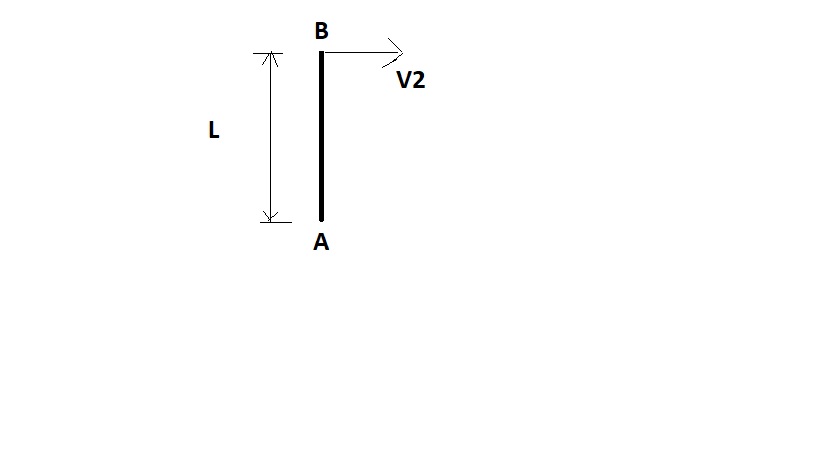
Point 'A' moves uniformly with velocity $V_1$ so that the vector $\vec{V}_1$ is continuously aimed at point 'B' which in its turn moves horizontally, rectilinearly and uniformly with velocity $V {2 \text {, such that }} V_1>V_2$. At the initial moment of time, $\vec{V}_1$ is perpendicular to $\overrightarrow{V_2}$, and the points are separated by a distance ' $L$ '. How soon will the points converge:-
| A. |
|
| B. |
|
| C. |
|
| D. |
|
You must be familiar with the experience of travelling in a train and being overtaken by another train moving in the same direction as you are. While that train must be travelling faster than you to be able to pass you, it does seem slower to you than it would be to someone standing on the ground and watching both the trains.