-
Engineering and Architecture
Exams
Colleges
Predictors
Resources
-
Computer Application and IT
Quick Links
Colleges
-
Pharmacy
Colleges
Resources
-
Hospitality and Tourism
Colleges
Resources
Diploma Colleges
-
Competition
Other Exams
Resources
-
School
Exams
Top Schools
Products & Resources
-
Study Abroad
Top Countries
Resources
-
Arts, Commerce & Sciences
Colleges
Upcoming Events
Resources
-
Management and Business Administration
Exams
Colleges & Courses
Predictors
-
Learn
Law Preparation
MBA Preparation
Engineering Preparation
Medical Preparation
-
Online Courses and Certifications
Top Streams
Specializations
- Digital Marketing Certification Courses
- Cyber Security Certification Courses
- Artificial Intelligence Certification Courses
- Business Analytics Certification Courses
- Data Science Certification Courses
- Cloud Computing Certification Courses
- Machine Learning Certification Courses
- View All Certification Courses
Resources
-
Medicine and Allied Sciences
Colleges
Predictors
Resources
-
Law
Resources
Colleges
-
Animation and Design
Exams
Predictors & Articles
Colleges
Resources
-
Media, Mass Communication and Journalism
Colleges
Resources
-
Finance & Accounts
Top Courses & Careers
Colleges
Speed and velocity - (Concept)
I. Speed
-
Rate of change of distance with time.
-
Formula-
$
\begin{aligned}
\text { Speed } & =\frac{\text { Change in distance }}{\text { change in time }} \\
v & =\frac{\text { distance }}{\text { time }}
\end{aligned}
$
- Tips of Speed-
1. S.I. unit $\rightarrow \mathrm{ms}^{-1}$ or meters per second.
2. Dimensions $=L T^{-1}$
3. Speed is a scalar quantity.
- E.g: A body covers a distance of 18 m in 1 sec
Using the formula of speed.
$
v=\frac{\text { distance }}{\text { time }}=\frac{18 \mathrm{~m}}{1 \mathrm{~s}} \Rightarrow 18 \mathrm{~m} / \mathrm{s}
$
II . Average Speed and Instantaneous Speed
1. Average Speed-
- Amount of total distance covered in total time.
- Formula-
$
\text { Average speed }=\frac{\text { total distance covered }}{\text { total time taken }} v_{a v}=\frac{s}{t}
$
- E.g A body covers a total distance of 50 m with variable speed in 5 sec .
$
v_{a v}=\frac{s}{t}
$
$
\Rightarrow \frac{50 \mathrm{~m}}{5 \mathrm{~s}}=10 \mathrm{~m} / \mathrm{s}
$
$
\text { Average Speed }=10 \mathrm{~m} / \mathrm{s}
$
- Tips for average speed-
If an object or body covers s1 distance in t 1 time and s 2 distance in t 2 time then average speed is calculated by the Formula- $V_{a v}=\frac{s_1+s_2}{t_1+t_2}$
2. Instantaneous Speed-
- It is the speed at that particular instant or small interval of time.
- Formula-
$
v_{\text {inst }}=\lim _{\Delta t \rightarrow 0} \frac{\Delta x}{\Delta t}
$
III. Velocity
- Rate of change of displacement with time.
- Formula-
$
V=\frac{\text { displacement }}{\text { time }}
$
-
Tips For velocity-
-
S.I. unit
m/s
-
Dimensions- $L T^{-1}$
3. Nelocity is a vector quantity.
4. Velocity is also called speed in a definite (particular) direction.
IV. Average Velocity and Instantaneous Velocity
1. Average Velocity-
- Amount of total displacement covered in total time.
- Formula-Average Velocity $=\frac{\text { Total Displacement }}{\text { Total time taken }}, \vec{V}_{\text {avg }}=\frac{\vec{S}_{\text {net }}}{t}$
2. Instantaneous Velocity-
- It is Velocity at that particular instant or small interval of time.
- Formula-$
\vec{V}_{\text {inst }}=\lim _{\Delta t \rightarrow 0} \frac{\overrightarrow{\Delta x}}{\Delta t}
$
V. Uniform motion and Non-uniform motion
-
Uniform motion-
-
If equal distance/displacement is covered in equal intervals of time, how small these intervals may be.
-
Uniform speed-If equal distances are covered in equal intervals of time.
-
Uniform velocity-If equal displacement are covered in equal intervals of time.
-
Uniform speed and Uniform velocity is the same as uniform motion.
-
For uniform motion along a straight line, the average and instantaneous velocities have the same values.
-
Non-uniform motion-
-
If equal distance/displacement is covered in unequal intervals of time.
-
Non-uniform speed-If equal distances are covered in unequal intervals of time.
-
Non-uniform velocity-If equal displacement are covered in unequal intervals of time.
-
Non-uniform speed and Non-uniform velocity is same as Non uniform motion
| Exam | Chapter |
| JEE MAIN | Kinematics |
Speed is
| A. |
|
| B. |
|
| C. |
|
| D. |
|
A body travels 100 km southwest and then $50 \sqrt{2} \mathrm{~km}$ in the northern direction. The total magnitude of the velocity if the time taken is 1 hr .|
| A. |
|
| B. |
|
| C. |
|
| D. |
|
An object moving with a speed of is decelerated at a rate given by
where
is the instantaneous speed. The time taken (in seconds) by the object, to come to rest, would be:
| A. |
|
| B. |
|
| C. |
|
| D. |
|
A particle is moving along elliptical path with constant speed. Then its motion is:
| A. |
|
| B. |
|
| C. |
|
| D. |
|
A particle moves such that its position vector where
is a constant and t is time. Then which of the following statements is true for the velocity
and acceleration
of the particle :
| A. |
|
| B. |
|
| C. |
|
| D. |
|
A car travelled along a circle having a radius r = 10 m. It complete the circle in 10 second then its average speed is
| A. |
|
| B. |
|
| C. |
|
| D. |
|
A particle moves 50 m in 5 second, then 20 m in next 4 second and 30 m in next 7 second then average speed (in m/s) of the particle is :
| A. |
|
| B. |
|
| C. |
|
| D. |
|
A particle travelled first 10 m with 2 m/s, next 10 m with 3 m/s and last 10 m with 6m/s then its average speed is (in m/s) :
| A. |
|
| B. |
|
| C. |
|
| D. |
|
A body moves along a semi-circle of radius (r) 1 m from point A to B in 3 seconds then its speed is

| A. |
|
| B. |
|
| C. |
|
| D. |
|
A car travels 30 m along the south and 40 m along west in 5 seconds magnitude of its velocity is (in m/s)
| A. |
|
| B. |
|
| C. |
|
| D. |
|
In motion with uniform velocity:
| A. |
|
| B. |
|
| C. |
|
| D. |
|
Which graph corresponds to an object moving with a constant negative acceleration and a positive velocity?
| A. |
|
| B. |
|
| C. |
|
| D. |
|
A particle is moving with speed along the positive x-axis. Calculate the speed of the particle at time
(assume that the particle is at the origin at t=0).
| A. |
|
| B. |
|
| C. |
|
| D. |
|
A car covers $A B$ distance with first one-third at velocity $\mathrm{v}_1 \mathrm{~ms}^{-1}$, second one-third at $\mathrm{v}_2 \mathrm{~ms}^{-1}$ and last one-third at $\mathrm{v}_3 \mathrm{~ms}^{-1}$. If $\mathrm{v}_3=3 \mathrm{v}_1, \mathrm{v}_2=2 \mathrm{v}_1$ and $\mathrm{v}_1=11 \mathrm{~ms}^{-1}$ then the average velocity of the car is $\qquad$ $\mathrm{ms}^{-1}$

| A. |
|
| B. |
|
| C. |
|
| D. |
|
If is :
| A. |
|
| B. |
|
| C. |
|
| D. |
|
The instantaneous velocity of a particle moving in a straight line is given as , where
are constants. The distance traveled by the particle between
is :
| A. |
|
| B. |
|
| C. |
|
| D. |
|
A particle is moving with constant speed of 50 m/sec along north and then after 10 second it start moving along west its motion is
| A. |
|
| B. |
|
| C. |
|
| D. |
|
Instantaneous Velocity is
| A. |
|
| B. |
|
| C. |
|
| D. |
|
Average Velocity is a
| A. |
|
| B. |
|
| C. |
|
| D. |
|
A particle located at at time
starts moving along the positive
- direction with a velocity
that varies as
The displacement of the particle varies with time as :
| A. |
|
| B. |
|
| C. |
|
| D. |
|
The velocity of a particle is If its position is
at
then its displacement after unit time
is :
| A. |
|
| B. |
|
| C. |
|
| D. |
|
The co-ordinates of a moving particle at any time t are given by and
, The speed of the particle at time t is given by
| A. |
|
| B. |
|
| C. |
|
| D. |
|
A person climbs up a stalled escalator in 60 s. If standing on the same escalator running with constant velocity he takes 40 seconds. How much time (in seconds) is taken by the person to walk up the moving escalator?
| A. |
|
| B. |
|
| C. |
|
| D. |
|
A particle is moving along a circular path with a constant speed of 10ms-1 . What is the magnitude of change in velocity of the particle, when it moves through an angle of 600 around the centre of the circle?
| A. |
|
| B. |
|
| C. |
|
| D. |
|
Ratio of magnitude of average speed to average velocity is
| A. |
|
| B. |
|
| C. |
|
| D. |
|
A body moving along a straight line travels one-third of the total distance with a speed of . The remaining distance is covered with a speed of
for the half time and
for the other half-time. The average speed during the motion is :
| A. |
|
| B. |
|
| C. |
|
| D. |
|
A boy walks on a straight road from his house to the market 2.5 km with a speed of . Finding the market closed he instantly turns and walks back with a speed of
.What is the average speed and average velocity of the boy between
?
| A. |
|
| B. |
|
| C. |
|
| D. |
|
Four persons named K, L, M, N are initially located at the four corners of a square of side d. Now everyone is moving with a constant speed v such that K is always moving straight to L, L straight to M, M straight to N, and N straight to K. Four people will meet at the same time.......

| A. |
|
| B. |
|
| C. |
|
| D. |
|
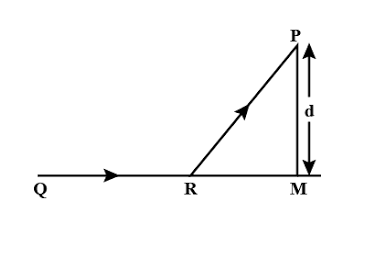
A man in a car at location Q on a straight highway is moving with speed . He decides to reach point P in a field at a distance d from the highway (point M) as shown in the figure. The speed of the car in the field is half to that on the highway. What should be the distance RM, so that the time taken to reach P is minimum?
| A. |
|
| B. |
|
| C. |
|
| D. |
|
A car travels a distance of ' $X^{\prime}$ with speed v1 and then the same distance ${ }^{\prime} X^{\prime}$ with speed v2 in the same direction. The average speed of the car is:
| A. |
|
| B. |
|
| C. |
|
| D. |
|
The distance travelled by a particle is related to time as
The velocity of the particle is :
| A. |
|
| B. |
|
| C. |
|
| D. |
|
A horse rider covers half the distance with $5 \ m/s$ speed. The remaining part of the distance wastravelled with speed $10 \ m/s$ for half the time and with speed $15 \ m/s$ for other half of the time. The mean speed of the rider averaged over the whole time of motion is $\frac{x}{7} \mathrm{~m} / \mathrm{s}$ . The value of $x$ is
| A. |
|
| B. |
|
| C. |
|
| D. |
|
A vehicle travels at speed of and another
with speed of
, then its average speed is
| A. |
|
| B. |
|
| C. |
|
| D. |
|
An object moves with speed v1, v2 and v3 along a line segment AB, BC and CD respectively as shown in figure. Where AB = BC and AD = 3AB, then average speed of the object will be:

| A. |
|
| B. |
|
| C. |
|
| D. |
|
A person travels x distance with velocity $v_1$ and then x distance with velocity $v_2$ in the same direction. The average velocity of the person is $v$, then the relation between $v, v_1$ and $v_2$ will be.
| A. |
|
| B. |
|
| C. |
|
| D. |
|
Two trains 'A' and 'B' of length 'l' and '4l' travel into a tunnel of length 'L' in parallel tracks from opposite directions with velocities of 108 km/h and 72 km/h, respectively. If train 'A' takes 35s less time than train 'B' to cross the tunnel then, the length 'L' of the tunnel is: (Given L = 60 l)
| A. |
|
| B. |
|
| C. |
|
| D. |
|
The distance travelled by an object in time t is given by. The instantaneous speed of the object at t =5 s will be :
| A. |
|
| B. |
|
| C. |
|
| D. |
|
The position of a particle related to time is given by . The magnitude of the velocity of the particle at t = 2s will be :
| A. |
|
| B. |
|
| C. |
|
| D. |
|
If the velocity of a particle is where
and
are constants, then the distance travelled by it between 1s and 2s is $\frac{7 \mathrm{~A}}{n}+\frac{15 \mathrm{~B}}{4}$
| A. |
|
| B. |
|
| C. |
|
| D. |
|
Prior to beginning to penetrate a 50 cm-thick mud wall, a 100g bullet travels at a speed of 5 m/s. When a bullet emerges from the other side of a wall with a mean resistance of 4.0 x 10⁻³ N, its speed is approximately (in nearest integer):
| A. |
|
| B. |
|
| C. |
|
| D. |
|
A particle moving in a straight line covers half the distance with the speed of $6 \mathrm{~m} / \mathrm{s}$. The other half of the distance is covered in two equal time intervals with the speed of $12 \mathrm{~m} / \mathrm{s}$ and $16 \mathrm{~m} / \mathrm{s}$. The average speed of the particle during this motion is approx
| A. |
|
| B. |
|
| C. |
|
| D. |
|
The velocity of a particle as a function of time is given as its displacement in time t is,
| A. |
|
| B. |
|
| C. |
|
| D. |
|
A bike rider covers half the distance at 10 m/s speed; then the remaining distance he covers with 20 m/s for the half time and another half time at 25 m/s speed; the mean speed of the bike rider over the whole motion is the value of
is
| A. |
|
| B. |
|
| C. |
|
| D. |
|
The position of an ant (S in meters) moving in the Y-Z plane is given by (where t is in second). The magnitude and direction of the velocity of the ant at t=1s will be :
| A. |
|
| B. |
|
| C. |
|
| D. |
|
A particle is moving in a straight line. The variation of position ' $x$ ' as a function of time ' $t$ ' is given as $x=\left(t^3-6 t^2+20 t+15\right) m$. The velocity of the body, when its acceleration becomes zero, is:
| A. |
|
| B. |
|
| C. |
|
| D. |
|
Velocity can be expressed as a derived quantity in terms of the following
| A. |
|
| B. |
|
| C. |
|
| D. |
|
A car covers half of its total distance with speed and the rest half distance with speed
. Its average speed during the complete journey is
| A. |
|
| B. |
|
| C. |
|
| D. |
|
A particle moves 50m in 5 second, then move 20m with constant speed of 5m/s and then move with constant speed of 30m/s for 1 second. Then find the average speed of particle during complete journey.
| A. |
|
| B. |
|
| C. |
|
| D. |
|
A particle moves 50m in 5 second , then move 20m with constant speed of 5m/s and then moves with constant speed of 30m/s for 1sec. Then find the average speed particle during complete journey:
| A. |
|
| B. |
|
| C. |
|
| D. |
|
A particle moves along a semicircle of a radius 10m in 5 seconds. The average velocity of the particle is
| A. |
|
| B. |
|
| C. |
|
| D. |
|
An athlete completes one round of a circular path of radius R = 30m in one minute with uniform speed then speed of athlete is -
| A. |
|
| B. |
|
| C. |
|
| D. |
|
For a moving particle which of the following statement is not true -
| A. |
|
| B. |
|
| C. |
|
| D. |
|
One car moving on a straight road covers one-third of the distance with 20 Km /Hr and the rest with 60 Km /Hr. Average speed is
| A. |
|
| B. |
|
| C. |
|
| D. |
|
Ram goes home to market (distance - 15 Km ) in one hour and comes back to home in 2 hours then average speed of Ram is
| A. |
|
| B. |
|
| C. |
|
| D. |
|
The magnitude of average velocity is equal to average speed when a particle moves -
| A. |
|
| B. |
|
| C. |
|
| D. |
|
Which of the following statement is not true
| A. |
|
| B. |
|
| C. |
|
| D. |
|
A particle goes from $A$ to $B$ with a speed of $20 \mathrm{~km} / \mathrm{h}$ and $B$ to $C$ with a speed of $30 \mathrm{~km} / \mathrm{h}$. If $A B=3 B C$, the average speed in $\mathrm{km} / \mathrm{h}$ between $A$ and $C$ is:
| A. |
|
| B. |
|
| C. |
|
| D. |
|
A particle is moving with constant speed in a circular path. When the particle turns by an angle 90o , the ratio of
instantaneous velocity to its average velocity is $\pi: x \sqrt{2 } $ The value of x will be -
| A. |
|
| B. |
|
| C. |
|
| D. |
|
A particle moving in a straight line covers half the distance with speed 6 m/s. The other half is covered in two equal time intervals with speeds 9 m/s and 15 m/s respectively. The average speed of the particle during the motion is :
| A. |
|
| B. |
|
| C. |
|
| D. |
|
A person standing on the open ground hears the sound of a jet aeroplane, coming from the north at an angle 60o with ground level. But he finds the aeroplane right vertically above his position. If $v$ is the speed of sound, the speed of the plane is :
| A. |
|
| B. |
|
| C. |
|
| D. |
|
A train starting from rest first accelerates uniformly up to a speed of 80 km/h for time t, then it moves with a constant speed for time 3t. The average speed of the train for this duration of journey will be (in km/h ) :
| A. |
|
| B. |
|
| C. |
|
| D. |
|
Direction: In the following question, a statement of Assertion (A) is followed by a statement of reason (R). Mark the correct choice as :
Assertion: Change in internal energy is independent of the path
Reason: Internal energy is a property of the system.
| A. |
|
| B. |
|
| C. |
|
| D. |
|
Direction: In the following question, a statement of Assertion (A) is followed by a statement of reason (R). Mark the correct choice as :
Assertion: AIr quickly leaking out of ballon becomes collar
Reason: The leaking gas undergoes isothermal expansion
| A. |
|
| B. |
|
| C. |
|
| D. |
|
Direction: In the following question, a statement of Assertion (A) is followed by a statement of reason (R). Mark the correct choice as :
Assertion: The specific heat for the adiabatic process is zero
Reason: The change in internal energy is zero in the adiabatic process
| A. |
|
| B. |
|
| C. |
|
| D. |
|
A train covers the first half of the distance between the stations with a speed of 40 Km/hr and the other half at 60Km/hr. Then its average speed is:
| A. |
|
| B. |
|
| C. |
|
| D. |
|
The magnitude of average velocity is equal to the average speed when a particle moves:
| A. |
|
| B. |
|
| C. |
|
| D. |
|
A ball is bouncing elastically with a speed of 1 m/s between the walls of a railway compartment of size 10 m in a direction perpendicular to the walls. The train is moving at a constant velocity of 10 m/s parallel to the direction of motion of the ball. As seen from the ground,
a) the direction of motion of the ball changes every 10 seconds
b) speed of the ball changes every 10 seconds
c) The average speed of the ball over any 20-second intervals is fixed
d) the acceleration of the ball is the same as of the train
| A. |
|
| B. |
|
| C. |
|
| D. |
|
A graph of x versus t is shown in Fig. 3.3. Choose the correct statements from below.

1) The particle was released from rest at t = 0.
2) At B, the acceleration a > 0.
3) At C, the velocity and the acceleration vanish.
4) The average velocity for the motion between A and D is positive.
5) The speed at D exceeds that at E
| A. |
|
| B. |
|
| C. |
|
| D. |
|
In a two-dimensional motion, instantaneous speed v0 is a positive constant. Then which of the following are necessarily true?
| A. |
|
| B. |
|
| C. |
|
| D. |
|
In a two dimensional motion, instantaneous speed is a positive constant. Then which of the following are necessarily true?
| A. |
|
| B. |
|
| C. |
|
| D. |
|
Direction : In the following question, a statement of Assertion (A) is followed by a statement of reason (R) . Mark the correct choice as :
Assertion : The work can change the temperature of system
Reason : Only heat can change the temperature of a system
| A. |
|
| B. |
|
| C. |
|
| D. |
|
The motion of a particle is defined by an equation:-
$x=8+9 t-t^3$
Where ' $x$ ' is in meter and $t$ is in second. What will be the position $(x)$ of the particle, When its velocity becomes zero:- (use $\sqrt{3}=1.732$ )
| A. |
|
| B. |
|
| C. |
|
| D. |
|
The rate of change of position for a time interval (dt) which is very small is?
| A. |
|
| B. |
|
| C. |
|
| D. |
|
A particle is moving on the $x$-axis such that its coordinate as a function of time is: $x=\frac{t^3}{3}-\frac{5 t^2}{2}+6 t+7$. Find out the correct option(s):
| A. |
|
| B. |
|
| C. |
|
| D. |
|
If velocity is taken as a fundamental quantity and its unit is called 'vel' which is equal to $15 \mathrm{~ms}^{-1}$ and the unit of time is taken as 'pec' which is equal to $(10 \mathrm{~s})$, what is the length of a 20-meter high building in this new system?
| A. |
|
| B. |
|
| C. |
|
| D. |
|
Three position Vs time graph is shown in the figure. In which case acceleration is zero

| A. |
|
| B. |
|
| C. |
|
| D. |
|
What is the formula for instantaneous speed?
| A. |
|
| B. |
|
| C. |
|
| D. |
|
Which of the following has the magnitude of the instantaneous velocity?
| A. |
|
| B. |
|
| C. |
|
| D. |
|
A train is moving with a velocity of 30 m/s and a bus is moving behind it at a velocity of 10 m/s in the same direction. The reaction velocity of the car with respect to a train is
| A. |
|
| B. |
|
| C. |
|
| D. |
|
A train is moving with a velocity of 30m/s M in the east direction. A monkey is running on the train in a direction with 5 m/s then the velocity of the train with aspect to the monkey is
| A. |
|
| B. |
|
| C. |
|
| D. |
|
Read the assertion and reason carefully to mark the correct option out of the options given below:
Assertion: The speedometer of a car measure the average velocity of the car.
Reason: Average velocity is equal to total displacement per unit time.
| A. |
|
| B. |
|
| C. |
|
| D. |
|
A person goes from point P to point Q covering 1/3 of the distance with speed 10 km/hr, the next 1/3 of the distance at 20 km/hr and the last 1/3 of the distance at 60 km/hr. The average speed of the person is
| A. |
|
| B. |
|
| C. |
|
| D. |
|
Two parallel discs are connected by a rigid rod of length L = 0.5 m centrally. Each disc has a slit oppositely placed as shown in the figure. A beam of neutral atoms is incident on one of the discs axially at different velocities v, while the system is rotated at an angular speed of 600 rev /second so that atoms only with a specific velocity emerge at the other end. Calculate the two largest speeds ( in meters/second) of the atoms that will emerge at the other end.

| A. |
|
| B. |
|
| C. |
|
| D. |
|
Two skaters P and Q are skating towards each other. Skater P throws a ball towards Q every 5 s such that it always leaves her hand with speed $2 \mathrm{~ms}^{-1}$ with respect to the ground. Consider two cases:
(I) P runs with speed $1 \mathrm{~ms}^{-1}$ towards Q while Q remains stationary.
(II) Q runs with speed $1 \mathrm{~ms}^{-1}$ towards P while P remains stationary.
Note that irrespective of the speed of P, the ball always leaves P 's hand with speed $2 \mathrm{~ms}^{-1}$ with respect to the ground. Ignore gravity. Balls will be received by Q.
| A. |
|
| B. |
|
| C. |
|
| D. |
|
A ball is travelling with uniform translatory motion. This means that
| A. |
|
| B. |
|
| C. |
|
| D. |
|
A vehicle travels half the distance L with speed $V_1$ and the other half with speed $V_2$, then its average speed is
| A. |
|
| B. |
|
| C. |
|
| D. |
|
At a metro station, a girl walks up a stationary escalator in time t1. If she remains stationary on the escalator, then the escalator take her up in time $t_2$. The time taken by her to walk up on the moving escalator will be
| A. |
|
| B. |
|
| C. |
|
| D. |
|
Direction: In the following question, a statement of Assertion (A) is followed by a statement of reason (R) . Mark the correct choice as :
Assertion: The velocity is moving in opposite direction of positive motion then its speed is negative
Reason: If the body is moving in opposite direction of positive motion then its speed is negative
| A. |
|
| B. |
|
| C. |
|
| D. |
|
The position vector of a moving body at any instant of time is given as $\overrightarrow{\mathrm{r}}=\left(5 \mathrm{t}^2 \hat{\mathrm{i}}-5 \mathrm{t} \hat{\mathrm{j}}\right) \mathrm{m}$. The magnitude and direction of velocity at $\mathrm{t}=2 \mathrm{~s}$ is,
| A. |
|
| B. |
|
| C. |
|
| D. |
|
A person travelling on a straight line moves with a uniform velocity $\mathrm{v}_1$ for a distance x and with a uniform velocity $\mathrm{v}_2$ for the next $\frac{3}{2} \mathrm{x}$ distance. The average velocity in this motion is $\frac{50}{7} \mathrm{~m} / \mathrm{s}$. If $\mathrm{v}_1$ is $5 \mathrm{~m} / \mathrm{s}$ then $\mathrm{v}_2=$ _____ $\mathrm{m} / \mathrm{s}$.
| A. |
|
| B. |
|
| C. |
|
| D. |
|
Average speed is defined as the total path length travelled divided by the total time interval during which the motion has taken place :