-
Engineering and Architecture
Exams
Colleges
Predictors
Resources
-
Computer Application and IT
Quick Links
Colleges
-
Pharmacy
Colleges
Resources
-
Hospitality and Tourism
Colleges
Resources
Diploma Colleges
-
Competition
Other Exams
Resources
-
School
Exams
Top Schools
Products & Resources
-
Study Abroad
Top Countries
Resources
-
Arts, Commerce & Sciences
Colleges
Upcoming Events
Resources
-
Management and Business Administration
Exams
Colleges & Courses
Predictors
-
Learn
Law Preparation
MBA Preparation
Engineering Preparation
Medical Preparation
-
Online Courses and Certifications
Top Streams
Specializations
- Digital Marketing Certification Courses
- Cyber Security Certification Courses
- Artificial Intelligence Certification Courses
- Business Analytics Certification Courses
- Data Science Certification Courses
- Cloud Computing Certification Courses
- Machine Learning Certification Courses
- View All Certification Courses
Resources
-
Medicine and Allied Sciences
Colleges
Predictors
Resources
-
Law
Resources
Colleges
-
Animation and Design
Exams
Predictors & Articles
Colleges
Resources
-
Media, Mass Communication and Journalism
Colleges
Resources
-
Finance & Accounts
Top Courses & Careers
Colleges
Vector addition and Vector Subtraction - (Concept)
- For the simple case in which both vectors have the same direction
-
Vector addition-
-
Vectors quantities are not added according to simple algebraic rules, because their direction that matters.
-
The addition of vectors means determining their resultant.
-
When two vectors are in the same direction then upon addition the direction of the resultant vector is the same as any of the two vectors, while the magnitude of the resultant vector is simply the algebraic sum of two vectors.
-
-eg, Vector $\vec{A}$ has magnitude $4 \&$ vector $\vec{B}$ has magnitude 2 in the same direction.
$\vec{A}+\vec{B}=4+2=6$ So resultant has a magnitude equal to 6 while its direction is either along $\vec{A}$ or $\vec{B}$
2) Vector Subtraction-
- Vector subtraction of $\vec{B}$ from $\vec{A}$ is equal to Vector addition of $\vec{A}$ and negative vector of $\vec{B}$.$
\vec{A}-\vec{B}=\vec{A}+(-\vec{B})
$- E.g., Vector $\vec{A}$ and $\vec{B}$ are in east direction with magnitudes 4 and 2 respectively.
Vector subtraction of $\vec{B}$ from $\vec{A}$ is equal
$
=\vec{A}-\vec{B}=4-2=2
$
The resultant vector has a magnitude of 2 in the east direction.
- For the case when both vectors do not have the same direction
-
Triangle law of vector addition
If two vectors are represented by both magnitude and direction by two sides of a triangle taken in the same order then their resultant is represented by side of the triangle.


The figure represents the triangle law of vector addition
So resultant side C is given by
$
c=\sqrt{a^2+b^2+2 a b \cos \theta}
$
Where $\theta=$ angle between two vectors.
-
Parallelogram law of vector addition
-
If two vectors are represented by both magnitude and direction by two adjacent sides of a parallelogram taken from the same point then their resultant is also represented by both magnitude and direction taken from the same point but by diagonal of the parallelogram.


- The figure represents law of parallelogram vector Addition
- Commutative law-
The Sum of vectors remains the same in whatever order they may be added.
$\vec{P}+\vec{Q}=\vec{Q}+\vec{P}$


Fig. Shows Commutative law of vector addition.
| Exam | Chapter |
| JEE MAIN | Kinematics |
Which of the following quantities is not a vector quantity?
| A. |
|
| B. |
|
| C. |
|
| D. |
|
The resultant of two forces 3P and 2P is R. If the first force is doubled, then the resultant is also doubled. The angle between the forces in degrees is
| A. |
|
| B. |
|
| C. |
|
| D. |
|
The ratio of maximum and minimum magnitudes of the resultant of two vectors $|\vec{a}|$ and $|\vec{b}|$ is $3: 1$, Now $|\vec{a}|=$
| A. |
|
| B. |
|
| C. |
|
| D. |
|
Two vectors have equal magnitudes. The magnitudes of
is 'n' times the magnitudes of
. The angle between
is :
| A. |
|
| B. |
|
| C. |
|
| D. |
|
The magnitude and direction of the resultant of two vectors $\vec{A}$ and $\vec{B}$ in terms of their magnitudes and angle $\theta$ between them is

| A. |
|
| B. |
|
| C. |
|
| D. |
|
Two forces are such that the sum of their magnitude is 18N, and their resultant is 12N which is perpendicular to the smaller force. Then the magnitude of the forces are
| A. |
|
| B. |
|
| C. |
|
| D. |
|
Two forces P and Q, of magnitude 2 F and 3 F, respectively, are at an angle $\theta$ with each other. If the force Q is doubled, then their resultant also gets doubled. Then the angle $\theta$ (in degrees) is :
| A. |
|
| B. |
|
| C. |
|
| D. |
|
The sum of two forces and
is
such that
The angle
(in degrees) that the resultant of
and
will make with
is ,
| A. |
|
| B. |
|
| C. |
|
| D. |
|
In an octagon ABCDEFGH of equal side, what is the sum of $\overrightarrow{A B}+\overrightarrow{A C}+\overrightarrow{A D}+\overrightarrow{A E}+\overrightarrow{A F}+\overrightarrow{A G}+\overrightarrow{A H}$ if $\overrightarrow{A O}=2 \widehat{i}+3 \widehat{j}-4 \widehat{k}$

| A. |
|
| B. |
|
| C. |
|
| D. |
|
A particle is moving along north after moving for 2 sec with a speed of 4 m/s, its speed becomes 5m/s. Its displacement (in meters) at end of 7 sec is ?
| A. |
|
| B. |
|
| C. |
|
| D. |
|
Which of the following relations is true for two unit vector $\hat{\mathrm{A}}$ and $\hat{\mathrm{B}}$ making an angle $\theta$ to each other ?
| A. |
|
| B. |
|
| C. |
|
| D. |
|
Two vectors have equal magnitudes. If the magnitude of
is equal to two times the magnitude of
, then the angle between
will be :
| A. |
|
| B. |
|
| C. |
|
| D. |
|
If $\vec{A}=(2 \hat{\mathrm{i}}+3 \hat{\mathrm{j}}-\hat{\mathrm{k}}) \mathrm{m}$ and $\vec{B}=(\hat{\mathrm{i}}+2 \hat{\mathrm{j}}+2 \hat{\mathrm{k}}) \mathrm{m}$. The magnitude of the component of vector $\vec{A}$ along vector $\vec{B}$ will be---- $\qquad$ m.
| A. |
|
| B. |
|
| C. |
|
| D. |
|
If $\vec{A}$ and $\vec{B}$ are two vectors satisfying the relation $\overrightarrow{\mathrm{A}} \cdot \overrightarrow{\mathrm{B}}=|\overrightarrow{\mathrm{A}} \times \overrightarrow{\mathrm{B}}|$. Then the value of $|\vec{A}-\vec{B}|_{\text {will be : }}$
| A. |
|
| B. |
|
| C. |
|
| D. |
|
Two vectors and
have equal magnitudes. If the magnitude of
is
times the magnitude of
, then angle between
and
is :
| A. |
|
| B. |
|
| C. |
|
| D. |
|
Match List I with List II, and Choose the correct answer from the options given below :

| A. |
|
| B. |
|
| C. |
|
| D. |
|
Two vectors have equal magnitude. The magnitude of
is
times the magnitude of
. The angle between
is :
| A. |
|
| B. |
|
| C. |
|
| D. |
|
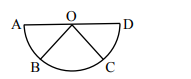
Assertion A : If A, B, C, D are four points on a semi-circular arc with centre at 'O' such that
$
\begin{aligned}
& |\overrightarrow{\mathrm{AB}}|=|\overrightarrow{\mathrm{BC}}|=|\overrightarrow{\mathrm{CD}}| \text {, then } \\
& \overrightarrow{\mathrm{AB}}+\overrightarrow{\mathrm{AC}}+\overrightarrow{\mathrm{AD}}=4 \overrightarrow{\mathrm{AO}}+\overrightarrow{\mathrm{OB}}+\overrightarrow{\mathrm{OC}}
\end{aligned}
$
Reason R : Polygon law of vector addition yields
$
\overrightarrow{\mathrm{AB}}+\overrightarrow{\mathrm{BC}}+\overrightarrow{\mathrm{CD}}+\overrightarrow{\mathrm{AD}}=2 \overrightarrow{\mathrm{AO}} \overrightarrow{\mathrm{AB}}+\overrightarrow{\mathrm{BC}}+\overrightarrow{\mathrm{CD}}+\overrightarrow{\mathrm{AD}}=2 \overrightarrow{\mathrm{AO}}
$
In the light of the above statements, choose the most appropriate answer from the options given below:
| A. |
|
| B. |
|
| C. |
|
| D. |
|
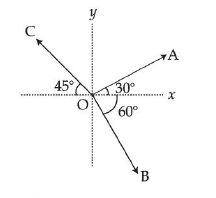
The magnitude of vectors $\overrightarrow{O A}, \overrightarrow{O B}$ and $\overrightarrow{O C}$ in the given figure are equal. the direction of $\overrightarrow{O A}+\overrightarrow{O B}-\overrightarrow{O C}$ with x-axis will be:
| A. |
|
| B. |
|
| C. |
|
| D. |
|
$\text { The angle between vector }(\vec{A}) \text { and }(\vec{A}-\vec{B}) \text { is: }$

| A. |
|
| B. |
|
| C. |
|
| D. |
|
Statement I:
Two forces $(\vec{P}+\vec{Q})$ and $(\vec{P}-\vec{Q})_{\text {where }} \vec{P} \perp \vec{Q}$, when act at an angle $\theta_1$ to each other, the magnitude of their resultant is $\sqrt{3\left(\mathrm{P}^2+\mathrm{Q}^2\right)}$, when they act at an angle $\theta_2$, the magnitude of their resultant becomes $\sqrt{2\left(\mathrm{P}^2+\mathrm{Q}^2\right)}$. This is possible only when $\theta_1<\theta_2$.
Statement II :
In the situation given above.
$
\theta_1=60^{\circ} \text { and } \theta_2=90^{\circ}
$
In the light of the above statements, choose the most appropriate answer from the options given below:
| A. |
|
| B. |
|
| C. |
|
| D. |
|
The ratio of maximum and minimum magnitudes of the resultant of two vectors $\vec{a}$ and $\vec{b}$ is $3: 1$, Now $|\vec{a}|=$
| A. |
|
| B. |
|
| C. |
|
| D. |
|
Which of the following is correct?
| A. |
|
| B. |
|
| C. |
|
| D. |
|
A particle has two velocities of equal magnitude inclined to each other at an angle θ. If one of them is halved, the angle between the other and the original resultant velocity is bisected by the new resultant. Then $\theta$ is :
| A. |
|
| B. |
|
| C. |
|
| D. |
|
Two forces are such that the sum of their magnitudes is 18 N and their resultant is 12 N which is perpendicular to the smaller force. Then the magnitudes of the forces are
| A. |
|
| B. |
|
| C. |
|
| D. |
|
If $|\vec{A}+\vec{B}|=|\vec{A}|=|\vec{B}|$, then the angle between $\vec{A}$ and $\vec{B}$ is (in degrees):
| A. |
|
| B. |
|
| C. |
|
| D. |
|
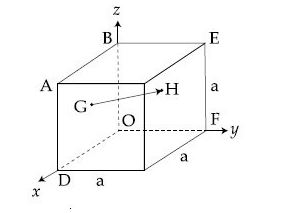
In the cube of side 'a' shown in the figure, the vector from the central point of the face ABOD to the central point of the face BEFO will be:
| A. |
|
| B. |
|
| C. |
|
| D. |
|
If $\vec{A}=5 \hat{i}+10 \hat{j}$ and $\vec{B}=10 \hat{i}+5 \hat{j}$, then the magnitude of $\vec{A}+\vec{B}$ is $x\sqrt{2}$. Find x.
| A. |
|
| B. |
|
| C. |
|
| D. |
|
If $\vec{A}=5 \hat{i}+10 \hat{j}$ and $\vec{B}=10 \hat{i}+5 \hat{j}$, then the magnitude of $\vec{A}-\vec{B}$ is x$\sqrt{2}$. Find x.
| A. |
|
| B. |
|
| C. |
|
| D. |
|
If . What is the angle (in degrees) between
?
| A. |
|
| B. |
|
| C. |
|
| D. |
|
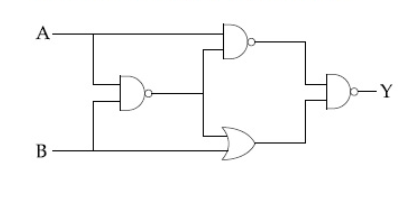
The output of the given logic circuit is :
| A. |
|
| B. |
|
| C. |
|
| D. |
|
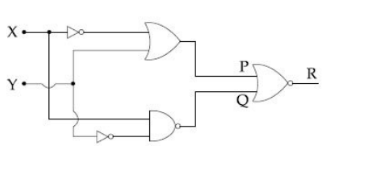
To get output '1' at R, for the given logic gate circuit, the input values must be:
| A. |
|
| B. |
|
| C. |
|
| D. |
|
The logic gate equivalent to the given logic circuit is :

| A. |
|
| B. |
|
| C. |
|
| D. |
|
Two vectors and
inclined at an angle
have a resultant
which makes an angle
with
. If the direction of
and
are interchanged, the resultant will have the same:
| A. |
|
| B. |
|
| C. |
|
| D. |
|
Which of the following quantities is dependent on the choice of orientation of the coordinate axes?
| A. |
|
| B. |
|
| C. |
|
| D. |
|
Vectors include an angle
between them. If
and
respectively subtend angles
with
, then
is:
| A. |
|
| B. |
|
| C. |
|
| D. |
|
Which of the following is not a property of the null vector
| A. |
|
| B. |
|
| C. |
|
| D. |
|
Given which of the following statements is not correct?
| A. |
|
| B. |
|
| C. |
|
| D. |
|
then the angle between
will be :
| A. |
|
| B. |
|
| C. |
|
| D. |
|
Two vectors are given by . Find the third vector
if
.
| A. |
|
| B. |
|
| C. |
|
| D. |
|
The components of the sum of vectors along x and y respectively are :
| A. |
|
| B. |
|
| C. |
|
| D. |
|
A vector $\vec{A}$ is rotated by small angle $\Delta \Theta$ radians $(\Delta \Theta<<1)$ to get a new vector $\vec{B}$.In that case $|\vec{B}-\vec{A}|$ is :
| A. |
|
| B. |
|
| C. |
|
| D. |
|
The sum of the magnitudes of two forces acting at the point is 16N. If the resultant force is 8N and its direction is perpendicular to the smaller force, then the forces are,
| A. |
|
| B. |
|
| C. |
|
| D. |
|
Two forces having magnitude and
are perpendicular to each other. The magnitude of their resultant is:
| A. |
|
| B. |
|
| C. |
|
| D. |
|
When a vector is subtracted from a vector
, it gives a vector equal to
. Then the magnitude of the vector
will be:
| A. |
|
| B. |
|
| C. |
|
| D. |
|
If two vectors $\vec{A}$ and $\vec{B}$ having equal magnitude R inclined at an angle $\theta$, then
| A. |
|
| B. |
|
| C. |
|
| D. |
|
A car travelling due north at 20 m/s turns west and travels at the same speed. The change in its velocity
| A. |
|
| B. |
|
| C. |
|
| D. |
|
If a vector is multiplied by a real number (-3) then
| A. |
|
| B. |
|
| C. |
|
| D. |
|
If $\vec{P}=3 \hat{i}+4 \hat{j}+7 \hat{k}$ and $\vec{Q}=\hat{i}+2 \hat{j}+\hat{k}$ the value of magnitude of resolution of $\vec{P}-\vec{Q}$ is.
| A. |
|
| B. |
|
| C. |
|
| D. |
|
If $\vec{A}$ and $\vec{B}$ are non zero vectors. Which obey the relation $|\vec{A}+\vec{B}|=|\vec{A}-\vec{B}|$ then the angle between them is -
| A. |
|
| B. |
|
| C. |
|
| D. |
|
If $\vec{P}+\vec{Q}=\vec{R}_{\text {and }}|\vec{P}|=8,|\vec{Q}|=15$ and $|\vec{R}|=17$ what is the angle between $\vec{P}$ and $\vec{Q}_{\text {is }}$
| A. |
|
| B. |
|
| C. |
|
| D. |
|
If $\vec{P}+\vec{Q}+\vec{R}$ and $|\vec{P}|=8|\vec{Q}|=215$ and $|\vec{R}|=17$ what is the angle between $\vec{P}$ and $\vec{Q}$
| A. |
|
| B. |
|
| C. |
|
| D. |
|
The position of a particle in a 500 triangular coordinate system is (4,6,-2). Its position vector will be
| A. |
|
| B. |
|
| C. |
|
| D. |
|
The position of a particle in a rectangular co-ordinate system is (4,6,-2). Then its position vector is :
| A. |
|
| B. |
|
| C. |
|
| D. |
|
Two forces of 12 N and 8 N act upon a body. The resultant force on the body has a maximum value of
| A. |
|
| B. |
|
| C. |
|
| D. |
|
Which of the following is true for the addition of the vectors?
| A. |
|
| B. |
|
| C. |
|
| D. |
|
which of the following is true for the addition of vector
| A. |
|
| B. |
|
| C. |
|
| D. |
|
Which of the following statements is true
1) The angle between negative vectors is equal to 180 degree
2) The magnitude of negative vectors is equal
3 ) negative vectors always have the same initial point
| A. |
|
| B. |
|
| C. |
|
| D. |
|
A vector perpendicular to $(4 \hat{i}-3 \hat{j})$ may be:
| A. |
|
| B. |
|
| C. |
|
| D. |
|
The minimum number of vectors of equal magnitude required to produce a zero resultant is:-
| A. |
|
| B. |
|
| C. |
|
| D. |
|
The resultant of $\vec{A}$ and $\vec{B}$ makes an angle $\alpha$ with $\vec{A}$ and $\beta$ with $\vec{B}$, then :-
| A. |
|
| B. |
|
| C. |
|
| D. |
|
Three vectors $A, B$ and $C$ add up to zero. Find which is false.
(a) $(A * B)^* C$ is not zero unless $B, C$ are parallel
(b) (A*B).C is not zero unless B,C are parallel
(c) If $A, B, C$ define a plane, $(A * B)^{\star} C$ is in that plane
(d) $\left(A^* B\right) \cdot C=|A||B||C| \rightarrow C^2=A^2+B^2$
| A. |
|
| B. |
|
| C. |
|
| D. |
|
For two vectors A and $\mathrm{B},|A+B|=|A-B|$ is always true when
(a) $|A|=|B| \neq 0$
(b) $|A| \perp|B|$
(c) $|A|=|B| \neq 0$ and A and B are parallel or anti parallel
(d) when either $|A|$ or $|B|$ is zero.
| A. |
|
| B. |
|
| C. |
|
| D. |
|
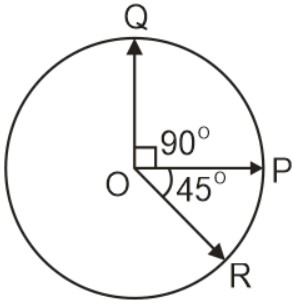
Three vectors $\mathrm{\overrightarrow{O P}, \overrightarrow{O Q}}$ and $\mathrm{\overrightarrow{O R}}$ each of magnitude A are acting as shown in figure. The resultant of the three vectors is $\mathrm{A \sqrt{x}}$. The value of x is ________.
| A. |
|
| B. |
|
| C. |
|
| D. |
|
Two forces $\vec{F}_1$ and $\vec{F}_2$ are acting on a body. One force has magnitude thrice that of the other force and the resultant of the two forces is equal to the force of larger magnitude. The angle between $\overrightarrow{\mathrm{F}}_1$ and $\vec{F}_2$ is $\cos ^{-1}\left(\frac{1}{n}\right)$. The value of $|n|$ is:
| A. |
|
| B. |
|
| C. |
|
| D. |
|
The five sides of a regular pentagon are represented by vectors $\overrightarrow{A_1}, \overrightarrow{A_2}, \overrightarrow{A_3}, \overrightarrow{A_4}$, and $\overrightarrow{A_5}$ in cyclic order as shown. Corresponding vertices are represented $\overrightarrow{B_1}, \overrightarrow{B_2}, \overrightarrow{B_3}, \overrightarrow{B_4}$, and $\overrightarrow{B_5}$, drawn from the centre of the pentagon.

Then,
$
\overrightarrow{B_2}+\overrightarrow{B_3}+\vec{B}_4+\overrightarrow{B_5}=
$
| A. |
|
| B. |
|
| C. |
|
| D. |
|
If $\vec{A}=4 \hat{i}-3 \hat{j}$ and $\vec{B}=6 \hat{i}+8 \hat{j}$ then magnitude and direction of $\vec{A}+\vec{B}$ will be
| A. |
|
| B. |
|
| C. |
|
| D. |
|
If $\vec{A}$ and $\vec{B}$ are non-zero vector which obey the relation $|\vec{A}+\vec{B}|=|\vec{A}-\vec{B}|$, then the angle between them is -------- $^{\circ}$
| A. |
|
| B. |
|
| C. |
|
| D. |
|
Two lines with direction cosines ${ }_{\mathrm{}} l_1, m_1, n_1$ and $l_2, m_2, n_2$ are at right angles if
| A. |
|
| B. |
|
| C. |
|
| D. |
|
Vectors, by definition, obey the triangle law or equivalently, the parallelogram law of addition.