-
Engineering and Architecture
Exams
Colleges
Predictors
Resources
-
Computer Application and IT
Quick Links
Colleges
-
Pharmacy
Colleges
Resources
-
Hospitality and Tourism
Colleges
Resources
Diploma Colleges
-
Competition
Other Exams
Resources
-
School
Exams
Top Schools
Products & Resources
-
Study Abroad
Top Countries
Resources
-
Arts, Commerce & Sciences
Colleges
Upcoming Events
Resources
-
Management and Business Administration
Exams
Colleges & Courses
Predictors
-
Learn
Law Preparation
MBA Preparation
Engineering Preparation
Medical Preparation
-
Online Courses and Certifications
Top Streams
Specializations
- Digital Marketing Certification Courses
- Cyber Security Certification Courses
- Artificial Intelligence Certification Courses
- Business Analytics Certification Courses
- Data Science Certification Courses
- Cloud Computing Certification Courses
- Machine Learning Certification Courses
- View All Certification Courses
Resources
-
Medicine and Allied Sciences
Colleges
Predictors
Resources
-
Law
Resources
Colleges
-
Animation and Design
Exams
Predictors & Articles
Colleges
Resources
-
Media, Mass Communication and Journalism
Colleges
Resources
-
Finance & Accounts
Top Courses & Careers
Colleges
Heat, Latent heat , Specific heat capacity and Temperature - (Concept)
-
Temperature-
It is fundamental quantity.
Dimensional formula- $M^0 L^0 T^0 K^1$ (where K represents Kelvin)
Sl unit- Kelvin
2. Heat
Dimensional formula- $M L^2 T^{-2}$
SI unit- Joule
3. Latent heat
Its dimensional formula is equal to $M^0 L^2 T^{-2}$
And its SI unit is equal to $\mathrm{m}^2 \mathrm{~s}^{-2}$ or $\mathrm{J} / \mathrm{kg}$
4. Specific heat capacity
Dimensional formula- $M^0 L^2 T^{-2} K^{-1}$
Sl unit- $\frac{J}{k g K}$
| Exam | Chapter |
| JEE MAIN | Physics and Measurement |
Dimensional formula of heat (Q) is
| A. |
|
| B. |
|
| C. |
|
| D. |
|
C.G.S unit of Latent heat is :
| A. |
|
| B. |
|
| C. |
|
| D. |
|
Match List I with List II:

Choose the correct answer from the options given below:
| A. |
|
| B. |
|
| C. |
|
| D. |
|
The latent heat of vaporisation of a substance is always
| A. |
|
| B. |
|
| C. |
|
| D. |
|
The quantity of heat required to change the unit mass of a solid substance from solid state to liquid state is defined as
| A. |
|
| B. |
|
| C. |
|
| D. |
|
Calculate the amount of heat required to melt 500 g ice at $0^0 c$ to water at $0^0 c$ (the latent heat of ice $=80 \mathrm{cal} / \mathrm{gm}$ )
| A. |
|
| B. |
|
| C. |
|
| D. |
|
Water is used to cool the radiator of engines because -
| A. |
|
| B. |
|
| C. |
|
| D. |
|
The dimensional formula of latent heat is:
| A. |
|
| B. |
|
| C. |
|
| D. |
|
Two different liquids of same mass are kept in two identical vessels, which are placed in a freezer that extracts heat from them at the same rate causing each liquid to transform into a solid. The schematic figure below shows the temperature $T$ vs time t plot for the two materials. We denote the specific heat in the liquid state to be $C_{L 1}$ and $C_{L 2}$ for material 1 and 2 respectively, and latent heats of fusion $U_1$ and $U_2$ respectively.
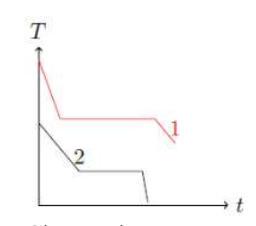
choose the correct option
| A. |
|
| B. |
|
| C. |
|
| D. |
|
If an average person jogs, he produces $14.5 \times 10^3 \mathrm{cal} / \mathrm{min}$. This is removed by the evaporation of sweat. The amount of sweat (in kg) evaporated per minute (assuming 1 kg requires $580 \times 10^3$ call for evaporation) is
| A. |
|
| B. |
|
| C. |
|
| D. |
|
Match List - I with List - II
| List - I | List - II |
| (A) Angular Impulse |
(I) $\quad\left[\mathrm{M}^0 \mathrm{~L}^2 \mathrm{~T}^{-2}\right]$ |
| (B) Latent Heat |
(II) $\left[\mathrm{M} \mathrm{L}^{-1} \mathrm{T}^{-3} \mathrm{~A}^{-1}\right]$ |
| (C) Electrical resistivity |
(III) $\left[\mathrm{M}^{-1} \mathrm{~T}^{-1}\right]$ |
| (D) Electromotive force |
(IV) $\left[M L^3 \mathrm{~T}^{-3} \mathrm{~A}^{-2}\right]$ |
Choose the correct answer from the options given below :
| A. |
|
| B. |
|
| C. |
|
| D. |
|
Match List-I with List-II.
| List-I | List-II |
| (A) Heat capacity of body | (I) $\mathrm{J} \mathrm{kg}^{-1}$ |
| (B) Specific heat capacity of body | (II) $\mathrm{JK}^{-1}$ |
| (C) Latent heat | (III) $\mathrm{J} \mathrm{kg}^{-1} \mathrm{~K}^{-1}$ |
| (D)Thermal conductivity | (IV) $\mathrm{Jm}^{-1} \mathrm{~K}^{-1} \mathrm{~s}^{-1}$ |
Choose the correct answer from the options given below :
| A. |
|
| B. |
|
| C. |
|
| D. |
|