-
Engineering and Architecture
Exams
Colleges
Predictors
Resources
-
Computer Application and IT
Quick Links
Colleges
-
Pharmacy
Colleges
Resources
-
Hospitality and Tourism
Colleges
Resources
Diploma Colleges
-
Competition
Other Exams
Resources
-
School
Exams
Top Schools
Products & Resources
-
Study Abroad
Top Countries
Resources
-
Arts, Commerce & Sciences
Colleges
Upcoming Events
Resources
-
Management and Business Administration
Exams
Colleges & Courses
Predictors
-
Learn
Law Preparation
MBA Preparation
Engineering Preparation
Medical Preparation
-
Online Courses and Certifications
Top Streams
Specializations
- Digital Marketing Certification Courses
- Cyber Security Certification Courses
- Artificial Intelligence Certification Courses
- Business Analytics Certification Courses
- Data Science Certification Courses
- Cloud Computing Certification Courses
- Machine Learning Certification Courses
- View All Certification Courses
Resources
-
Medicine and Allied Sciences
Colleges
Predictors
Resources
-
Law
Resources
Colleges
-
Animation and Design
Exams
Predictors & Articles
Colleges
Resources
-
Media, Mass Communication and Journalism
Colleges
Resources
-
Finance & Accounts
Top Courses & Careers
Colleges
Errors of measurements - (Concept)
It is the magnitude of the difference between the true value and the measured value of the quantity.
It may be positive in certain cases and negative in certain other cases
If $a_1, a_2, a_3 \ldots \ldots \ldots a_n$ are a measured value
then $a_m=\frac{a_1+a_2+\ldots \ldots a_n}{n}$
where $a_m=$ true value
then
1) Absolute Error for nth reading $=\Delta a_n=a_m-a_n=$ true value - measured value
So $\Delta a_1=a_m-a_1$
$
\Delta a_2=a_m-a_2
$
2) Mean absolute error
$
\Delta \bar{a}=\frac{\left|\Delta a_1\right|+\left|\Delta a_2\right|+\ldots .\left|\Delta a_n\right|}{n}
$
3) Relative error or Fractional error
The ratio of mean absolute error to the mean value of the quantity measured.
Relative error $=\frac{\Delta \bar{a}}{a_m}$
$\Delta \bar{a}-$ mean absolute error
$a_m=$ mean value
4) Percentage error
Percentage error $=\frac{\Delta \bar{a}}{a_m} \times 100 \%$
| Exam | Chapter |
| JEE MAIN | Physics and Measurement |
For measurement of the length of the cylinder by vernier callipers following readings are taken
3.29 cm 3.28 cm 3.29 cm 3.31 cm 3.28 cm 3.27 cm 3..29cm 3.30cm
The absolute error in measurement for the 5th reading is -
| A. |
|
| B. |
|
| C. |
|
| D. |
|
For a measurement of the diameter of a hollow cylinder following calculations are obtained for absolute error of different measurements
What will be the mean absolute error for the measurement?
| A. |
|
| B. |
|
| C. |
|
| D. |
|
In the measurement of the period of a simple pendulum, the readings turn out to be (1) 2.63 s (2) 2.56 s (3) 2.42 s (4) 2.71 s (5) 2.80 s. Calculate the % error in the measurement.
| A. |
|
| B. |
|
| C. |
|
| D. |
|
The unit of percentage error is
| A. |
|
| B. |
|
| C. |
|
| D. |
|
The value of the absolute error of the first measurement in a measured value a1,a2..............am is equal to [am is the true value]
| A. |
|
| B. |
|
| C. |
|
| D. |
|
For measurement of the diameter of a hollow cylinder, the following calculation are obtained for the absolute error of different measurement
What will be the mean absolute error for the measurement?
| A. |
|
| B. |
|
| C. |
|
| D. |
|
The resistance where
and
The percentage error in R is x %. The value of 'x' to the nearest integer is _________.
| A. |
|
| B. |
|
| C. |
|
| D. |
|
Which of the following statements is true for a measuring process -
| A. |
|
| B. |
|
| C. |
|
| D. |
|
In an experiment, the value of the refractive index of glass was found to be 1.54, 1.53 1.44, 1.54, 1.56 and 1.45 in successive measurement. What is an absolute error in the measurement of the third reading?
| A. |
|
| B. |
|
| C. |
|
| D. |
|
If a tuning fork of frequency 340Hz, tolerance
is used in the resonance column method
the first and the second resonances are measured at The max. permissible error in speed of sound is :
| A. |
|
| B. |
|
| C. |
|
| D. |
|
In MKS system for measurement of length, mass and time which fundamental units are used
| A. |
|
| B. |
|
| C. |
|
| D. |
|
In a simple pendulum, experiment for determination of acceleration due to gravity (g), the time taken for 40 oscillations is measured by using a watch of 2 second least count. the mean value of time taken comes out to be 60 seconds. The length of the pendulum was measured by a meter scale of least count 2 mm and the value obtained 60 cm. The percentage error in the determination of g close to _____
| A. |
|
| B. |
|
| C. |
|
| D. |
|
Given below are two statements; one is labelled as Assertion (A) and the other is labelled as Reason (R).
Assertion (A): The angular speed of the moon in its orbit around the Earth is more than the angular speed of the earth in its orbit around the sun.
Reasons (R): The moon takes less time to move around the earth than the time taken by the earth to move around the sun.
In the light of the above statements, choose the most appropriate answer from the options given below:
| A. |
|
| B. |
|
| C. |
|
| D. |
|
The resistance $\mathrm{R}=\frac{\mathrm{V}}{\mathrm{I}}$ where $\mathrm{V}=(200 \pm 5) \mathrm{V}$ and $\mathrm{I}=(20 \pm 0.2) \mathrm{A}$, the percentage error in the measurement of $\mathrm{R}$ is :
| A. |
|
| B. |
|
| C. |
|
| D. |
|
If the percentage errors in measuring the length and the diameter of a wire are $0.1 \%$ each. The percentage error in measuring its resistance will be :
| A. |
|
| B. |
|
| C. |
|
| D. |
|
The measured value of the length of a simple pendulum is 20 cm with 2 mm accuracy. The time for 50 oscillations was measured to be 40 seconds with 1 second resolution. From these measurements, the accuracy in the measurement of acceleration due to gravity is N%. The value of N is
| A. |
|
| B. |
|
| C. |
|
| D. |
|
The radius ( $\mathrm{r}$ ), length (1) and resistance (R) of a metal wire were measured in the laboratory as
$ \mathrm{r}=(0.35 \pm 0.05) \mathrm{cm} $
$ \mathrm{R}=(100 \pm 10) \mathrm{ohm} $
$ \mathrm{l}=(15 \pm 0.2) \mathrm{cm}$
The percentage error in resistivity of the material of the wire is:
| A. |
|
| B. |
|
| C. |
|
| D. |
|
A physical quantity is given by $X=\frac{P^a Q^b}{R^c}$. The percentage error in measurement of $\mathrm{P}, \mathrm{Q}$ and R are $\alpha, \beta$ and $\gamma$ respectively. Then maximum percentage error in quantity X is :
| A. |
|
| B. |
|
| C. |
|
| D. |
|
For a measurement of the radius of a ball following readings are taken:
3.26cm 3.28cm 3.31cm
absolute error for the first reading is :
| A. |
|
| B. |
|
| C. |
|
| D. |
|
For the measurement of the cylinder following readings are taken :
1.52cm 1.50cm 1.51cm 1.48cm
mean absolute error for the measurement is :
| A. |
|
| B. |
|
| C. |
|
| D. |
|
The heat produced is given by H = I2RT, where I is the current, R is the resistance and T is time. If the error in the measurement of I,R and T are 1%,3% and 4% respectively then the error in the measurement of H is:
| A. |
|
| B. |
|
| C. |
|
| D. |
|
If the length of the stick $P$ is $(28.7 \pm 0.5) \mathrm{cm}$ and that of the stick $Q$ is $(19.6 \pm 0.3) \mathrm{cm}$. What will be the percentage error in $R$, if $R=P+Q$
| A. |
|
| B. |
|
| C. |
|
| D. |
|
If the mass of box $A$ is $(3.25 \pm 0.01) \mathrm{kg}$ and that of $B$ is $(4.19 \pm 0.01) \mathrm{kg}$, then box $B$ is heavier than $A$ by:
| A. |
|
| B. |
|
| C. |
|
| D. |
|
If the percentage error in the measurement of resistance R is 5% and that of in a measurement of current I is 2% , then maximum fractional error in voltage V will be :
| A. |
|
| B. |
|
| C. |
|
| D. |
|
If $D=\frac{A C^2}{B^3}$, find the relative error in measurement of D if the relative error in measurement of $\mathrm{A}, \mathrm{B}$ and C are respectively 1, 2, and 3 percentages.
| A. |
|
| B. |
|
| C. |
|
| D. |
|
The magnitude of difference between the true value and measured value of quantity is called
| A. |
|
| B. |
|
| C. |
|
| D. |
|
The ratio of mean absolute error to the mean value of the quantity measured is called:
| A. |
|
| B. |
|
| C. |
|
| D. |
|
The resistance $R=\frac{V}{I}$ where $V=(100 \pm 3)$ volts ${\text {and }} I=(10 \pm 0.3) A$. What is the total error in the R?
| A. |
|
| B. |
|
| C. |
|
| D. |
|
The unit of percentage error is :
| A. |
|
| B. |
|
| C. |
|
| D. |
|
The value of absolute error of first measurement in a measured value a1,a2..............am is equal to
[am is the true value]
| A. |
|
| B. |
|
| C. |
|
| D. |
|
If the error in the mass and kinetic energy is 3% and 4% respectively. Then what is the maximum percentage error in its momentum?
| A. |
|
| B. |
|
| C. |
|
| D. |
|
If the error in measuring the diameter of a circle is 4%, the error in the circumference of the circle will be
| A. |
|
| B. |
|
| C. |
|
| D. |
|
The mean length of an object is 5 cm . Which of the following measurements is most accurate?
| A. |
|
| B. |
|
| C. |
|
| D. |
|
The distance of the Sun from earth is $1.5 \times 10^{11} \mathrm{~m}$ and its angular diameter is $(2000) \mathrm{s}$ when observed from the earth. The diameter of the Sun will be $1.45 \times 10^x \mathrm{~m}$, then the value of x will be
| A. |
|
| B. |
|
| C. |
|
| D. |
|
If $D=\frac{A C^2}{B^3}$ Find the relative error in measurement of $D$ if relative error in measurement of $A, B$, and $C$ are respectively 1,2 and 3 percentage
| A. |
|
| B. |
|
| C. |
|
| D. |
|
Young's modulus is determined by the equation given by $Y=49000 \frac{\mathrm{m}}{\ell} \frac{\text { dyne }}{\mathrm{cm}^2}$ where $M$ is the mass and $\ell$ is the extension of wire used in the experiment. Now error in Young modules $(\mathrm{Y})$ is estimated by taking data from $\mathrm{M}-\ell$ plot in graph paper. The smallest scale divisions are $5 \mathrm{~g}$ and 0.02 $\mathrm{cm}$ along the load axis and extension axis respectively. If the value of $\mathrm{M}$ and $\ell$ are $500 \mathrm{~g}$ and $2 \mathrm{~cm}$ respectively then percentage error of $\mathrm{Y}$ is :
| A. |
|
| B. |
|
| C. |
|
| D. |
|
Two students P and Q perform an experiment to verify Ohm's law for a conductor with resistance R. They use a current source and a voltmeter with the least counts 0.1mA and 0.1mV, respectively. The plots of variation of voltage drop (V) across the current (I) for both are shown below.
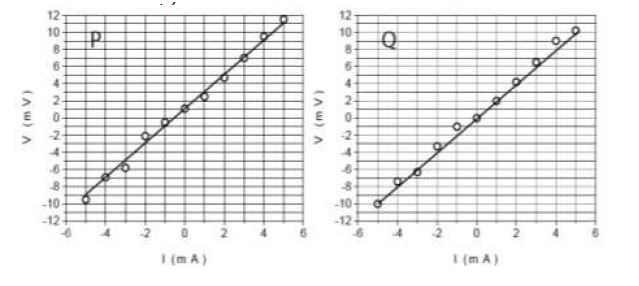
The statement which is more likely to be correct is:
| A. |
|
| B. |
|
| C. |
|
| D. |
|
The energy of a system is given as $E(t)=\alpha^3 e^{-\beta t}$, where $t$ is the time and $\beta=0.3 \mathrm{~s}^{-1}$. The errors in the measurement of $\alpha$ and $t$ are $1.2 \%$ and $1.6 \%$, respectively. At $t=5 \mathrm{~s}$, the maximum percentage error in the energy is:
| A. |
|
| B. |
|
| C. |
|
| D. |
|
The magnitude of the difference between the individual measurement and the true value of the quantity is called the absolute error of the measurement.