-
Engineering and Architecture
Exams
Colleges
Predictors
Resources
-
Computer Application and IT
Quick Links
Colleges
-
Pharmacy
Colleges
Resources
-
Hospitality and Tourism
Colleges
Resources
Diploma Colleges
-
Competition
Other Exams
Resources
-
School
Exams
Top Schools
Products & Resources
-
Study Abroad
Top Countries
Resources
-
Arts, Commerce & Sciences
Colleges
Upcoming Events
Resources
-
Management and Business Administration
Exams
Colleges & Courses
Predictors
-
Learn
Law Preparation
MBA Preparation
Engineering Preparation
Medical Preparation
-
Online Courses and Certifications
Top Streams
Specializations
- Digital Marketing Certification Courses
- Cyber Security Certification Courses
- Artificial Intelligence Certification Courses
- Business Analytics Certification Courses
- Data Science Certification Courses
- Cloud Computing Certification Courses
- Machine Learning Certification Courses
- View All Certification Courses
Resources
-
Medicine and Allied Sciences
Colleges
Predictors
Resources
-
Law
Resources
Colleges
-
Animation and Design
Exams
Predictors & Articles
Colleges
Resources
-
Media, Mass Communication and Journalism
Colleges
Resources
-
Finance & Accounts
Top Courses & Careers
Colleges
Intersection of Set, Properties of Intersection - (Concept)
The intersection of sets $A$ and $B$ is the set of all elements which are common to both $A$ and $B$. The symbol ' $\cap$ 'is used to denote the intersection.
Symbolically, we write $A \cap B=\{x: x \in A$ and $x \in B\}$
For example, let $\mathrm{A}=\{2,4,6,8\}$ and $\mathrm{B}=\{2,3,5,8\}$, then $\mathrm{A} \cap \mathrm{B}=\{2,8\}$

If $A$ and $B$ are two sets such that $A \cap B=\varphi$, then $A$ and $B$ are called disjoint sets.
For example, let $A=\{2,4,6,8\}$ and $B=\{1,3,5,7\}$. Then $A$ and $B$ are disjoint sets because there are no elements which are common to A and B .
Properties of intersection
$\mathrm{A} \cap \mathrm{B}=\mathrm{B} \cap \mathrm{A}$ (Commutative law).
$(A \cap B) \cap C=A \cap(B \cap C)$ (Associative law).
$\mathrm{A} \cap \phi=\phi$,
$\mathrm{A} \cap \mathrm{U}=\mathrm{A}$ (Law of $\phi$ and U$)$.
$\mathrm{A} \cap \mathrm{A}=\mathrm{A}$ (Idempotent law)
If $A$ is subset of $B$, then $A \cap B=A$
Distributive laws
1. $A \cap(B \cup C)=(A \cap B) \cup(A \cap C)$ i. e., $\cap$ distributes over $\cup$
This can be seen easily from the following Venn diagrams
LHS:

RHS:


2. $A \cup(B \cap C)=(A \cup B) \cap(A \cup C)$
This can be seen easily from the following Venn diagrams
LHS:


RHS:


| Exam | Chapter |
| JEE MAIN | Sets, Relations and Functions |
If A,B and C are three sets such that , then
| A. |
|
| B. |
|
| C. |
|
| D. |
|
Let $\mathrm{A}, \mathrm{B}$ and C be sets such that $\phi \neq A \cap B \subseteq C$. Then which of the following statements is not true?
| A. |
|
| B. |
|
| C. |
|
| D. |
|
then which of the following is true?
| A. |
|
| B. |
|
| C. |
|
| D. |
|
Which of the following is the associative property of intersection?
| A. |
|
| B. |
|
| C. |
|
| D. |
|
, then which of the following is true?
| A. |
|
| B. |
|
| C. |
|
| D. |
|
If A and B are equal sets, then which of the following is NOT true?
| A. |
|
| B. |
|
| C. |
|
| D. |
|
Given . Find the value of
| A. |
|
| B. |
|
| C. |
|
| D. |
|
Given , then what is the value of
.
| A. |
|
| B. |
|
| C. |
|
| D. |
|
| A. |
|
| B. |
|
| C. |
|
| D. |
|
If ; and
then
= ?
| A. |
|
| B. |
|
| C. |
|
| D. |
|
If and
, then
is equal to
| A. |
|
| B. |
|
| C. |
|
| D. |
|
If and
; then:
| A. |
|
| B. |
|
| C. |
|
| D. |
|
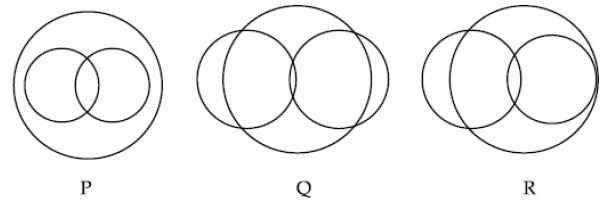
In a school, there are three types of games to be played. Some of the students play two types of games, but none play all three games. Which Venn diagrams can justify the above statement?
| A. |
|
| B. |
|
| C. |
|
| D. |
|
If aN={ax:xN} and bN
cN=dN where b,c
N are relatively prime, then
| A. |
|
| B. |
|
| C. |
|
| D. |
|
If A={1,3,5}, B={3,7,9} and C={3}, then which of the following is true?
| A. |
|
| B. |
|
| C. |
|
| D. |
|
If A={5,6,7} and B={ }, then which of the following is true?
| A. |
|
| B. |
|
| C. |
|
| D. |
|
If , then which of the following is true?
| A. |
|
| B. |
|
| C. |
|
| D. |
|
| A. |
|
| B. |
|
| C. |
|
| D. |
|
, then which of the following equals
?
| A. |
|
| B. |
|
| C. |
|
| D. |
|
Which of the following Venn Diagram shows $A\cap B\cap C \,'$ ?
| A. |
|
| B. |
|
| C. |
|
| D. |
|
Which of the following is the correct representation of the set $A \cap B$?
| A. |
|
| B. |
|
| C. |
|
| D. |
|
| A. |
|
| B. |
|
| C. |
|
| D. |
|
If and
Find
| A. |
|
| B. |
|
| C. |
|
| D. |
|
Suppose is a real-valued function satisfying
and Suppose
The value of
is:
| A. |
|
| B. |
|
| C. |
|
| D. |
|
| A. |
|
| B. |
|
| C. |
|
| D. |
|
In a group of 100 persons 75 speak English and 40 speak Hindi. Each person speaks at least one of the two
languages. If the number of persons, who speak only English is and the number of persons who speak only
Hindi is , then the eccentricity of the ellipse
is:
| A. |
|
| B. |
|
| C. |
|
| D. |
|
The number of elements in the set :
| A. |
|
| B. |
|
| C. |
|
| D. |
|
An organization awarded 48 medals in event ‘A’, 25 in event ‘B’ and 18 in event ‘C’. If these medals went to total 60 men and only five men got medals in all the three events, then, how many received medals in exactly two of three events ?
| A. |
|
| B. |
|
| C. |
|
| D. |
|
A group of 40 students appeared in an examination of 3 subjects - Mathematics, Physics and Chemistry. It was found that all students passed in at least one of the subjects, 20 students passed in Mathematics, 25 students passed in Physics, 16 students passed in Chemistry, at most 11 students passed in both Mathematics and Physics, and most 15 students passed in both Physics and Chemistry, at most 15 students passed in both Mathematics and Chemistry. The maximum number of students passed in all the three subjects is __________.
| A. |
|
| B. |
|
| C. |
|
| D. |
|
$(-3,4) \cap[0,5] \cap(5,7]$ equals
| A. |
|
| B. |
|
| C. |
|
| D. |
|
$
\phi \cap A=?
$
Where $\phi$ is a null set.
| A. |
|
| B. |
|
| C. |
|
| D. |
|
If $A=\{x: x \in N$ and $x<5\}$ then $A \cap A=B$ where $\mathrm{B}=$
| A. |
|
| B. |
|
| C. |
|
| D. |
|
Let A = {1,2,3} , B = {3,6} and C = {4,5,6,7} Then $A \cup (B\cap C ) is$
| A. |
|
| B. |
|
| C. |
|
| D. |
|
What is $A \cap B$ for $\mathrm{A}=\{\mathrm{x}: \mathrm{x} \in$ prime no. less than 29$\}$
$
B=\{1,2,3,4,5,6\}
$
| A. |
|
| B. |
|
| C. |
|
| D. |
|
What is the distributive property?
| A. |
|
| B. |
|
| C. |
|
| D. |
|
What is the Idempotent Law?
| A. |
|
| B. |
|
| C. |
|
| D. |
|
Which is the associative property of intersection?
| A. |
|
| B. |
|
| C. |
|
| D. |
|
Which is the commutative property of intersection?
| A. |
|
| B. |
|
| C. |
|
| D. |
|
Which of the following is a distributive property?
| A. |
|
| B. |
|
| C. |
|
| D. |
|
If A and B are any two sets, then $A \cup(A \cap B)$ is equal to
| A. |
|
| B. |
|
| C. |
|
| D. |
|
If A and B are two sets, then A ∩ (A ∪ B) equals
| A. |
|
| B. |
|
| C. |
|
| D. |
|
Intersection of intervals $(2,5)$ and $(\pi, 4]$ is
| A. |
|
| B. |
|
| C. |
|
| D. |
|
Let $U$ be the Universal set and $A \cup B \cup C=U$. Then $((A-B) \cup(B-C) \cup(C-A))^{\prime}=$
| A. |
|
| B. |
|
| C. |
|
| D. |
|
If sets A and B are defined as $A = \left\{(x,y):y= \frac{1}{x}, 0\neq x\in R \right \}\prod $ $B= \left\{(x,y):y= -x, x\in R \right \}$, then
| A. |
|
| B. |
|
| C. |
|
| D. |
|
In a class of 60 students, 25 students play cricket and 20 students play tennis, and 10 students play both the games. Then, the number of students who play neither is
| A. |
|
| B. |
|
| C. |
|
| D. |
|
Let S = set of points inside the square, T = the set of points inside the triangle and C = the set of points inside the circle. If the triangle and circle intersect each other and are contained in a square. Then
| A. |
|
| B. |
|
| C. |
|
| D. |
|
Intersection of the intervals $(-4,3),[-2,2]$ and $(0,5]$ is
| A. |
|
| B. |
|
| C. |
|
| D. |
|
Intersection of the intervals $(-6,0)$ and $(-2,4)$ is
| A. |
|
| B. |
|
| C. |
|
| D. |
|
Let $A=\left\{\theta \in \mathbb{R} \mid \cos ^2(\sin \theta)+\sin ^2(\cos \theta)=1\right\}$ and $B=\{\theta \in \mathbb{R} \mid \cos (\sin \theta) \sin (\cos \theta)=0\}$. Then $A \bigcap B$
| A. |
|
| B. |
|
| C. |
|
| D. |
|
If $a N=\{a x: x \in N\}$, then $4 N \cap 6 N$ equals
| A. |
|
| B. |
|
| C. |
|
| D. |
|