-
Engineering and Architecture
Exams
Colleges
Predictors
Resources
-
Computer Application and IT
Quick Links
Colleges
-
Pharmacy
Colleges
Resources
-
Hospitality and Tourism
Colleges
Resources
Diploma Colleges
-
Competition
Other Exams
Resources
-
School
Exams
Top Schools
Products & Resources
-
Study Abroad
Top Countries
Resources
-
Arts, Commerce & Sciences
Colleges
Upcoming Events
Resources
-
Management and Business Administration
Exams
Colleges & Courses
Predictors
-
Learn
Law Preparation
MBA Preparation
Engineering Preparation
Medical Preparation
-
Online Courses and Certifications
Top Streams
Specializations
- Digital Marketing Certification Courses
- Cyber Security Certification Courses
- Artificial Intelligence Certification Courses
- Business Analytics Certification Courses
- Data Science Certification Courses
- Cloud Computing Certification Courses
- Machine Learning Certification Courses
- View All Certification Courses
Resources
-
Medicine and Allied Sciences
Colleges
Predictors
Resources
-
Law
Resources
Colleges
-
Animation and Design
Exams
Predictors & Articles
Colleges
Resources
-
Media, Mass Communication and Journalism
Colleges
Resources
-
Finance & Accounts
Top Courses & Careers
Colleges
Modulus Function, Properties of Modulus Function - (Concept)
Modulus Function:
The function f: RR defined by f(x) = |x| for each x
R is called the modulus function.
For each non-negative value of x, f(x) is equal to x. But for negative values of x, the value of f(x) is the negative of the value of x
$|\mathrm{x}|, \quad \mathrm{x} \in \mathbb{R}=\left\{\begin{array}{cc}x, & x \geq 0 \\ -x, & x<0\end{array}\right.$

Range $\in[0, \infty)$
Modulus Equations: Properties
If $a>0$
1. $|x|=a$, then $x=a,-a$
2. $|x|=|-x|$
3. $|x|^2=x^2$
4. If $|\mathrm{x}|=\mathrm{x}$, then $\mathrm{x}>0$ or $\mathrm{x}=0$
5. If $|x|=-x$, then $x<0$ or $x=0$
6. $|f(x)|=|g(x)|$, then $f(x)=g(x)$ or $f(x)=-g(x)$
Modulus inequalities
These deal with the inequalities (<, >, ≤, ≥ ) on expressions with absolute value sign.
Properties
If a, b > 0, then
1.
$
\begin{aligned}
& |x| \leq a \Rightarrow x^2 \leq a^2 \\
& \Rightarrow-a \leq x \leq a
\end{aligned}
$
2.
$
\begin{aligned}
& |x| \geq a \Rightarrow x^2 \geq a^2 \\
& \Rightarrow x \leq-a \text { or } x \geq a
\end{aligned}
$
3.
$
\begin{aligned}
& a \leq|x| \leq b \Rightarrow a^2 \leq x^2 \leq b^2 \\
& \Rightarrow x \in[-b,-a] \cup[a, b]
\end{aligned}
$
4. $|x+y|=|x|+|y| \Leftrightarrow x y \geq 0$.
5. $|x-y|=|x|-|y| \Rightarrow x \cdot y \geq 0$ and $|x| \geq|y|$
6. $|x \pm y| \leq|x|+|y|$
7. $|x \pm y| \geq||x|-|y||$
| Exam | Chapter |
| JEE MAIN | Sets, Relations and Functions |
Let $S$ be the set of all real roots of the equation, $3^x\left(3^x-1\right)+2=\left|3^x-1\right|+\left|3^x-2\right| \cdot$ Then S $\qquad$
| A. |
|
| B. |
|
| C. |
|
| D. |
|
If . Then the range of f(x) is
| A. |
|
| B. |
|
| C. |
|
| D. |
|
If . Then range of f(x) is
| A. |
|
| B. |
|
| C. |
|
| D. |
|
If , then what is the range of f(x)?
| A. |
|
| B. |
|
| C. |
|
| D. |
|
Let $\mathrm{A}=\{\mathrm{x} \in \mathbb{R}:|\mathrm{x}+1|<2\}_{\text {and }} \mathrm{B}=\{\mathrm{x} \in \mathbb{R}:|\mathrm{x}-1| \geq 2\}$. Then which one of the following statements is NOT true?
| A. |
|
| B. |
|
| C. |
|
| D. |
|
Let
Consider
Then,
| A. |
|
| B. |
|
| C. |
|
| D. |
|
:
| A. |
|
| B. |
|
| C. |
|
| D. |
|
The number of real solutions of the equation, is:
| A. |
|
| B. |
|
| C. |
|
| D. |
|
If then the set of value of x is:
| A. |
|
| B. |
|
| C. |
|
| D. |
|
The number of the integral solution of is:
| A. |
|
| B. |
|
| C. |
|
| D. |
|
For , x R y is a relation such that
where R is an equivalence relation. Find image(s) of 5
| A. |
|
| B. |
|
| C. |
|
| D. |
|
Let ,
, where [t] denotes greatest integer function. Then,
| A. |
|
| B. |
|
| C. |
|
| D. |
|
The number of real solutions of the equation $x\left(x^2+3|x|+5|x-1|+6|x-2|\right)=0$ is
| A. |
|
| B. |
|
| C. |
|
| D. |
|
Define $\left|x^2-3 x+2\right|$
| A. |
|
| B. |
|
| C. |
|
| D. |
|
Define the mod: $|x+2|$.
| A. |
|
| B. |
|
| C. |
|
| D. |
|
If $|x-3|=5$, then $x=$
| A. |
|
| B. |
|
| C. |
|
| D. |
|
If $\mathrm{S}=\{\mathrm{a} \in \mathrm{R}:|2 \mathrm{a}-1|=3[\mathrm{a}]+2\{\mathrm{a}\}\}$, where [t] denotes the greatest integer less than or equal to $t$ and $\{t\}$ represents the fractional part of $t$, then $72 \sum_{\mathrm{a} \in \mathrm{S}} \mathrm{a}$ is equal to $\qquad$
| A. |
|
| B. |
|
| C. |
|
| D. |
|
If solution of $|x+9|>-3$ is the set A and the solution of $|x+9|<-3$ is the set $B$ then set $A$ and set $B$ are
| A. |
|
| B. |
|
| C. |
|
| D. |
|
If solutions of $|x+4|=3$ are $\mathrm{a}, \mathrm{b}$, then the value of $\mathrm{a}-\mathrm{b}$ equals $(\mathrm{a}>\mathrm{b})$
| A. |
|
| B. |
|
| C. |
|
| D. |
|
Which of the following statement is always true?
| A. |
|
| B. |
|
| C. |
|
| D. |
|
Which of the statements is true?
| A. |
|
| B. |
|
| C. |
|
| D. |
|
Solution of $||x|-2| \leq 2$ is
| A. |
|
| B. |
|
| C. |
|
| D. |
|
Solution of $|x+4|=-3$ is
| A. |
|
| B. |
|
| C. |
|
| D. |
|
Solution of $|x+2|+1=|x+1|$ is
| A. |
|
| B. |
|
| C. |
|
| D. |
|
Solution of $|| x-1|+2| \leqslant 4$ is
| A. |
|
| B. |
|
| C. |
|
| D. |
|
Solution of $2\left [ x-4 \right ]=\left [ x+2 \right ]$ is
(where [. ] is greatest integer function)
| A. |
|
| B. |
|
| C. |
|
| D. |
|
Solution set of $|x+2|\geq 1$ is
| A. |
|
| B. |
|
| C. |
|
| D. |
|
Solution set of $|x+2|\leq 1$ is
| A. |
|
| B. |
|
| C. |
|
| D. |
|
Solutions of $||x+1|-2|=1$ is/are
| A. |
|
| B. |
|
| C. |
|
| D. |
|
The graph of $y=3|x-2|$ is
| A. |
|
| B. |
|
| C. |
|
| D. |
|
The graph of $y=\mid x+4\mid$ is
| A. |
|
| B. |
|
| C. |
|
| D. |
|
Let $\alpha, \beta, \gamma, \delta$ are real number such that $|\alpha-\beta|=4,|\beta-\gamma|=6,|\gamma-\delta|=8$. Then the sum of all possible value of $|\alpha-\delta|\ {\text {is:}}$
| A. |
|
| B. |
|
| C. |
|
| D. |
|
Column-I and column-II contain equation and their number of solution respectively.
$
\begin{array}{|l|l|l|l|}
\hline & \text { column - I } & & \text { column-II } \\
\hline \text { P. } & ||x-3|-2|=2 & 1 . & 3 \\
\hline \text { Q. } & |x-1|-|x-2|=\frac{1}{2} & 2 . & 1 \\
\hline \mathrm{R} & \left||x-1|+|x-2|=\frac{1}{2}\right. & 3 . & 8 \\
\hline \mathrm{~S} & \left|\left(x^2-5|x|+6\right)\right|=\frac{1}{8} & 4 . & 0 \\
\hline & & 5 . & 4 \\
\hline & & 6 . & 2 \\
\hline
\end{array}
$
Correct option is
| A. |
|
| B. |
|
| C. |
|
| D. |
|
If $f(x)=2 x+1+3|x-2|+2|x+1|-|x-1|$ and $h(x)=\left\{\begin{array}{ll}1 & , x<5 \\ x & , x \geq 5\end{array}\right.$ then correct option are
| A. |
|
| B. |
|
| C. |
|
| D. |
|
Let $A=\{(x, y) \in \mathbf{R} \times \mathbf{R}:|x+y| \geq 3\}$ and $B=\{(x, y) \in \mathbf{R} \times \mathbf{R}:|x|+|y| \leq 3\}$.
If $C=\{(x, y) \in \mathbf{A} \cap \mathbf{B}: x=0$ or $y=0\}$, then $\sum_{(x, y) \in C}|x+y|$ is :
| A. |
|
| B. |
|
| C. |
|
| D. |
|
Let $\mathrm{f}: \mathrm{R} \rightarrow \mathrm{R}$ be a function defined by $f(x)=(2+3 a) x^2+\left(\frac{a+2}{a-1}\right) x+b, a \neq 1$. If $f(x+y)=f(x)+f(y)+1-\frac{2}{7} x y$, then the value of $28 \sum_{i=1}^5|f(i)|$ is:
| A. |
|
| B. |
|
| C. |
|
| D. |
|
$x$ and $b$ are real numbers. If $b>0$ and $|x|>b$ then
| A. |
|
| B. |
|
| C. |
|
| D. |
|
If $y=f(x)$ is
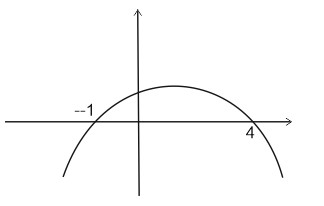
then the graph of $y=|f(x)|_{\text {is }}$
| A. |
|
| B. |
|
| C. |
|
| D. |
|
The number of real roots of the equation $\mathrm{x}|\mathrm{x}-2|+3|\mathrm{x}-3|+1=0$ is :
| A. |
|
| B. |
|
| C. |
|
| D. |
|
Let $S$ be a subset of the plane defined by:
$
S=\{(x, y):|x|+2|y|=1\}
$
Then the radius of the smallest circle with a center at the origin and having a non-empty intersection with $S$ is
| A. |
|
| B. |
|
| C. |
|
| D. |
|
The Modulus function The function f: RR defined by f(x) = |x| for each x
R is called modulus function. For each
non-negative value of x, f(x) is equal to x.
But for negative values of x, the value of f(x) is the negative of the value of x,