-
Engineering and Architecture
Exams
Colleges
Predictors
Resources
-
Computer Application and IT
Quick Links
Colleges
-
Pharmacy
Colleges
Resources
-
Hospitality and Tourism
Colleges
Resources
Diploma Colleges
-
Competition
Other Exams
Resources
-
School
Exams
Top Schools
Products & Resources
-
Study Abroad
Top Countries
Resources
-
Arts, Commerce & Sciences
Colleges
Upcoming Events
Resources
-
Management and Business Administration
Exams
Colleges & Courses
Predictors
-
Learn
Law Preparation
MBA Preparation
Engineering Preparation
Medical Preparation
-
Online Courses and Certifications
Top Streams
Specializations
- Digital Marketing Certification Courses
- Cyber Security Certification Courses
- Artificial Intelligence Certification Courses
- Business Analytics Certification Courses
- Data Science Certification Courses
- Cloud Computing Certification Courses
- Machine Learning Certification Courses
- View All Certification Courses
Resources
-
Medicine and Allied Sciences
Colleges
Predictors
Resources
-
Law
Resources
Colleges
-
Animation and Design
Exams
Predictors & Articles
Colleges
Resources
-
Media, Mass Communication and Journalism
Colleges
Resources
-
Finance & Accounts
Top Courses & Careers
Colleges
Percentage Composition And Equivalent Weight - (Concept)
Percentage Composition:
The percentage combination of the compound is the relative mass of each of the constituent elements in 100 parts of it.
Let us take an example of water (H2O), it contains hydrogen and oxygen, the percentage composition of both these elements can be calculated as follow:
The molar mass of water = 18.02 g
One can check the purity of a given sample by analyzing percentage composition.
Equivalent Weight:
-
Equivalent weight is the weight of an element or a compound that combines with or displaces 1 gram of hydrogen or 8 grams of oxygen, or 35.5 part by weight of Chlorine.
-
Equivalent weight is a number and when it is denoted in grams, it is called gram equivalent.
-
It depends upon the nature of chemical reaction in which substance takes part
How To Find Equivalent Weight:
n-Factor or Valence Factor:
It calculates the molar ratio of the species taking part in reactions that are, reactants. The reciprocal of the n-factor 's ratio of the reactants represents the molar ratio of the reactants. For example, If A (having n-factor = a) reacts with B (having n-factor = b) then its n-factor's ratio is a: b, so molar ratio of A to B is b: a.
It can be represented as follows:
Calculation of n-Factor
Before calculating the n-factor of any of the reactants in a given chemical reaction we must have a clear idea about the type of reaction. The reaction may be any of these types:
(i) Acid-base or neutralization reaction
(li) Redox reaction
- Acid-Base or Neutralization Reactions:
As we know that according to the Arrhenius concept, "An acid provides H+ ion(s) while a base provides OH- ion(s) in neutralization these H+ and OH- ion/ions combines together".
The number of H+ ion(s) and OH- ion(s) represent n-factor for acid and base respectively, that is, basicity and acidity respectively.
Example,
- Redox Reactions
These reactions involve oxidation and reduction simultaneously. Here the exchange of electrons occurs. To find the n-factor for Oxidizing or agent we must find out the change in the oxidation state of these species.
You will be learning the following in detail in the chapter of redox. For now, just look at the definition. Sufficient questions will be practiced later.
- For Redox Reactions:
E = (Molecular weight) / (Change in oxidation number),
x= change in oxidation state
For Example, for KMnO4
(a) In acidic medium: E = M/5
5 unit change in oxidation number.
(b) In basic medium: E = M/1
one unit change in oxidation number
(c) In neutral medium: E = M/3
3 unit change in oxidation number
Formulae for calculation of Equivalent Weight:
- For Acids:
E = (Molecular weight) / (Protocity or Basicity of Acid), x= number of furnishable protons
For Example, for H3PO4, E = M/3
For H2SO4 , E =M/2 - For Bases:
E = (Molecular weight) / (Acidity or number of OH- ions),x= number of furnishable OH- ions
For Example, for Ca(OH)2, E = M/2
For Al(OH)3, E =M/3 - For Ions:
E = (Molecular weight) / (Charge on ion), x= charge on ion
For Example, for SO42-, E = M/2
For PO43-, E = M/3 - For Compounds:
E = (Molecular weight) / (total positive charge or negative charge present in compound),
x= total positive charge or negative charge present in compound
For Example, for CaCO3, E = M/2
For AlCl3, E =M/3
- For Acidic Salt:
E = (Molecular weight) / (Number of replaceable H-atoms)
For example, for H3PO4
- Metal displacement method
E1 / E2 = W1 / W2
| Exam | Chapter |
| JEE MAIN | Some basic concepts in chemistry |
Find the equivalent mass of H3PO4 in the reaction:
| A. |
|
| B. |
|
| C. |
|
| D. |
|
74.5 g of a metallic chloride contain 35.5 g of chlorine. The equivalent weight of the metal is
| A. |
|
| B. |
|
| C. |
|
| D. |
|
The oxide of a metal has 32% oxygen. Its equivalent weight would be
| A. |
|
| B. |
|
| C. |
|
| D. |
|
What is the equivalent weight of Sulphuric Acid (H2SO4) when it behaves as a diprotic acid?
| A. |
|
| B. |
|
| C. |
|
| D. |
|
A compound possesses sulphur by mass. The least molecular mass is
| A. |
|
| B. |
|
| C. |
|
| D. |
|
The exact volumes 1 M NaOH solution required to neutralise $50 \mathrm{~mL} 1 \mathrm{M} H_3 P O_3$ solution and 100 mL of ${ }_{2 \mathrm{M}} \mathrm{H}_3 \mathrm{PO}_2$ solution, respectively, are____ mL ____mL
| A. |
|
| B. |
|
| C. |
|
| D. |
|
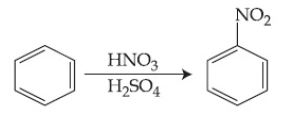
In the above reaction, 3.9 g of benzene on nitration gives 4.92 g of nitrobenzene. The percentage yield of nitrobenzene in the above reaction is ______%. (Round off to the Nearest Integer).
(Given atomic mass : C:12.0;u,H:1.0;u,O:16.0;u,N:14.0;u)
| A. |
|
| B. |
|
| C. |
|
| D. |
|
Consider the above reaction. The percentage yield of amide product is __________. (Round off to the Nearest Integer).
(Given : Atomic mass : C : 12.0 u, H : 1.0u, N : 14.0 u, O : 16.0 u, Cl : 35.5 u)
| A. |
|
| B. |
|
| C. |
|
| D. |
|
Hemoglobin contains of iron by mass. The number of
atoms in
of hemoglobin is
| A. |
|
| B. |
|
| C. |
|
| D. |
|
On complete combustion of of an organic compound containing
was produced. The % composition of oxygen in the compound is_____________.
| A. |
|
| B. |
|
| C. |
|
| D. |
|
On heating 0.199 g of a metallic oxide in a current of hydrogen 0.045 g of water is formed. Find the equivalent weight of the metal.
| A. |
|
| B. |
|
| C. |
|
| D. |
|
Sulphur forms the chlorides S2Cl2 and SCl2. The equivalent mass (in g/mol) of sulphur in SCl2 is:
| A. |
|
| B. |
|
| C. |
|
| D. |
|
The mass percentage of nitrogen in histamine is ____.
| A. |
|
| B. |
|
| C. |
|
| D. |
|
Which of the following expression is used for the detection of percentage of carbon?
| A. |
|
| B. |
|
| C. |
|
| D. |
|
During the estimation of hydrogen in cyclopropane $\left(\mathrm{C}_3 \mathrm{H}_4\right)$, combustion of the compound produces 2 moles of water. Calculate the percentage of hydrogen present in cyclopropane.
| A. |
|
| B. |
|
| C. |
|
| D. |
|
In Carius method for detection of percentage of Phosphorus,
%$\underset{\%}{P}=\frac{62 * W_1 * 100}{222 * W_2}$
$W_1, W_2$ respectively are
| A. |
|
| B. |
|
| C. |
|
| D. |
|
What is the ratio of the mass of O to the mass of S in SOx, if the ratio of the masses of Oxygen in SO2 and SOx is 2:3?
| A. |
|
| B. |
|
| C. |
|
| D. |
|
What is the equivalent weight of HCl?
| A. |
|
| B. |
|
| C. |
|
| D. |
|
Haemoglobin contain of iron by weight. The molecular weight of haemoglobin is approximately 67200.
The number of iron atoms (At.wt. of ) present in one molecule of hemoglobin is
| A. |
|
| B. |
|
| C. |
|
| D. |
|
What quantity (in mL) of a 45% acid solution of a monoprotic strong acid must be mixed with a 20% solution of the same acid to produce 800 mL of a 29.875% acid solution?
| A. |
|
| B. |
|
| C. |
|
| D. |
|
Number of hydrogen atoms per molecule of a hydrocarbon A having carbon is (Given: Molar mass of
)
| A. |
|
| B. |
|
| C. |
|
| D. |
|
When 0.01 mol of an organic compound containing 60% carbon was burnt completely, 4.4 g of was produced. The molar mass of compound is _______
(Nearest integer).
| A. |
|
| B. |
|
| C. |
|
| D. |
|
On complete combustion, of an organic compound gave
of
.The
of carbon in the organic compound is (Nearest integer)
| A. |
|
| B. |
|
| C. |
|
| D. |
|
of an organic compound (X) with
carbon will produce______
of
on complete combustion.
| A. |
|
| B. |
|
| C. |
|
| D. |
|
A metal chloride contains 55.0% of chlorine by weight. 100 mL vapors of the metal chloride at STP weigh 0.57 g. The molecular formula of the metal chloride is: (Given the atomic mass of chlorine is 35.5u )
| A. |
|
| B. |
|
| C. |
|
| D. |
|
An organic compound gives 0.220 g of and 0.126 g of
on complete combustion. If the
of carbon is 24 then the
of hydrogen is ____________
.( Nearest integer)
| A. |
|
| B. |
|
| C. |
|
| D. |
|
0.400 g of an organic compound (X) gave 0.376 g of AgBr in the Carius method for the estimation of bromine. % of bromine in the compound (X) is ____. (Given : Molar mass AgBr = 188 g mol-1 , Br = 80 g mol-1)
| A. |
|
| B. |
|
| C. |
|
| D. |
|
Calculate the mass of and
present in a
mixture if out of the total weight of the mixture
of sodium is present. (Given atomic weight of
as
, respectively).
| A. |
|
| B. |
|
| C. |
|
| D. |
|
Semimolar $\mathrm{HCl}$ & decimolar $\mathrm{HCl}$ are mixed in 1:4 volume ratio, Final molarity of solution is?
| A. |
|
| B. |
|
| C. |
|
| D. |
|
Calculate the minimum molecular weight of starch if some amount of potato starch was converted to starch like molecule having lower molecular weight wing a ball mill if the product analysed (atomic weights of
).
| A. |
|
| B. |
|
| C. |
|
| D. |
|
One litre of a mixture of CO and CO2 is passed through red-hot charcoal in tube. The new volume becomes 1.4 litres. The % composition of the mixture by volume is ___ and ___. All measurements are made at same P and T.
| A. |
|
| B. |
|
| C. |
|
| D. |
|
Find the atomic mass of metal if the equivalent mass of metal M is x and the formula of its oxide is $\mathrm{M}_{\mathrm{n}} \mathrm{O}_{\mathrm{m}}$
| A. |
|
| B. |
|
| C. |
|
| D. |
|
Complete combustion of 1.80g of an oxygen-containing compound $\left(C_x H_y O_z\right)$ gave 2.64 g of CO2 and 1.08 g of $\mathrm{H}_2 \mathrm{O}$. The percentage of oxygen in the organic compound is:
| A. |
|
| B. |
|
| C. |
|
| D. |
|
A gas mixture contains 25% He and 75% CH4 by volume at a given temperature and pressure. The percentage by mass of methane in the mixture is approximately _________
| A. |
|
| B. |
|
| C. |
|
| D. |
|
A constant current (0.5 amp) is passed for 1 hour through
(i) aqueous AgNO3,
(ii) aqueous CuSO4 and
(iii) molten AlF3, separately. The ratio of the mass of the metals deposited on the
cathode is
[MAg, MCu, MAl are molar masses of the respective metals]
| A. |
|
| B. |
|
| C. |
|
| D. |
|
An organic compound having molecular formula C2H6O undergoes oxidation with K2Cr2O7/H2SO4 to produce X which contains 40% carbon, 6.7% hydrogen and 53.3% oxygen. The molecular formula of the compound X is
| A. |
|
| B. |
|
| C. |
|
| D. |
|
Complete reaction of 2.0 g of calcium (at wt. = 40) with excess HCl produces 1.125 L of H2 gas. Complete reaction of the same quantity of another metal "M" with excess HCl produces 1.85 L of H2 gas under identical conditions. The equivalent weight of "M" is closest to
| A. |
|
| B. |
|
| C. |
|
| D. |
|
Natural abundance of ${ }^{12} \mathrm{C}$ and ${ }^{13} \mathrm{C}$ isotopes of carbon are $99 \%$ and $1 \%$, respectively. Assuming they only contribute to the mol. wt. of $C_2 F_4$, the percentage of $C_2 F_4$ having a molecular mass of 101 is:
| A. |
|
| B. |
|
| C. |
|
| D. |
|
Upon gully dissolving 2.0g of ametal insulfuric acid ,6.8g of the metal sulfate is formed. The equivalent weight ofthe metal is
| A. |
|
| B. |
|
| C. |
|
| D. |
|
In Carius method for estimation of halogens, 180 mg of an organic compound produced 143.5 mg of AgCl . The percentage composition of chlorine in the compound is ________ $\%$.
[Given : molar mass in $\mathrm{g} \mathrm{mol}^{-1}$ of $\mathrm{Ag}: 108$, $\mathrm{Cl}=35.5]$
| A. |
|
| B. |
|
| C. |
|
| D. |
|
During "S" estimation, 160 mg of an organic compound gives 466 mg of barium sulphate. The percentage of sulfur in the given compound is_________ \%.
(Given molar mass in $\mathrm{g} \mathrm{mol}^{-1}$ of $\mathrm{Ba}: 137, \mathrm{~S}: 32$, O:16)
| A. |
|
| B. |
|
| C. |
|
| D. |
|
0.1 M solution of KI reacts with excess of $\mathrm{H}_2 \mathrm{SO}_4$ and $\mathrm{KIO}_3$ solution. According to equation
$5 \mathrm{I}^{-}+\mathrm{IO}_3^{-}+6 \mathrm{H}^{+} \rightarrow 3 \mathrm{I}_2+3 \mathrm{H}_2 \mathrm{O}$
Identify the correct statements :
(A) 200 mL of KI solution reacts with 0.004 mol of $\mathrm{KIO}_3$
(B) 200 mL of KI solution reacts with 0.006 mol of $\mathrm{H}_2 \mathrm{SO}_4$
(C) 0.5 L of KI solution produced 0.005 mol of $\mathrm{I}_2$
(D) Equivalent weight of $\mathrm{KIO}_3$ is equal to $\left(\frac{\text { Molecular weight }}{5}\right)$
Choose the correct answer from the options given below:
| A. |
|
| B. |
|
| C. |
|
| D. |
|
In the sulphur estimation, 0.20 g of a pure organic compound gave 0.40 g of barium sulphate. The percentage of sulphur in the compound is ________ $\times 10^{-1} \%$.
(Molar mass : $\mathrm{O}=16, \mathrm{~S}=32, \mathrm{Ba}=137$ in $\mathrm{g} \mathrm{mol}^{-1}$ )
| A. |
|
| B. |
|
| C. |
|
| D. |
|
Calculate the equivalent mass of H3PO3
| A. |
|
| B. |
|
| C. |
|
| D. |
|
The acid solution has a specific gravity of 1.8, when it contains 62% by weight of the acid. The solution is diluted to such an extent that its specific gravity is lowered to 1.2. What is the % by weight of the acid in the new solution?
| A. |
|
| B. |
|
| C. |
|
| D. |
|
The percentage of P2O5 in diammonium hydrogen Phosphate $\left[\left(\mathrm{NH}_4\right)_2 \mathrm{HPO}_4\right]$ is:
| A. |
|
| B. |
|
| C. |
|
| D. |
|
For electroplating, 1.5 amp current is passed for 250 s through 250 mL of 0.15 M solution of $\mathrm{MSO}_4$. Only $85^{\circ} \%$ of the current was utilized for electrolysis. The molarity of $\mathrm{MSO}_4$ solution after electrolysis is closest to:
[ Assume that the volume of the solution remained constant ]
| A. |
|
| B. |
|
| C. |
|
| D. |
|
In the following reaction, P gives two products Q and R, each with a 40% yield. 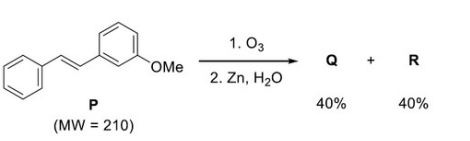
If the reaction is carried out with 420 mg of P, the reaction yields 108.8mg of Q. The amount of R produced in the reaction is closest to
(A) 97.6 mg
(B) 108.8 mg
(C) 84.8 mg
(D) 121.6 mg
| A. |
|
| B. |
|
| C. |
|
| D. |
|
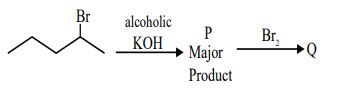
Consider the above sequence of reactions. 151 g of 2-bromopentane is made to react. Yield of major product P is $80 \%$ whereas Q is $100 \%$.
Mass of product Q obtained is $\qquad$ g.
(Given molar mass in $\mathrm{g} \mathrm{mol}^{-1} \mathrm{H}: 1, \mathrm{C}: 12, \mathrm{O}: 16$, $\mathrm{Br}: 80)$
| A. |
|
| B. |
|
| C. |
|
| D. |
|
0.5 g of an organic compound on combustion gave 1.46 g of $\mathrm{CO}_2$ and 0.9 g of $\mathrm{H}_2 \mathrm{O}$. The percentage of carbon in the compound is ______(Nearest integer)
[Given : Molar mass (in $\mathrm{g} \mathrm{mol}^{-1}$ ) $\mathrm{C}: 12, \mathrm{H}: 1$, $0: 16]$
| A. |
|
| B. |
|
| C. |
|
| D. |
|
An organic compound weighing 500 mg , produced 220 mg of $\mathrm{CO}_2$. on complete combustion. The percentage composition of carbon in the compound is________%. (nearest integer)
(Given molar mass in $\mathrm{g} \mathrm{mol}^{-1}$ of $\mathrm{C}: 12, \mathrm{O}: 16$ )
| A. |
|
| B. |
|
| C. |
|
| D. |
|
Thyroxine, the hormone has given below structure
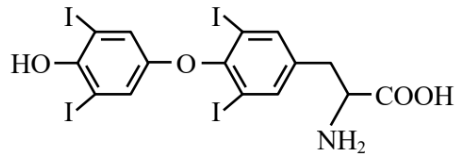
The percentage of iodine in thyroxine is ___________ %. (nearest integer)
(Given molar mass in $\mathrm{g} \mathrm{mol}^{-1} \mathrm{C}: 12 . \mathrm{H}: 1, \mathrm{O}: 16$, $\mathrm{N}: 14, \mathrm{I}: 127)$
| A. |
|
| B. |
|
| C. |
|
| D. |
|
On combustion 0.210 g of an organic compound containing $\mathrm{C}, \mathrm{H}$ and O gave $0.127 \mathrm{~g} \mathrm{H}_2 \mathrm{O}$ and $0.307 \mathrm{~g} \mathrm{CO}_2$. The percentages of hydrogen and oxygen in the given organic compound respectively are:
| A. |
|
| B. |
|
| C. |
|
| D. |
|
What mass (in g) of $95 \%$ pure $\mathrm{CaCO}_3$ will be required to neutralise solution according to the following reaction?
$$
\mathrm{CaCO}_{3(s)}+2 \mathrm{HCl}_{(\mathrm{aq})} \rightarrow \mathrm{CaCl}_{2(\mathrm{aq})}+\mathrm{CO}_{2(\mathrm{~g})}+2 \mathrm{H}_2 \mathrm{O}_{(1)}
$$
[Calculate upto second place of decimal point]
| A. |
|
| B. |
|
| C. |
|
| D. |
|
The right option for the mass of $C O_2$ produced by 20 g of 20\% pure limestone is (Atomic mass of $\mathrm{Ca}=40$ )
$
\mathrm{CaCO}_3 \xrightarrow{1200 \mathrm{~K}} \mathrm{CaO}+\mathrm{CO}_2
$
| A. |
|
| B. |
|
| C. |
|
| D. |
|
Percent composition of an element can be calculated by the formula:
Mass % of an element =[ (Mass of element in the compound) / molar mass of compound ] x 100