
-
Engineering and Architecture
Exams
Colleges
Predictors
Resources
-
Computer Application and IT
Quick Links
Colleges
-
Pharmacy
Colleges
Resources
-
Hospitality and Tourism
Colleges
Resources
Diploma Colleges
-
Competition
Other Exams
Resources
-
School
Exams
Top Schools
Products & Resources
-
Study Abroad
Top Countries
Resources
-
Arts, Commerce & Sciences
Colleges
Upcoming Events
Resources
-
Management and Business Administration
Exams
Colleges & Courses
Predictors
-
Learn
Law Preparation
MBA Preparation
Engineering Preparation
Medical Preparation
-
Online Courses and Certifications
Top Streams
Specializations
- Digital Marketing Certification Courses
- Cyber Security Certification Courses
- Artificial Intelligence Certification Courses
- Business Analytics Certification Courses
- Data Science Certification Courses
- Cloud Computing Certification Courses
- Machine Learning Certification Courses
- View All Certification Courses
Resources
-
Medicine and Allied Sciences
Colleges
Predictors
Resources
-
Law
Resources
Colleges
-
Animation and Design
Exams
Predictors & Articles
Colleges
Resources
-
Media, Mass Communication and Journalism
Colleges
Resources
-
Finance & Accounts
Top Courses & Careers
Colleges
Get Answers to all your Questions


(i) Draw a ray diagram showing the geometery of formation of image of a point object situated on the principal axis and on the convex side of a spherical surface of radius of curvature R. Taking the rays as incident from a rarer medium of refractive index n1 to a denser medium of refractive index n2 , derive the relation.
, where symbols have their usual meaning.
(ii) Explain briefly how the focal length of a convex lens changes with increase in wavelength of incident light.
(iii) What happens to the focal length of convex lens when it is immersed in water? Refractive index of the material of lens is greater than that of water.
Answers (1)
(i)
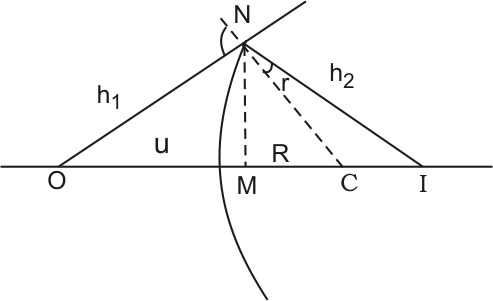
from
.....(1)
from
.......(2)
form
.......(3)
The angle is very small
(1) + (2)
.......(4)
.....(5)
from Snell's law
or
(ii) decreases, focal length increases
(iii) as increases focal length increases.
