
Browse by Stream
-
Engineering and Architecture
Exams
Colleges
Predictors
Resources
-
Computer Application and IT
Quick Links
Colleges
-
Pharmacy
Colleges
Resources
-
Hospitality and Tourism
Colleges
Resources
Diploma Colleges
-
Competition
Other Exams
Resources
-
School
Exams
Top Schools
Products & Resources
-
Study Abroad
Top Countries
Resources
-
Arts, Commerce & Sciences
Colleges
Upcoming Events
Resources
-
Management and Business Administration
Exams
Colleges & Courses
Predictors
-
Learn
Law Preparation
MBA Preparation
Engineering Preparation
Medical Preparation
-
Online Courses and Certifications
Top Streams
Specializations
- Digital Marketing Certification Courses
- Cyber Security Certification Courses
- Artificial Intelligence Certification Courses
- Business Analytics Certification Courses
- Data Science Certification Courses
- Cloud Computing Certification Courses
- Machine Learning Certification Courses
- View All Certification Courses
Resources
-
Medicine and Allied Sciences
Colleges
Predictors
Resources
-
Law
Resources
Colleges
-
Animation and Design
Exams
Predictors & Articles
Colleges
Resources
-
Media, Mass Communication and Journalism
Colleges
Resources
-
Finance & Accounts
Top Courses & Careers
Colleges
Get Answers to all your Questions


- Home
- Engineering
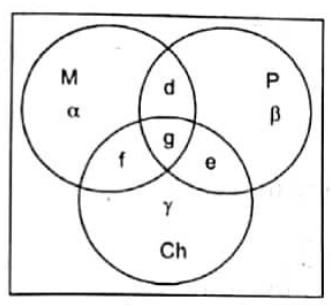
- The probabilities that a student passes in Mathematics, Physics and Chemistry are m, p and c respectively. Of these subjects, the student has <img alt="75 \%" src="https://entrancecorner.oncodecogs
The probabilities that a student passes in Mathematics, Physics and Chemistry are m, p and c respectively. Of these subjects, the student has chance of passing in at least one, a
chance of passing in at least two and a
chance of passing in exactly two. Following relations are drawn in
Option: 1
Only relation I is true
Option: 2
Only relation ill is true.
Option: 3
Relations II and III are true
Option: 4
Relations I and III are true.
Answers (1)

JEE Main high-scoring chapters and topics
Study 40% syllabus and score up to 100% marks in JEE

