
Browse by Stream
-
Engineering and Architecture
Exams
Colleges
Predictors
Resources
-
Computer Application and IT
Quick Links
Colleges
-
Pharmacy
Colleges
Resources
-
Hospitality and Tourism
Colleges
Resources
Diploma Colleges
-
Competition
Other Exams
Resources
-
School
Exams
Top Schools
Products & Resources
-
Study Abroad
Top Countries
Resources
-
Arts, Commerce & Sciences
Colleges
Upcoming Events
Resources
-
Management and Business Administration
Exams
Colleges & Courses
Predictors
-
Learn
Law Preparation
MBA Preparation
Engineering Preparation
Medical Preparation
-
Online Courses and Certifications
Top Streams
Specializations
- Digital Marketing Certification Courses
- Cyber Security Certification Courses
- Artificial Intelligence Certification Courses
- Business Analytics Certification Courses
- Data Science Certification Courses
- Cloud Computing Certification Courses
- Machine Learning Certification Courses
- View All Certification Courses
Resources
-
Medicine and Allied Sciences
Colleges
Predictors
Resources
-
Law
Resources
Colleges
-
Animation and Design
Exams
Predictors & Articles
Colleges
Resources
-
Media, Mass Communication and Journalism
Colleges
Resources
-
Finance & Accounts
Top Courses & Careers
Colleges
Get Answers to all your Questions


- Home
- Engineering
- Find the radius (approximately) of smaller circle which touches the straight line <img alt="\mathrm{3x - y = 6}" src="https://entrancecorner.oncodecogs.com/gif.latex?%5Cmathrm%7B3x%20-%20y%20%3D%20
Find the radius (approximately) of smaller circle which touches the straight line at
and also touches the line
Option: 1
Option: 2
Option: 3
Option: 4
Answers (1)

Let be the center of the circle. Let
be the lines represented by
respectively.
Clearly, the circle touches at
Equation of line perpendicular to which passes through
then
perpendicular line is
which passes through
then ............(i)
Now center
radius
........(ii)
Since radius from (ii)
Hence radius of smaller circle is units. (nearly)
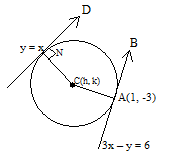
Hence option 2 is correct.
View full answer
JEE Main high-scoring chapters and topics
Study 40% syllabus and score up to 100% marks in JEE

