
-
Engineering and Architecture
Exams
Colleges
Predictors
Resources
-
Computer Application and IT
Quick Links
Colleges
-
Pharmacy
Colleges
Resources
-
Hospitality and Tourism
Colleges
Resources
Diploma Colleges
-
Competition
Other Exams
Resources
-
School
Exams
Top Schools
Products & Resources
-
Study Abroad
Top Countries
Resources
-
Arts, Commerce & Sciences
Colleges
Upcoming Events
Resources
-
Management and Business Administration
Exams
Colleges & Courses
Predictors
-
Learn
Law Preparation
MBA Preparation
Engineering Preparation
Medical Preparation
-
Online Courses and Certifications
Top Streams
Specializations
- Digital Marketing Certification Courses
- Cyber Security Certification Courses
- Artificial Intelligence Certification Courses
- Business Analytics Certification Courses
- Data Science Certification Courses
- Cloud Computing Certification Courses
- Machine Learning Certification Courses
- View All Certification Courses
Resources
-
Medicine and Allied Sciences
Colleges
Predictors
Resources
-
Law
Resources
Colleges
-
Animation and Design
Exams
Predictors & Articles
Colleges
Resources
-
Media, Mass Communication and Journalism
Colleges
Resources
-
Finance & Accounts
Top Courses & Careers
Colleges
Get Answers to all your Questions


- #Biology
- #National Eligibility Cum Entrance Test
- #Class 12
- #Medical
- #Biotechnology and Its Applications
- #National Eligilibility Cum Entrance Test
By employing precise laboratory methodologies, a scientist embarked on the intricate task of transferring Gene X from a plasmid exclusive to bacteria to a plasmid exclusive to yeast. The initial step involved the strategic utilization of restriction enzymes to cleave, or fragment, the bacteria-specific plasmid on both sides of the target gene. Consequently, this enzymatic process generated a heterogeneous mixture consisting of two linear DNA fragments
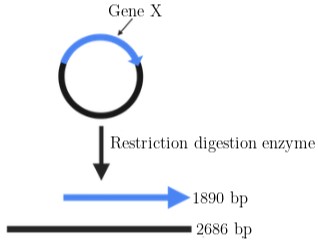
The bacterial plasmid is shown in a diagram before and after being digested by a restriction enzyme (bp = base pairs).
The researcher divided the obtained DNA fragments by size using gel electrophoresis. Then, in order to separate the gene from the gel, the scientist removed the portion of the gel that contained Gene X.
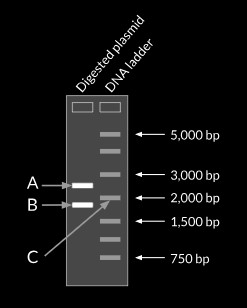
The digested plasmid DNA is depicted in the accompanying diagram using gel electrophoresis, with distinct bands denoted by the letters A, B, and C. Which band was the scientist able to separate Gene X DNA from?
A Band
B Band
C Band
Both A and B bands
Answers (1)
In order to determine which band was removed by the scientist to isolate Gene X DNA, we need to identify the band that corresponds to a DNA fragment of approximately 1,890 base pairs (bp) in length. Comparing the digested plasmid bands with the bands of a DNA ladder, which provide known sizes, we can observe that the lower band in the sample is likely the one around 1,890 bp. Therefore, it can be concluded that the scientist cut out Band B to isolate Gene X DNA.Hence, the correct answer is option 2.
NEET 2024 Most scoring concepts
- Just Study 32% of the NEET syllabus and Score up to 100% marks

