
Browse by Stream
-
Engineering and Architecture
Exams
Colleges
Predictors
Resources
-
Computer Application and IT
Quick Links
Colleges
-
Pharmacy
Colleges
Resources
-
Hospitality and Tourism
Colleges
Resources
Diploma Colleges
-
Competition
Other Exams
Resources
-
School
Exams
Top Schools
Products & Resources
-
Study Abroad
Top Countries
Resources
-
Arts, Commerce & Sciences
Colleges
Upcoming Events
Resources
-
Management and Business Administration
Exams
Colleges & Courses
Predictors
-
Learn
Law Preparation
MBA Preparation
Engineering Preparation
Medical Preparation
-
Online Courses and Certifications
Top Streams
Specializations
- Digital Marketing Certification Courses
- Cyber Security Certification Courses
- Artificial Intelligence Certification Courses
- Business Analytics Certification Courses
- Data Science Certification Courses
- Cloud Computing Certification Courses
- Machine Learning Certification Courses
- View All Certification Courses
Resources
-
Medicine and Allied Sciences
Colleges
Predictors
Resources
-
Law
Resources
Colleges
-
Animation and Design
Exams
Predictors & Articles
Colleges
Resources
-
Media, Mass Communication and Journalism
Colleges
Resources
-
Finance & Accounts
Top Courses & Careers
Colleges
Get Answers to all your Questions


Screenshot_2019-01-23_at_4.55.28_PM.png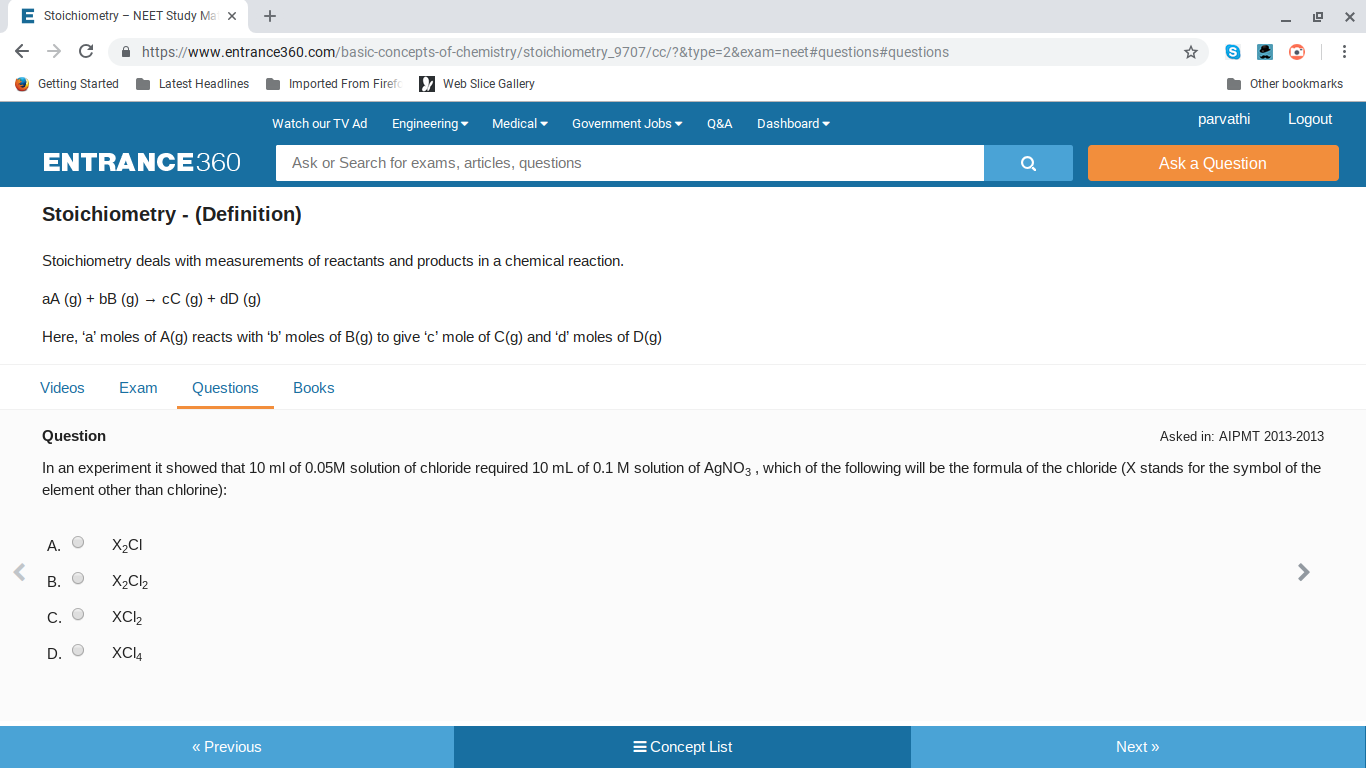 In an experiment it showed that 10 ml of 0.05M solution of chloride required 10 mL of 0.1 M solution of AgNO3 , which of the following will be the formula of the chloride (X stands for the symbol of the element other than chlorine):
Answers (2)
Stoichiometry -
Stoichiometry deals with measurements of reactants and products in a chemical reaction.
aA (g) + bB (g) → cC (g) + dD (g)
Here, ‘a’ moles of A(g) reacts with ‘b’ moles of B(g) to give ‘c’ mole of C(g) and ‘d’ moles of D(g)
 No. of moles of AgNO3=10-3 mol
No. of moles the chloride= 0.5 x 10⁻³ mol
Suppose the formula for the chloride is XCln then moles of chloride ion=n x 0.5 x 10⁻³
The reaction goes as follows:
Ag+ + Cl- = AgCl
Then, going by stoichiometry we get
n x 0.5 x 10-3= 10-3
n=2
Therefore, the formula is XCl2( answer)
View full answer
NEET 2024 Most scoring concepts
- Just Study 32% of the NEET syllabus and Score up to 100% marks
Stoichiometry -
Stoichiometry deals with measurements of reactants and products in a chemical reaction.
- wherein
aA (g) + bB (g) → cC (g) + dD (g)
Here, ‘a’ moles of A(g) reacts with ‘b’ moles of B(g) to give ‘c’ mole of C(g) and ‘d’ moles of D(g)
No. of moles of AgNO3=10-3 mol
No. of moles the chloride= 0.5 x 10⁻³ mol
Suppose the formula for the chloride is XCln then moles of chloride ion=n x 0.5 x 10⁻³
Reaction goes as follows:
Then, going by stoichiometry we get
n x 0.5 x 10-3= 10-3
n=2
Therefore, formula is XCl2
View full answer

