
-
Engineering and Architecture
Exams
Colleges
Predictors
Resources
-
Computer Application and IT
Quick Links
Colleges
-
Pharmacy
Colleges
Resources
-
Hospitality and Tourism
Colleges
Resources
Diploma Colleges
-
Competition
Other Exams
Resources
-
School
Exams
Top Schools
Products & Resources
-
Study Abroad
Top Countries
Resources
-
Arts, Commerce & Sciences
Colleges
Upcoming Events
Resources
-
Management and Business Administration
Exams
Colleges & Courses
Predictors
-
Learn
Law Preparation
MBA Preparation
Engineering Preparation
Medical Preparation
-
Online Courses and Certifications
Top Streams
Specializations
- Digital Marketing Certification Courses
- Cyber Security Certification Courses
- Artificial Intelligence Certification Courses
- Business Analytics Certification Courses
- Data Science Certification Courses
- Cloud Computing Certification Courses
- Machine Learning Certification Courses
- View All Certification Courses
Resources
-
Medicine and Allied Sciences
Colleges
Predictors
Resources
-
Law
Resources
Colleges
-
Animation and Design
Exams
Predictors & Articles
Colleges
Resources
-
Media, Mass Communication and Journalism
Colleges
Resources
-
Finance & Accounts
Top Courses & Careers
Colleges
Get Answers to all your Questions


- #Class 12
- #Current Electricity
- #Physics
- #National Eligibility Cum Entrance Test
- #National Eligilibility Cum Entrance Test
- #Medical
.In the given circuit, with steady current, the potential drop across the capacitor must be
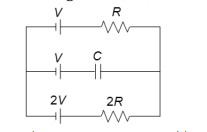
Answers (1)

Method I: In this, there will be no current flowing in branch B E in steady condition. Let I be the current flowing in the loop ABCDEFA. Applying Kirchhoff's law in the loop moving in anticlockwise direction starting from Applying Kirchhoff's law in the circuit A B E F / A we get on moving in anticlockwise direction starting from B
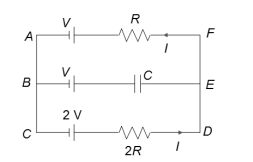
where
is the potential difference across capacitor
Method II
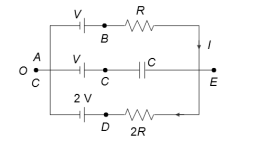
Let us consider A to be at 0V. Then points B, C and D will be at V, V and 2V, respectively. Let the current be flowing in the clockwise direction. Applying Kirchhoff's law in the outer loop, we get
. The minus sign here indicates that the current is in the opposite direction to what we have assumed. Applying Kirchhoff's law from A to E via B, we get
Again applying Kirchhoff's law from A to E via C, we get
NEET 2024 Most scoring concepts
- Just Study 32% of the NEET syllabus and Score up to 100% marks

