
-
Engineering and Architecture
Exams
Colleges
Predictors
Resources
-
Computer Application and IT
Quick Links
Colleges
-
Pharmacy
Colleges
Resources
-
Hospitality and Tourism
Colleges
Resources
Diploma Colleges
-
Competition
Other Exams
Resources
-
School
Exams
Top Schools
Products & Resources
-
Study Abroad
Top Countries
Resources
-
Arts, Commerce & Sciences
Colleges
Upcoming Events
Resources
-
Management and Business Administration
Exams
Colleges & Courses
Predictors
-
Learn
Law Preparation
MBA Preparation
Engineering Preparation
Medical Preparation
-
Online Courses and Certifications
Top Streams
Specializations
- Digital Marketing Certification Courses
- Cyber Security Certification Courses
- Artificial Intelligence Certification Courses
- Business Analytics Certification Courses
- Data Science Certification Courses
- Cloud Computing Certification Courses
- Machine Learning Certification Courses
- View All Certification Courses
Resources
-
Medicine and Allied Sciences
Colleges
Predictors
Resources
-
Law
Resources
Colleges
-
Animation and Design
Exams
Predictors & Articles
Colleges
Resources
-
Media, Mass Communication and Journalism
Colleges
Resources
-
Finance & Accounts
Top Courses & Careers
Colleges
Get Answers to all your Questions


- #National Eligilibility Cum Entrance Test
- #Class 12
- #Medical
- #Physics
- #National Eligibility Cum Entrance Test
- #Optics
A pin is placed in front of a convex lens of focal length
made of a material having refractive index 1.5. The surface of the lens is farther away from the pin is silvered and has a radius of curvature
.Determine the position of the final image. State the nature of the image.
Answers (1)

The curved silvered surface will behave as a concave lens of focal length
And hence
Further as the focal length of lens is i.e.,
its power will be
Now as in image formation, light after passing through the lens will be reflected back by the curved mirror through the lens again.
So the focal length of equivalent mirror
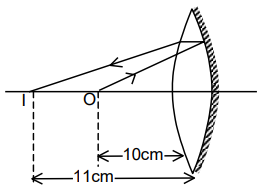
i.e. the silvered lens behaves as a concave mirror of focal length (110/21) cm. So for object at a distance 10 cm in front of it
i.e. image will be infront of the silvered lens and will be real as shown in figure.
NEET 2024 Most scoring concepts
- Just Study 32% of the NEET syllabus and Score up to 100% marks

