
-
Engineering and Architecture
Exams
Colleges
Predictors
Resources
-
Computer Application and IT
Quick Links
Colleges
-
Pharmacy
Colleges
Resources
-
Hospitality and Tourism
Colleges
Resources
Diploma Colleges
-
Competition
Other Exams
Resources
-
School
Exams
Top Schools
Products & Resources
-
Study Abroad
Top Countries
Resources
-
Arts, Commerce & Sciences
Colleges
Upcoming Events
Resources
-
Management and Business Administration
Exams
Colleges & Courses
Predictors
-
Learn
Law Preparation
MBA Preparation
Engineering Preparation
Medical Preparation
-
Online Courses and Certifications
Top Streams
Specializations
- Digital Marketing Certification Courses
- Cyber Security Certification Courses
- Artificial Intelligence Certification Courses
- Business Analytics Certification Courses
- Data Science Certification Courses
- Cloud Computing Certification Courses
- Machine Learning Certification Courses
- View All Certification Courses
Resources
-
Medicine and Allied Sciences
Colleges
Predictors
Resources
-
Law
Resources
Colleges
-
Animation and Design
Exams
Predictors & Articles
Colleges
Resources
-
Media, Mass Communication and Journalism
Colleges
Resources
-
Finance & Accounts
Top Courses & Careers
Colleges
Get Answers to all your Questions


- #Medical
- #Human Physiology
- #Class 11
- #National Eligilibility Cum Entrance Test
- #Biology
- #National Eligibility Cum Entrance Test
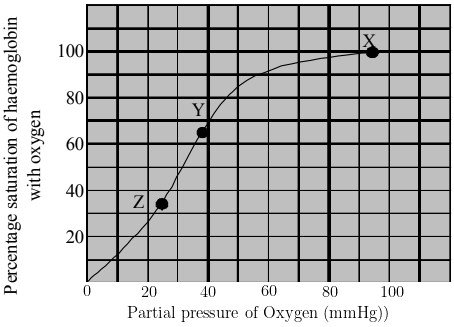
At which anatomical locations in the human body will hemoglobin achieve the indicated percentage saturation levels observed at points X, Y, and Z?
X - Pulmonary artery, Y - Pulmonary vein, Z- Carotid artery
X - Systemic artery, Y - Pulmonary artery, Z - Pulmonary vein
X - Pulmonary vein, Y - Systemic vein, Z - Systemic vein during exercise
X - Left ventricle, Y - Right ventricle, Z - Systemic artery
Answers (1)

In the human body, hemoglobin will achieve the indicated percentage saturation levels as follows:
Point X refers to the pulmonary vein. This refers to the location where blood, after being oxygenated in the lungs, returns to the heart before being pumped to the rest of the body. At this point, hemoglobin is fully saturated with oxygen due to the oxygen exchange that occurs in the lungs.
Point Y refers to the systemic vein. This refers to veins that carry deoxygenated blood back to the heart from various organs and tissues in the body. At this point, hemoglobin has released a significant amount of oxygen, resulting in a lower percentage saturation level compared to point X.
Point Z refers to the systemic vein during exercise. During exercise, the demand for oxygen by the muscles increases, leading to an accelerated oxygen exchange in tissues. As a result, the percentage saturation of hemoglobin in the systemic veins during exercise is even lower than at point Y, as more oxygen is released to meet the increased oxygen demands of the active muscles.
Hence, the correct answer is option 3.
NEET 2024 Most scoring concepts
- Just Study 32% of the NEET syllabus and Score up to 100% marks

