
-
Engineering and Architecture
Exams
Colleges
Predictors
Resources
-
Computer Application and IT
Quick Links
Colleges
-
Pharmacy
Colleges
Resources
-
Hospitality and Tourism
Colleges
Resources
Diploma Colleges
-
Competition
Other Exams
Resources
-
School
Exams
Top Schools
Products & Resources
-
Study Abroad
Top Countries
Resources
-
Arts, Commerce & Sciences
Colleges
Upcoming Events
Resources
-
Management and Business Administration
Exams
Colleges & Courses
Predictors
-
Learn
Law Preparation
MBA Preparation
Engineering Preparation
Medical Preparation
-
Online Courses and Certifications
Top Streams
Specializations
- Digital Marketing Certification Courses
- Cyber Security Certification Courses
- Artificial Intelligence Certification Courses
- Business Analytics Certification Courses
- Data Science Certification Courses
- Cloud Computing Certification Courses
- Machine Learning Certification Courses
- View All Certification Courses
Resources
-
Medicine and Allied Sciences
Colleges
Predictors
Resources
-
Law
Resources
Colleges
-
Animation and Design
Exams
Predictors & Articles
Colleges
Resources
-
Media, Mass Communication and Journalism
Colleges
Resources
-
Finance & Accounts
Top Courses & Careers
Colleges
Get Answers to all your Questions


- #Class 11
- #National Eligilibility Cum Entrance Test
- #Physics
- #Medical
- #National Eligibility Cum Entrance Test
- #Thermodynamics
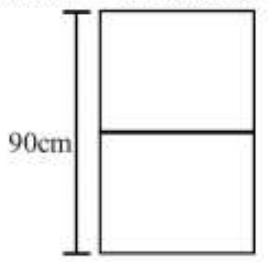
Figure shown a vertical cylindrical vessel separated in two parts by a frictionless pistion free to move along the length of the vessel. The length of the cylinder is and the pistion divides the cylinder in the ratio of
.Each of the two parts of the vessel contains 0.1 mole of an ideal gas. The temperature of the gas is
in each part. Calculate the mass of the piton.
-
-
-
-
Answers (1)

Let and
be the lengths of the upper part and the lower part of the cylinder respectively. clearly,
and
. Let the perssures in the upper and lower parts be
and
respectively. Let the area of coss-section of the cylinder be
. The temperature in both parts is
.
Consider the equilibrium of the piston. The forces acting on the pistion are
(a) its weight mg
(b) A downward, by the upper part of the gas and (c)
upward, by the lower part of the gas.
Thus,
Using for the upper and the lower parts
Putting and
from (ii) and (iii) into (i),
Thus,
.
NEET 2024 Most scoring concepts
- Just Study 32% of the NEET syllabus and Score up to 100% marks

